

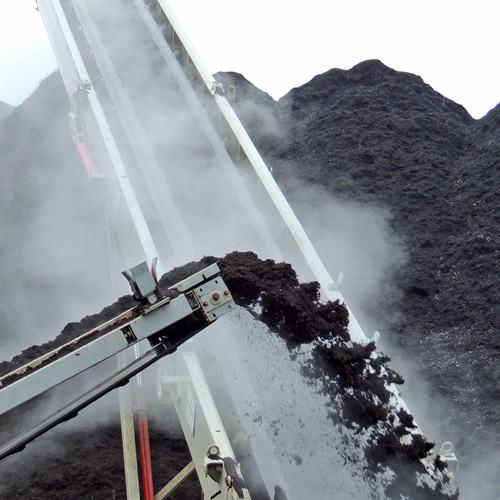
Top: Landfills came out on top of organics recycling based on assumptions including higher carbon storage when organics are landfilled than when they are composted and land applied, and minimal inefficiencies in landfill gas collection and generation. Image by Doug Pinkerton
 Sally Brown
It is very tempting to look at the world in black and white, good and evil, right and wrong. That works really well when you’re reading Harry Potter (Harry Potter good, Lord Voldemort evil) but not nearly as well when you leave the world of adolescent fantasy fiction. In the real world we have nuance and the great unknown. Both leave us with choices that come in many shades of gray. The more you know and the broader your perspective, the greater your chances of making the right decision. The first thing to realize is that anything that presents itself as a black and white type of choice is likely hiding something.
We can start with a discussion of landfills and their place as a home for organics. This is a question that I had hoped was settled decades ago. Dead horse you ask? Apparently not. Let’s look at this in the black and white color scheme. First realize that landfills are not all bad. One bin was the paradigm for more than a generation. It is easy. It only requires one truck. No yuck and no sorting. Leachate and air emissions aside, landfills were also good at protecting public health from contaminants in the waste.
Also realize that the planet is good. The problem or the shades of gray come when you realize that the convenience of the one-bin system and its reliance on landfills does harm to the planet. It is pretty easy to recognize that the good of the planet merits a higher weight than the convenience of the landfill. Unless you are a landfill engineer. Then your tendency will be to do everything that you can to improve landfills rather than classify them as a source of evil. That may give you a passing grade in the world of landfill engineers but it can lead to a clear fail from a planetary perspective.
LCAs: Garbage In, Garbage Out
A recent report from EREF (Environmental Research and Education Foundation) — Life-Cycle Assessment (LCA) of Curbside Material Recovery — looked into curbside recycling using life cycle analysis (LCA). It concluded in almost black and white terms that recycling organics is for the birds. To understand whether this is really as black and white as described, you have to look at the document with critical eyes.
First task is to understand what LCAs are. LCAs are a tool to understand the impact of different activities with a broader lens than just capital and operating costs. They include a number of categories but most often are focused on greenhouse gas emissions. Typically LCAs use different computer models to generate values for different categories. Depending on the default values in the particular model and what is included and excluded, the LCA can be reasonable or can clearly reflect a particular ideological framework.
Here the LCA relied on the Solid Waste Optimization Life-cycle Framework (SWOLF) model, developed at North Carolina State University. Morton Barlaz, one of the authors of the current LCA, was also a co-author of the SWOLF model. Funding for this model was also provided by EREF. Barlaz is a well-qualified engineer with an excellent publication record. He is not bad or completely wrong. However, he is a landfill engineer and that very much colors his perspective and his interpretations. From my perspective, that means that on this question, he very much failed the test. Let me explain.
In the new LCA, the authors compare the following:
- 1 truck no recycling
- 2 trucks with diversion and recycling of inorganics (paper, glass and plastic)
- 3 trucks with diversion and recycling of inorganics and yard waste
- 3 trucks with diversion and recycling of inorganics and organics (yard and food waste)
The model has embedded assumptions on capture rates, fuel usage, composition of MSW, decomposition rates of organics and landfill gas collection efficiency and more. With those embedded assumptions, the model spits out results that have caused many in the organics field to have a crisis of confidence. Recycling glass, plastic and paper or the 2- truck system comes out as the best option with 38% less carbon emissions than traditional landfilling. Including that third truck (the one carrying organics) actually reduces those benefits.
In other words, separating organics comes out as the wrong answer. With just yard waste you are essentially taking away the benefits of recycling inorganics and having the same carbon impact as landfilling everything. When you add in the food waste you get some of those lost benefits back (10%). How can this be, you ask, as you are ripping out your hair? This is not worth going bald over. Remember, knowledge is power. The broader your perspective, the more likely you are to make the right decision.
If you look at the third table in the document, the one that gives the specific numbers, you can understand the assumptions that went into the SWOLF model that resulted in the answers it spit out. Let’s start with the more palatable aspects of this analysis. The model gives a credit (kg CO2e per metric ton of MSW managed). You spend 121 kg of CO2e for re-manufacturing but you get a credit of -244 kg CO2e for reusing what you recycle, giving you a net of -123 kg CO2e per ton of MSW. I don’t know enough about paper and aluminum but am OK to take that without an argument.
Organics Assumptions Fail The Test
Rather than dead stored carbon in landfills, the carbon stored in soils, including when amended with compost, brings enhanced productivity and life. Photos courtesy of Sally Brown
From an organics perspective, most of the assumptions used in the model would get a failing grade in any of my classes. Here are the most important ones:
- The model assumes minimal inefficiencies in landfill gas (LFG) collection and generation
- The model assumes higher carbon storage when organics are landfilled than when they are composted and land applied
Now let’s get into the weeds (aka the organics). A topic I do know something about. Looking at the results for the 2-truck system (paper recycling), the model gives a high credit for landfill carbon storage (-341 kg CO2e per ton MSW) with an associated landfill “operations”emission of 230 kg CO2e per ton of MSW. This does not include any debits for fugitive methane release, assuming that the landfill gas collection has 100% efficiency. There is also a significant energy credit for landfill gas capture and reuse (-34 kg CO2e per ton of MSW).
According to this model, when you change to a 3-truck system — including pick up of both yard waste and food scraps — you are effectively starving the landfill and not in a good way. Carbon storage goes down to -246 and landfill gas collection goes down to -24. That compost pile that you foolishly considered to be a good thing gets a ding of 12 for methane emissions and a carbon storage credit of -19.
Deeper into the analysis you can see some of the assumptions. Below are the critical ones.
- Landfills with no LFG collection: 1.15 tons CO2e per ton of MSW
- Landfills with flaring: -0.025 tons CO2e per ton of MSW
- Landfills with LFG to energy: -0.230 tons CO2e per ton of MSW
On this particular exam, I would have to give the LCA a failing grade. These estimates suggest that landfills with any type of gas collection system don’t emit methane. That suggestion has been proven false by several papers, each using real time measures of gas emissions from landfills (e.g., Cusworth et al., 2024; Duren et al., 2019). In fact, the EPA WARM model was updated to reflect that before gas collection systems are active, their efficiency is 0%. Those systems are often not active within a landfill cell that is being filled.
Perpetuating The Landfill Myth

The decomposition of leaves and newsprint in the landfill was estimated at about 16%, which — based on this landfill excavation exercise — is likely too high.
As has been discussed repeatedly in this column, the food in a landfill starts to mold and decay a long time before cell closure. This error carries over from the picnic sandwich to the yard waste from the garden. This EREF LCA estimated that about 70% of yard waste consists of leaves and grass with the remainder being branches. It also estimates that the methane yield is highest for grass, then branches and lowest for leaves. It estimates that a little less than half of the grass will decompose with 23% of the branches and 15% of the leaves. The decomposition of leaves here is about the same as newsprint (16%).
Once you realize that landfills emit methane, you are pretty much free to discard the results of this LCA. If you really want to dig deep (pun intended) you could also point out flaws in the carbon storage assumptions. As a soil scientist, it is abundantly clear that soil carbon storage is critical to soil health. Soils are often referred to as the living skin of the earth, suggesting that the health of the soil is directly tied to the health of the planet. While it is true that landfills will sequester a portion of the organics, it is also true that soils will sequester organics. Rather than dead stored carbon in landfills, the carbon stored in soils brings enhanced productivity and life.
If you really want to go deep with this, there are any number of columns I can refer you to. Take the whole Drawdown series in BioCycle as a place to start. In this LCA the authors give the 3-truck option (food and yard waste diversion) a carbon storage credit of -246 kg CO2e per ton of MSW managed. In comparison, the 2-truck system stores -341 kg of CO2e. In other words, you store more carbon in a landfill than you do in a soil.
It is true that sites of historic landfills (think centuries ago) now support highly productive soils (Parr and Hornick, 1992; Weidner et al., 2015). It is also true that adding the organic fraction of MSW directly to soils before waiting centuries for the landfill conversion is also highly effective and that the results can be seen almost immediately. Unlike the landfills of old where your organics were mixed in with the occasional metal tool or ceramic pot, today’s landfills contain the shag carpet from yesterday along with enough plastic wrap to make any future soil inhospitable. What kind of carbon storage would you prefer?
Once you take away the illusion of landfill gas collection efficiency with regard to food scraps and the rapidly decomposing components of yard waste, it is clear that the conclusions in this LCA are flawed. If you give landfills the failing grade they deserve with regards to organics, the 3-truck system is the best way to go. So does this study count as bad as Voldermort? Clearly no. More like the slush on a street in New York City a day or two after a snow. A very dark shade of gray.
Sally Brown, BioCycle Senior Advisor, is a Research Professor at the University of Washington in the College of the Environment.