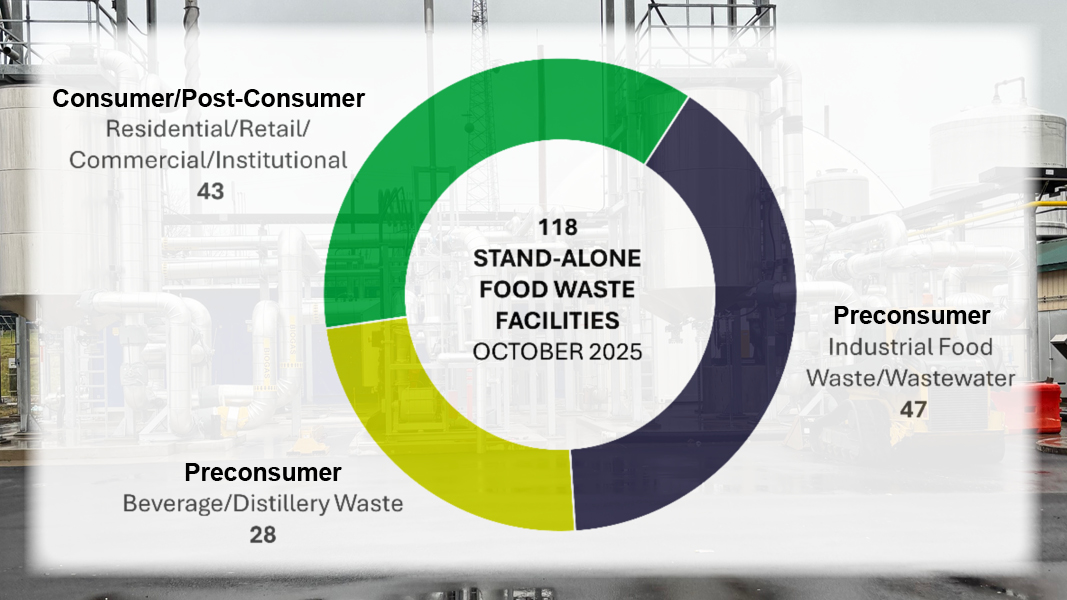
Top: Graphic courtesy American Biogas Council
As of October 2025, the American Biogas Council (ABC) reports 118 stand-alone “biogas capture” digester facilities in the U.S. utilizing food waste as the primary feedstock. Almost two-thirds of these are in the food production sector, dedicated to preconsumer feedstocks such as industrial food/beverage processing and production waste and wastewater. There are currently 43 facilities accepting retail and postconsumer food waste, according to ABC’s data.
Four new stand-alone food waste anaerobic digestion (AD) facilities started operating in 2025, bringing the total coming on line during the past five years to 16. An additional 18 are listed as under construction and scheduled for commissioning by the end of 2026. “We currently estimate total U.S. biogas capture at stand-alone food waste facilities at 24 billion cubic feet (Bcf) per year, representing 3.2% of national capacity,” says Ian Taylor, ABC’s Data and Analysis Manager. “The majority of this biogas is still used for electricity generation or heat production, but there has been a significant swing towards renewable natural gas (RNG) production in recent years, with 12 of the 17 new biogas capture facilities going into operation since 2021 upgrading their biogas output to RNG.”
Over a quarter of all U.S. stand-alone food waste facilities are located in California. Its 32 facilities exceed the number found in all the next five leading states (North Carolina, Ohio, Pennsylvania, Wisconsin and New York) combined. Nine stand-alone food waste digesters are in development in California, “likely due in part,” notes Taylor, to the state’s law (SB 1383) that mandates organic waste collection and recycling.
Half of the six states that currently have the highest levels of biogas capture from stand-alone food waste facilities also have the highest potential. “Leading the way is California which, if all its potential is realized, could capture a further 27 Bcf biogas from food waste annually,” according to ABC. “Florida and Texas have the potential to capture an additional 13 Bcf annually, followed by Washington, Wisconsin and New York.”