
Top: Timber Creek Recycling receives about 50,000 tons/year of yard trimmings, biosolids and food waste at its Nampa, Idaho aerated static pile composting site. Compost facility photos courtesy Green Mountain Technologies
Timber Creek Recycling entered the world of organics recycling many years ago as a way to make bedding for its cows. “We needed bedding to keep the cows dry in the winter, so we purchased a grinder to process wood and yard trimmings,” recalls Mike Murgoitio, founder of Timber Creek Recycling in Meridian, Idaho. “Neighboring farmers had a need for the bedding as well, and that business grew. We then saw an opportunity with concrete recycling, and got into that early on ahead of the competition.”
As a crop farmer, Murgoitio also recognized the need to maintain soil health. In 2013, he started a windrow composting operation at the recycling facility in Meridian, processing manure, food manufacturing residuals and biosolids. “We wanted to move to no-till farming, and in order to do that, we had to build up our soil health to the point where there was enough organic matter and soil porosity to support that,” he explains. “Compost has been key to that transition.”

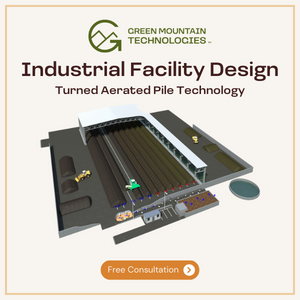
The ASP facility design created by Green Mountain Technologies for Timber Creek required using a long narrow strip of land on the site, while leaving enough space for a transfer station, C&D recycling, and a large sales yard.
A few years ago, Murgoitio decided to open a second facility in Nampa, about 10 miles from Meridian. He identified a 33-acre property next to a sugar factory that has a rail head and a nearby gas pipeline. The state and county permitting process for a solid waste transfer station, aerated static pile (ASP) composting facility and a depackaging operation was challenging, but ultimately successful. In 2023, Timber Creek Recycling installed an aerated static pile (ASP) composting plant at the Nampa site designed to expand to up to 200,000 tons/year of processing capacity. The facility opened in 2024, and receives about 50,000 tons/year of industrial and commercial food waste, yard trimmings and biosolids.
“We procured a depackager with a secondary cleaning step for the commercial stream,” says Murgoitio. “Tanks were installed for receiving liquid industrial waste. Feedstocks that are solid enough are tipped onto the paved pad. Amendment is layered on top and then we are using a tractor-pulled CMC ST 300 compost turner supplied by Green Mountain Technologies (GMT) to mix the feedstocks prior to placing them on the aerated concrete pad.” GMT also designed the composting facility and provided the aeration equipment and control system. “The ASP facility design we created for Timber Creek was an interesting challenge in that we had to use a long narrow strip of land on the site, while leaving enough space for a transfer station, C&D recycling, and a large sales yard,” notes Orion Black-Brown, President of GMT.

Concrete crushing and recycling operation at the Timber Creek facility. Photo courtesy of Timber Creek Recycling
Once the facility was up and running, there was an operational learning curve that required outside support. “Initially we didn’t have our carbon to nitrogen ratio right, and the excess nitrogen was causing odor issues,” says Murgoitio. “With GMT’s assistance, we learned that the particle size of our carbon materials wasn’t quite right. We increased the surface area of our carbon and that was a real game changer.” Active composting piles are topped with a biocover and can be operated in positive or negative aeration modes. Finished compost is sold in bulk and blends at the facility’s retail yard.