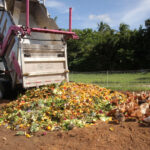

Top: The composting industry’s involvement in organizations like AAPFCO helps ensure the development of good regulations that positively impact compost and soil blend markets. Photo courtesy Timber Creek Recycling
Ron Alexander
As the composting industry has continued to expand and mature, marketplace and environmental requirements have changed. To be effective, individual composters must be aware of these changes, as well as related regulations that impact the production and sale of their products. The composting industry must also work to influence the development of good regulations that not only positively impact the composting industry, but also its compost customers. Each state’s Department of Agriculture (or equivalent) and AAPFCO (Association of American Plant Food Control Officials), the national organization that represents them, regulate the sale of soil amendments and fertilizers. For this reason, they can impact the production and marketability of compost products.
 The US Composting Council (USCC), through its industry liaison to AAPFCO, has represented the composting industry for over 25 years at AAPFCO’s semi-annual meetings, assisting the industry with a variety of initiatives, as well as defending it when appropriate. The relationship between the composting industry (the USCC) and AAPFCO state Control Officials is strong. AAPFCO’s Lab Services Committee has reviewed the TMECC (Test Methods for the Examination of Composting and Compost) lab manual and has approved its usage as standardized compost test methods. State Control Officials also are aware of the USCC’s Seal of Testing Assurance program. The USCC has worked diligently to represent itself to AAPFCO as an organization that follows good science, respects fair industry play, and appreciates ongoing dialogue. Further, its efforts have assisted not only the composting industry, but also the organics recycling industry overall.
Part I outlined who AAPFCO is and what they do, as well as the basics of compost labeling and registration. This article outlines efforts that have been completed through AAPFCO which benefit the composting industry and can benefit potential composters.

AAPFCO’s “Rules and Regulations-Bulk Compost” allow composters to more easily make nutrient claims when in bulk form, if registered as a fertilizer, while still making a series of soil amending claims. Photo courtesy of Recology
Older Initiatives
SUIP (Statement of Uniform Interpretation and Policy) 25 – Metals in Fertilizers: The SUIP created heavy metal limits for phosphate and micronutrient-containing fertilizers, and in some states, it is used to regulate all fertilizer products. After several years, it was suggested that the SUIP’s text be placed in the Uniform State Fertilizer Bill Rules and Regulations and pertain to all fertilizer products. An AAPFCO Working Group was created to modify the SUIP language to make it suitable to fit in the Uniform Bill. A USCC representative was involved in this Working Group, as well as the development of the original SUIP. Keep in mind that through USCC involvement, compost, manure and biosolids products were (and are) exempted from the SUIP, even if the products are labeled as fertilizers. This is because the risk assessment research and heavy metal limits completed during the development of the USEPA Part 503 regulations for biosolids was demonstrated to be more appropriate for compost and carbon-based products. Various states have placed the heavy metal SUIP reference in their state fertilizer and soil amendment laws.
The “Rules and Regulations – Bulk Compost”: Essentially, this regulatory language allows composters to more easily make nutrient claims when in bulk form, if registered as a fertilizer, while still making a series of soil amending claims. One of the key benefits in the language allows for more accurate nutrient disclosure to be made, allowing fractional nutrient claims (e.g., 0.5% Nitrogen), which is important for the environment, plant efficacy and regulatory adherence (nutrient management). The language also created a mechanism to deal with nutrient guarantees, which were not met (lower than guaranteed) because of outdoor compost storage and dilution caused by precipitation. It also developed a list of allowable compost labeling claims that (in theory) are accepted by all 50 states. The updated list of labeling claims is outlined in the box below.
New(er) Registration/Labeling Initiatives
Industry-approved definition: The composting industry wanted to replace the somewhat scientifically inaccurate AAPFCO “compost” and “composting” definitions, as well as promote that compost was:
- Produced through an understood “manufacturing” process
- Heat treated, thus destroying most human pathogens and weed seeds (there has been a lot of concern about human pathogens in food)
- Contains stabilized carbon (which is more beneficial to soil than unstabilized carbon)
The industry-approved definition is: “Compost: Is the product manufactured through the controlled aerobic, biological decomposition of biodegradable materials. The product has undergone mesophilic and thermophilic temperatures, which significantly reduce the viability of pathogens and weed seeds, and stabilize the carbon such that it is beneficial to plant growth. Compost is typically used as a soil amendment, but may also contribute plant nutrients.”
The last line in the new definition makes it known that compost can be registered as a soil amendment or fertilizer depending on the labeling claims and desire of the manufacturer. “Fertilizer” in labeling and registration just means that the product makes guaranteed nutrient claims. Although this new definition may not be deemed as perfect by some — which is often the case with AAPFCO’s definitions that are a cross between scientific and marketing definitions — it helps to differentiate compost from other products in the marketplace (e.g., anaerobic digestate).
Creation of the Uniform Beneficial Substances Bill: The Uniform Beneficial Substances Bill replaces the Uniform Soil Amendment Bill. The USCC provided input during the development of the Bill which was deemed necessary to better regulate the sale of plant biostimulants and soil and plant inoculants (microorganisms), as well as more standard soil amendments like compost. Another important goal is to more uniformly label these and mixtures of these products from state to state. Understand that the creation of this new Bill does not affect composters’ abilities to register their compost as a soil amendment (or alternatively, as a fertilizer, if nutrient claims are made). Within the Bill, compost received an exemption whereas the ingredient statement for a compost sold as a soil amendment only has to claim the compost’s main feedstock (e.g., Ingredient Statement: yard trimmings compost).
“Rules and Regulations – Bulk Compost” 2025/26 update: Since the approval of a uniform list of compost labeling claims in 2007, regulations have changed which disallowed certain claims to be made without major caveats, and the definition for compost had changed. Therefore, changes were suggested to improve specific compost claims, making them more universally allowed from state to state and helping Control Officials evaluate them when placed on labels (see Box for allowable claims). Also, within the Rules and Regulations, the updated definition for “compost” was added. The new language will likely “go official” in 2026.
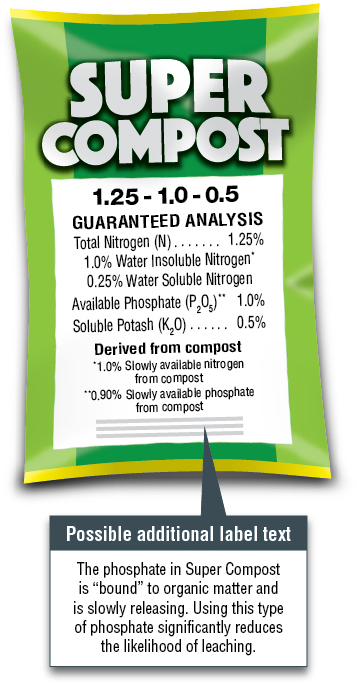 Water-Extractable Phosphorus (WEP): In response to state regulations regarding phosphorus fertilizer usage, AAPFCO developed recommended language regarding “Fertilizer Restrictions for Urban Landscapes,” as well as other related SUIPs, to assist states in developing science-based regulation. Unfortunately, many states ignored relevant science, regulating all phosphate sources the same and ignoring their actual mobility. In many of these states, compost was impacted by these regulations if nutrient claims were made, and sometimes even when they weren’t. To be able to claim that carbon-based products like compost contain lower amounts of WEP, slowly releasing forms of phosphorus, the USCC completed a series of tasks:
- Identified a test method for WEP
- Tested a series of carbon-based products
- Determined an appropriate way to claim slow-release phosphorus on a fertilizer label
The USCC also proposed (and gained approval for) a definition for WEP. Through these efforts, most composts that are registered as fertilizers can claim slow-release phosphorus in their product. The importance of this claim relates not only to the potential negative environmental impacts of highly soluble phosphate products but also helps compost customers better manage nutrient addition for proper plant growth.
Humic Substance Claims: The formation of humic substances is not yet fully understood, but several popular theories exist (e.g., lignin theory, polyphenol theory, etc.). While humic substances are found in soil, compost and other materials, they are in a more diluted amount. Deposits of concentrated humic substances have also been discovered in nature (e.g., Leonardite) and are being harvested for sale into horticulture and agriculture markets. AAPFCO has approved revised definitions for humic substances and related materials which has made it easier to test and market them. Compost contains humic substances, which are very stable forms of organic matter, and are important components of healthy soils.

Humic substance formation. Image source: Bruce Bailey, Kurtz Bros., Inc. – June, 2005
There appears to be a strong positive correlation between compost stability, and both cation exchange capacity (CEC) and the content of humic substances. While the new definition suggests that humic substances are ”commercially harvested (mined) from terrestrial deposits,” thereby excluding composts, many state Control Officials have stated that they will allow compost to claim humic substance content. Of course, this can only be done on composts registered as soil amendments and where proper testing is completed and label guarantees are made.
Get Involved
As you can see, a lot of activity has taken place through AAPFCO, to the benefit of composting industry. Remember, to avoid any conflict or fines from state Control Officials, we suggest that you get more familiar with the soil amendment and fertilizer registration regulations in the states in which you operate and market your compost products. Also, if your products are registered, or if you plan to register them, use that fact in your marketing materials. This is one way to regain the costs associated with the regulatory fees.
Note: The composting and organics recycling industries would greatly benefit if they had more involvement with AAPFCO. More representatives from national and large regional players in our industry, as well as the biosolids and manure management industries, would help bring more perspectives and solutions to the development of good regulations that positively impact the composting and organics recycling industries — and their customers.
Learn More
A free 90-minute session regarding AAPFCO, product labeling and registration, and organic listing will be offered to attendees of the 2026 US Composting Council Conference in Sacramento, California.
Ron Alexander is President of R. Alexander Associates, Inc., Cary, NC, Ron@alexassoc.net. R. Alexander Associates, Inc. specializes in product and market research, and development for organic recycled products. Ron Alexander has served as an Industry Liaison to AAPFCO, representing the U.S. Composting Council, for over 25 years. For more information, go to: www.alexassoc.net and click on Library of Articles.