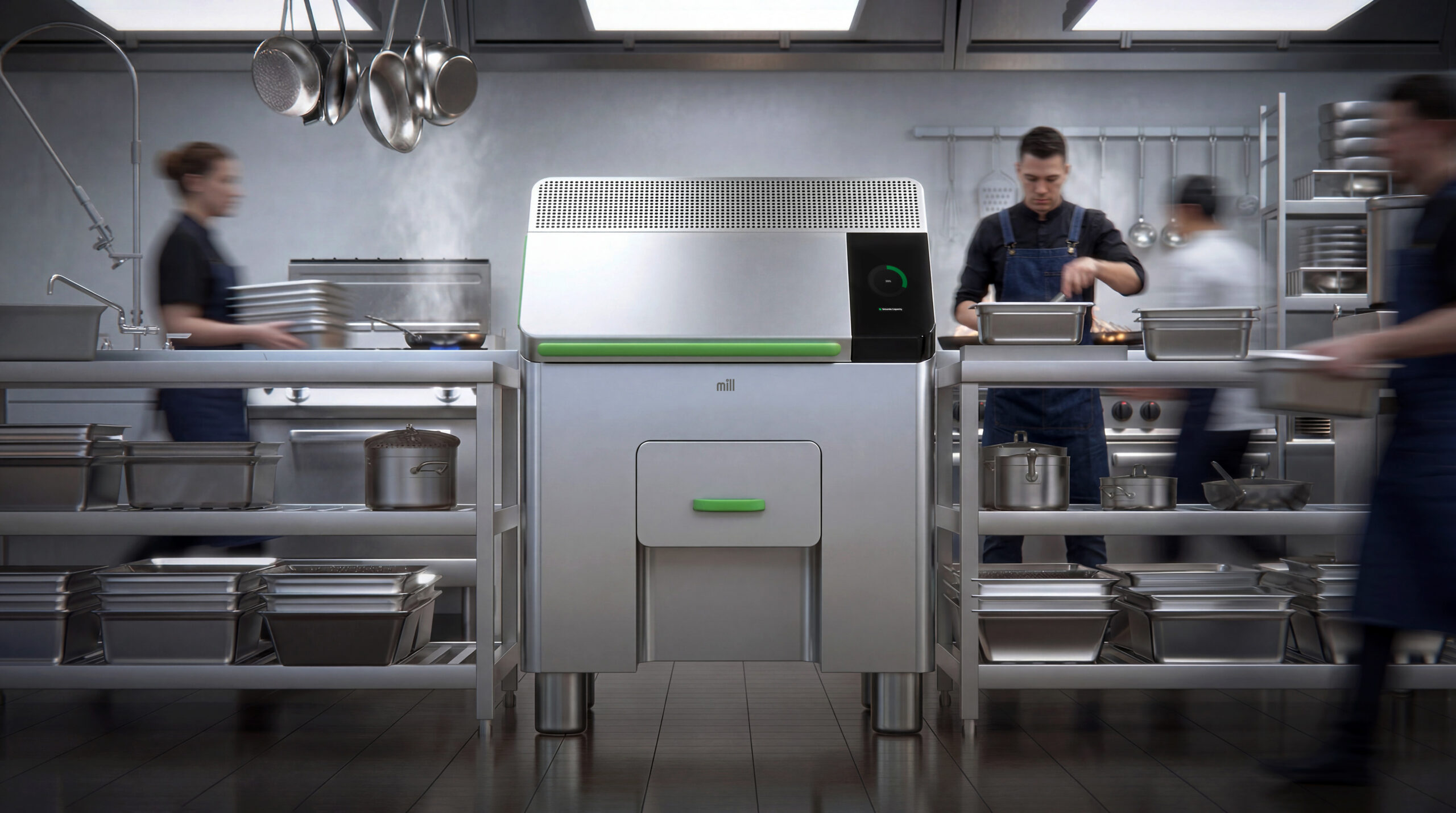
Top photo: Mill commercial unit courtesy of Mill
Mill, which makes food waste dehydration units for residential and commercial markets, is moving quickly to establish itself in commercial food waste management, positioning its technology at the intersection of hardware, data, and kitchen operations.
Two recent announcements give a sense of where things are headed. Mill has partnered with Compass Group North America and is also working with Google’s AI Futures Fund to strengthen its waste characterization capabilities.
The Compass agreement brings immediate scale, according to Mill. Compass serves more than 14 million meals per day across 55,000 locations, spanning corporate campuses, hospitals, universities, and sports venues. Beginning in 2027, the company plans to deploy Mill’s commercial system across its footprint as part of a broader commitment to cut food waste in half by 2030.
“Operators don’t just want data, they want actions and a playbook,” says Harry Tannenbaum, Co-Founder & President at Mill. “I think what’s really important, and unique, about our approach is that we are designing systems alongside the operators that we are partnering with, like Compass Group, to drive action. We are hyper-focused on surfacing the actionable recommendations that a person (or a system) can use to deliver outcomes in the moment.”
The scale of the opportunity is significant. U.S. foodservice generates about 12.5 million tons of surplus food each year, according to ReFED and most of it still ends up in landfills. At the same time, many commercial kitchens don’t have a clear picture of what they’re throwing away.
Mill’s approach centers on making that waste visible. Its system combines on-site hardware that reduces food scrap volume by up to 80% with an AI layer that identifies what is being thrown away in real time. The idea is straightforward. If operators can see waste as it happens, they can change purchasing, prep, and menu decisions before it becomes waste.
“Our system is able to deliver real time, item level classification,” adds Tannenbaum. “Think: menu item [x] was scraped off a plate, or ingredient [y] was overproduced. When we think about how ‘waste audits’ are taking place today, they are intermittent.”
That data layer is where the company’s second announcement comes into focus. Through its partnership with Google’s AI Futures Fund, Mill is gaining access to Gemini models to improve how it identifies and categorizes food waste in commercial kitchens.
Waste characterization in these environments has historically been difficult. Kitchens are fast-moving, inconsistent, and often chaotic. Ingredients vary by day and by operator. Lighting, volume, and contamination all add complexity. Mill is betting that combining purpose-built hardware with continuously improving AI models will allow it to capture data that has been largely unavailable until now.
“With AI, we are able to help businesses move from intermittent auditing to continuous auditing,” notes Tannenbaum. “Building on today’s LLMs (large language model) is a huge leg up compared to what was possible even 2 years ago, and being part of Google’s AI Futures Fund means that we get early access to next generation models and features, providing an additional boost. We’re also leveraging Google X’s Project Delta data set, which includes years worth of labeled food waste data that will enable even faster development and deployment of our food waste characterization capabilities.”
The company’s background reflects that approach. Its team includes engineers from Apple, Nest, Google, Uber, and Tesla, with experience building products for real-world use, not just controlled environments. What stands out, emphasizes Mill, is how tightly integrated the system is. The hardware is not just collecting waste; it’s also where data is generated. Instead of layering intelligence on top, it’s built directly into day-to-day operations.
That combination may prove critical. Food waste has long been recognized as a major cost center in foodservice, but one that is rarely measured with precision. Without consistent data, efforts to reduce waste tend to rely on audits, estimates, or behavior change campaigns that are difficult to sustain. Mill is taking a different approach by turning waste into a continuous feedback loop. The Compass rollout will test whether that model holds at scale. If it does, it could change how foodservice operators think about waste, shifting it from a back-of-house disposal issue to a front-line operational metric.
For now, the focus is on showing that better visibility can lead to real change. Kitchens already know they generate waste. The challenge is seeing it clearly enough to actually do something about it.