
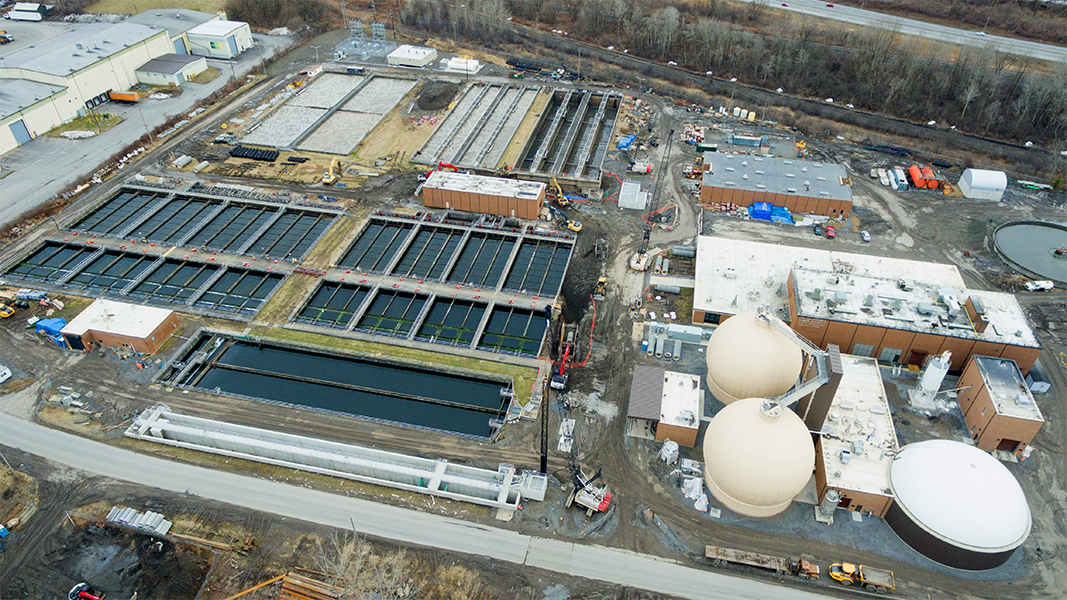
Top: Oneida County, NY’s Water Pollution Control Plant (WPCP) with new egg-shaped digesters in foreground.
A new study from Princeton University suggests that our current understanding of the wastewater treatment sector’s climate footprint is incomplete. Published in Nature Climate Change, the researchers found that greenhouse gas (GHG) emissions from wastewater systems are underestimated in national climate inventories by 19% to 27%. This discrepancy cited represents a massive reporting gap, accounting for 52 to 73 million metric tons of CO2-equivalent annually across the 38 countries analyzed.
A press release from Princeton on the study’s findings said “the analysis shows that underreporting is systemic rather than isolated. Many national inventories omit decentralized systems such as septic tanks and latrines, limit accounting of emissions from effluent discharge and untreated releases, and rely on outdated emission factors that underestimate methane and nitrous oxide formation in biological treatment processes. Sewer networks and sludge management pathways are also frequently excluded due to limited monitoring data. More recent measurement-based studies indicate higher and more variable emissions than earlier guidance assumed.”
When these emission sources are added to the equation, the climate footprint of the sector grows significantly, notes the study. This raises important questions about whether current state-level inventories are capturing the full picture.
“The same issues we see in national inventories show up at the facility level,” said Dr. Jason Ren, Professor of Civil and Environmental Engineering and the Andlinger Center for Energy and the Environment at Princeton University, and lead of the Water and Energy Technologies Lab, which conducted the study. “In practice, we’re relying on simplified assumptions and incomplete boundaries that don’t reflect how these systems actually operate.”
At the plant level, those gaps are most pronounced in core treatment processes. Nitrous oxide emissions from biological nitrogen removal, for example, are highly sensitive to operating conditions such as dissolved oxygen and loading, added Dr. Ren. “While models often treat these emissions as relatively stable, field measurements show they can vary by orders of magnitude, even across similar facilities.”
Methane presents a similar challenge. Emissions from liquid treatment processes and biosolids handling are frequently underestimated, in part because older guidance assumes minimal methane generation in aerobic systems and does not fully account for leakage from anaerobic digestion and biogas infrastructure. According to Dr. Ren, field measurements across dozens of facilities show significant variability, particularly at plants with anaerobic digestion.
“Beyond individual processes, entire portions of the system remain outside traditional accounting boundaries,” he noted. “Effluent discharge, sewer networks, and biosolids management pathways are often excluded altogether. When these omissions are combined with simplified emission factors, the result is a systematic undercount of the sector’s true climate impact.”
Filling the Data Gaps
To better understand how these findings translate to operational realities, we reached out to the California Association of Sanitation Agencies (CASA), which represents utilities serving over 90% of the state’s sewered population. A portion of CASA members recently contributed data to the Princeton-led survey aimed at improving the accuracy of GHG inventories for Water Resource Recovery Facilities (WRRFs).
According to CASA, these efforts are helping identify where emissions are not currently inventoried, where they are estimated using outdated assumptions, and where real-world performance diverges from standardized protocols. Filling these gaps is critical. The better data operators have, the better decisions practitioners can make to adjust operations or upgrade infrastructure to limit those emissions while achieving water quality objectives. The ideal end point would be to minimize emissions and recover those that can be utilized as a resource to bolster the WRRF’s operational resilience and fully establish a circular system, notes the Association.
The move toward more accurate accounting is not just a matter of bookkeeping. It is a prerequisite for developing effective strategies to reduce methane and nitrous oxide, which will account for an even larger share of the sector’s footprint as electricity-related emissions fall, states the study. This requires a shift away from modeled data toward direct monitoring.
Establishing a Baseline
For utilities, however, that shift does not begin with installing new sensors everywhere, said Dr. Ren: “The first step is not measurement, it is establishing a solid baseline. Many utilities do not yet have facility-level inventories that reflect up-to-date methods.”
Starting with updated inventories allows operators to understand the relative scale of different emission sources and where uncertainty matters most. From there, the focus shifts to identifying what is both material and actionable.
In many cases, the most immediate opportunities lie in systems that are already being monitored. Biogas infrastructure, for example, can often be assessed using existing data. Simple mass balance checks between gas production and use can reveal methane losses, while SCADA data on airflow, dissolved oxygen, and nitrogen species can help identify likely emission hotspots before additional instrumentation is deployed.
“The goal isn’t to measure everything immediately,” he explained. “It’s to identify where major emission sources are. Once the priorities are identified, actionable plans can be made to focus on the highest impacts.”
This staged approach also helps address one of the sector’s key concerns: cost. Rather than requiring comprehensive monitoring upfront, utilities can prioritize investments where they are most likely to drive operational or financial returns. Reducing methane losses can improve energy recovery, while better control of biological processes can reduce energy demand. In addition to emissions reductions, these improvements can support process stability, safety, and overall system performance.
The authors recommend that countries harmonize their reporting methods and incorporate more measurement-based studies to reflect the variability seen in practice. They argue that wastewater systems can “absolutely serve” as a climate solution, but only if the industry fully understands and measures emissions across the whole system rather than just a single point in the process.
In California, this push for better data is unfolding alongside policy changes that are reshaping the role of wastewater infrastructure. Senate Bill 1383 requires a 40% reduction in landfill methane by 2030 to be achieved through diverting 75% of the organic waste received by 2025, diverting large volumes of food waste away from landfills. As a result, many WRRFs are evaluating co-digestion strategies to accept these materials and recover their energy value.
CASA notes that the long-term goal is not only to minimize emissions, but to capture and utilize them. By recovering methane for renewable energy or fuel and producing beneficial soil amendments, facilities can strengthen their operational resilience while contributing to a more circular system that underpins community resilience. But those outcomes depend on having a clear understanding of where emissions are generated across the process.
Accurate accounting provides the foundation for sound decision-making. As the sector continues to evolve into a hub for energy and materials recovery, closing this emissions gap will be essential to ensuring that wastewater’s role in the green transition is both credible and effective.