
Top Photo: California’s SB 1046 requires pre-checkout bags at food retailers to be reusable, recycled paper, or certified compostable.
Juliana Beecher and Paula Luu
A bill moving through California’s legislature, AB 1812, would ban compostable biopolymers across all applications in the state. If passed, the only legally compliant pre-checkout bag in California grocery stores would be paper – a material that works well for many applications, but can be less practical for holding wet produce, food scraps, or kitchen waste. The composting industry is divided on the bill. So is the data.
AB 1812 is the second legislative challenge in 18 months to SB 1046, California’s 2025 law requiring pre-checkout bags at food retailers to be reusable, recycled paper, or certified compostable. The 15-inch opening width SB 1046 specifies wasn’t arbitrary – it was designed to let the bag have a second life as a kitchen food scrap caddy liner. The first challenge, AB 2226, would have repealed SB 1046 outright. There were also some claims that the compostable pre-checkout bags are “unpopular with shoppers, grocers and municipal composters alike.” However, the bill was withdrawn in late April because stakeholders across the system made clear they did not want plastic produce bags back on shelves.
AB 1812 comes from the opposite direction. Its proponents argue that compostable biopolymers contaminate finished compost and complicate access to organic agriculture markets. Its opponents argue that banning the bag without replacing the tool collapses the bridge between household kitchens and California’s organics infrastructure, the bridge SB 1383 needs to function.
A new survey of 500 California households, commissioned by Novamont North America and conducted independently by SurveyMonkey in early 2026, offers data that has been missing from the policy discussions. According to polling experts Qualtrics, a sample size this large for California’s nearly 40 million residents would yield results with a margin of error of +/- 5% and a 95% confidence level. The administered survey tests some claims raised that compostable produce bags are unpopular with shoppers. More importantly, it examines whether Californians are actually using these bags the way SB 1046 intended, by bringing them home and repurposing them to collect food scraps.
Sixty-three percent of respondents said they reuse compostable produce bags for food scrap collection, the single highest response in the survey. That number is the quiet center of California’s organics debate, and it is largely absent from the conversation in Sacramento.
Why the Composting Industry Is Divided
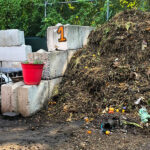
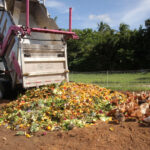
The contamination concern driving proponents of AB 1812 is legitimate. In California, even when composting facilities accept compostable bags, they are often removed during preprocessing along with non-compostable bags and other contaminants – a defensive measure shaped by the standards required by the end markets composters sell into, particularly certified organic agriculture. For composters who have spent years building clean feedstock streams, a bag that may look compostable but enters their facility as conventional plastic is a liability.
But banning the material is a different choice than refining how it’s labeled, sorted, and processed. AB 1812 makes that choice for California, and if it passes, paper would be the only remaining compliant produce bag option, despite paper’s well-documented impracticality for wet, fresh produce and food scraps. The bill is shifting the conversation from whether shoppers prefer compostable bags over conventional plastic to a conversation about whether contamination concerns at composting facilities outweigh the practical tools households are actually using to participate in food scrap collection.
That question has been debated in Sacramento largely without data on what California households actually do with the certified compostable pre-checkout bag once they get it home. The Novamont North America survey was commissioned to help fill that gap. The company’s Mater-Bi material is used by US-based bag manufacturers, including in California. Novamont noted that claims about shopper sentiment differed sharply from case studies of similar initiatives in Europe, and that a survey could also speak to a quieter but critical question:
Are Californians actually reusing these bags as food scrap collection tools, the way SB 1046 intended?
California General Public Survey
The survey questions were originally developed for a European consumer research study and adapted by Novamont North America for the California market. SurveyMonkey was contracted to disseminate the survey statewide.
SurveyMonkey uses paid survey takers and did not divulge the name of the survey designer on the survey. Demographic information on respondents’ age, income range and gender was collected, but more exact location within California (town/city, county, rural/urban) was not. The survey included 5 standard demographic questions alongside 11 questions specific to compostable produce bags.
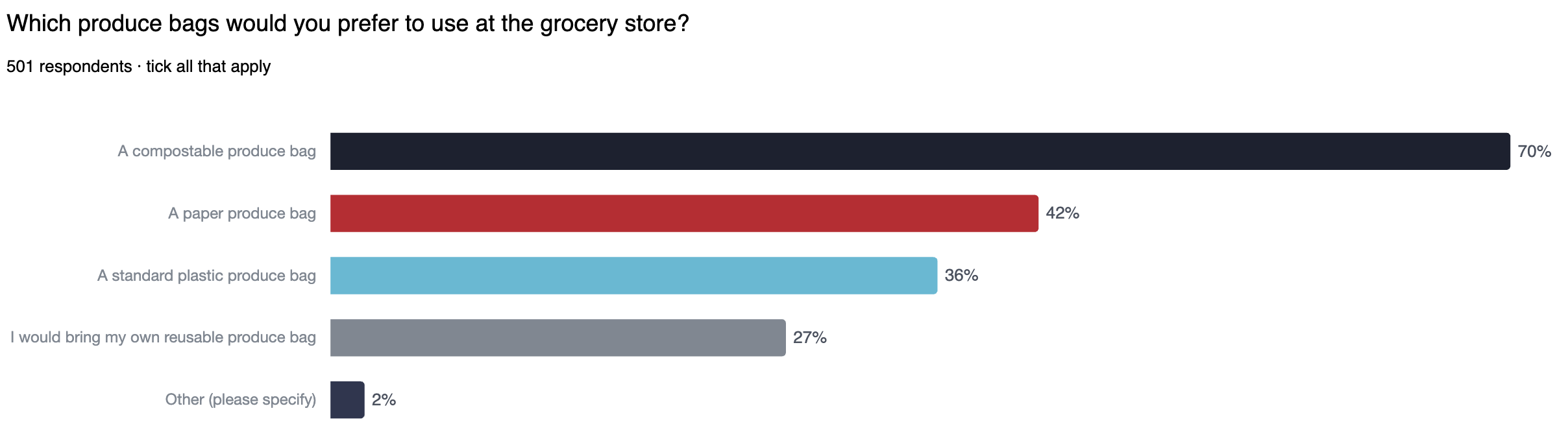
Results show strong overall satisfaction with compostable produce bags provided in grocery stores – 47% very satisfied and 30% satisfied (Figure 1) – and a majority preference for compostable bags over conventional plastic, paper, and reusable alternatives (Figure 2). Many respondents expect produce bags to be offered for free (43%), though more were willing to pay 1-2 or 3-5 cents per bag (19% and 29%, respectively).
Figure 1. Opinion of Compostable Produce Bags in Grocery Stores

Click figure to enlarge.
Figure 2. Which produce bags would you prefer to use at the grocery store?
Click figure to enlarge.
The majority of respondents reported being extremely (46%) or very (33%) interested in environmental issues and engaged in food scrap collection or composting (62% use curbside service, Figure 3). The largest share of respondents, 63%, said they would reuse compostable produce bags for food scrap collection, the single highest response among all bag types listed (Figure 4).
This is the finding that has been largely absent from California’s policy conversation. SB 1046’s 15-inch opening width was deliberately designed so the produce bag could have a second life as a kitchen caddy liner – a free, already-in-the-home tool to lower the friction of food scrap collection under SB 1383. The survey suggests Californians are using it that way. Eliminating compostable biopolymers through AB 1812 removes that bridge between the grocery store and the green bin without offering a workable substitute. Paper bags, the only remaining compliant option under AB 1812, do not typically hold wet food scraps – the same reason households don’t use them for regular trash.
Figure 3. Do you currently dispose of food scraps separately for composting?

Click figure to enlarge.
Figure 4. What do you use (or would consider using) to collect food scraps for disposal?

Click figure to enlarge.
The survey asked whether respondents use compostable produce bags to store fruits and vegetables at home. Respondents reported using them to store produce in the fridge (57%) or at room temperature (40%). One quarter of respondents did not use compostable produce bags for storage.
Some survey respondents reflected this dynamic, noting that certain produce did not last as long in compostable bags. This makes sense given the tradeoffs between compostable and conventional plastics in produce storage. Some compostable produce bags tend to be more breathable, which can shorten shelf life for items like lettuce or cucumbers that benefit from tighter moisture control in the fridge. However, that same breathability can be an advantage for produce stored at room temperature, such as potatoes, and can also help reduce odors when compostable bags are used in vented kitchen caddies. Consumer education and recommendations would be helpful in this instance.
Overall, the survey results demonstrate strong support for compostable produce bags continuing to be offered in grocery stores. Additionally, the results show interest in using compostable produce bags for food scrap collection (as designed in SB 1046) – but some respondents noted that their local solid waste jurisdiction/food scrap collection service does not accept compostable bags. This points to another tension in California’s food waste diversion efforts.
How Composters Handle the Bag
California’s composters operate under three realities that shape what bags they can accept, regardless of what the legislature decides.
- Technological Limitations: Depackaging equipment doesn’t differentiate between compostable and conventional plastic.
- Regulatory Constraints: Current USDA National Organic Program rules do not allow compostable plastic feedstocks in compost destined for certified organic agriculture, limiting access to important end markets for some composters.
- Reputational Pressures: Even one piece of conventional plastic in finished compost can disqualify a load from premium end markets, so composters preprocess defensively.
For composters serving certified organic agriculture, compostable plastics remain a complicated regulatory issue. In January 2026, the NOSB voted unanimously against recommending the addition of broad classes of synthetic compostable materials to the National List of allowed substances. While the board indicated it may consider specific materials or use cases in the future, such as compostable bags used for food scrap collection, any eventual change would still require action through the USDA’s National Organic Program and is unlikely to produce near-term regulatory clarity across jurisdictions.
Studies have shown that compostable plastic bags used for food scrap collection break down effectively in composting operations, while conventional plastic persists, fragmenting through the process and accumulating in finished compost and eventually in soils. Yet the threat of contamination from conventional plastic still leads some composters to reject all bags, compostable and conventional alike, as a precautionary measure. The defensive logic is understandable. The unintended consequence is that the bag designed to reduce contamination gets treated the same as the bag causing it.
Some California collection programs are embracing compostable bags for food scraps collection. Compostable liner bags have long been part of San Francisco’s Zero Waste program, and residential and commercial customers alike rely on them. The liners are especially important in multifamily housing, where residents carry trash and food scraps to separate receptacles or chutes for collection. San Francisco’s organics go to Recology for processing. A recent analysis sampled post-composting residual overs to measure the quantity and composition of visible plastic film. A third-party lab tested 440 of the fragments and found one piece of compostable plastic. The rest were conventional plastic.
“It’s clear that the contamination issue is conventional plastic,” says Hilary Near, Commercial Zero Waste Senior Coordinator at SF Environment. “I’m not ready to oppose compostable liners because I fear residents would move to conventional plastic or stop composting altogether.”
At Napa Recycling & Waste Services, compostable liner bags are especially important for commercial customers for food scrap collection, and have been accepted at the composting facility since 2008. It’s harder for Napa Recycling to quantify how important liner bags are for residential customers, because food scraps, with and without liner bags, are collected in the same bin as yard waste. Commercial food waste streams are now typically run through a depackager where compostable liners are removed before composting. Bags are also removed from the residential stream, as a precaution to reduce contamination from conventional plastic and because of the National Organic Program (NOP) rules. But the bags break down well in Napa’s composting system – the facility has participated in many studies to prove that.
Tim Dewey-Mattia, Recycling & Public Education Manager at Napa Recycling, sees the rationale and utility of compostable liner bags. “They help capture food scraps,” says. He cites participation as a bigger challenge than contamination. “Even 10+ years in, 50% of customers still don’t participate in food scrap collection, including many multifamily residential customers,” notes Dewey-Mattia. “Late adopters need assistance to get started, and bags help.” The compostable produce bags offered at grocery stores are great tools, he continues. “It helps that they’re free, that people don’t have to buy something additional in order to collect food scraps.”
Tradeoffs and Systems Thinking
Napa Recycling’s experience highlights a real tension in California’s organics system. Should programs prioritize the cleanest possible compost, or make food scrap collection easy enough for households to participate consistently?
Napa Recycling’s organics recycling is fully integrated, with the company operating the municipally-owned composting facility (and the recycling facility), hauling organics, and educating residents and commercial customers. That interconnection makes it easier to simplify messaging and keep rules consistent. Ultimately, increasing participation will be essential to California meeting the goals of SB 1383. Figuring out how to get more food scraps out of kitchens and into organics recycling systems is crucial.
California is not the first jurisdiction to wrestle with this. Italy banned conventional polyethylene plastic bags and required certified compostable liner bags for food scrap collection starting in 2014. Separate food scrap collection was mandated across Italy starting January 1, 2022. The integration worked because the supporting infrastructure was already there. Municipal collection services and organics processing facilities were already established across the country, with Milan as a frequently cited example – collecting residential food scraps in compostable bags since 2012 – and because Biorepack, a 2020 extended producer responsibility scheme for compostable products created economic alignment between bag manufacturers, retailers, and composters. The compostable bag wasn’t asked to solve the system on its own; it was one piece of a system designed to work together.
California has the laws (SB 1383, SB 1046, SB 54) and the regulatory framework, but the operational integration is uneven and the policy signals are now contradictory. AB 1812 would deepen that contradiction. Some composting and food waste program managers see compostable bags as different from other compostable products because they facilitate the collection of food scraps. Novamont suggests that clear labels on compostable and non-compostable bags, along with consistent, rational systems for use across jurisdictions, could meaningfully increase participation rates while reducing contamination risk. The current SB 1046 actually removed one of the major composting contaminants (conventional plastic produce bags) from circulation in California.
California’s Truth-in-Labeling laws require compostable plastic bags to include certification logos, color schemes, and text of a certain size. They also require that all products labeled “compostable” must be made of materials that are allowable inputs for compost used in organic agriculture by June 30, 2027. (The timeline for this requirement was extended in June 2025 due to the NOSB’s review process.) The NOSB’s ruling not to allow broad classes of synthetic materials as compost inputs has thrown into question how and if compostable products, such as pre-checkout bags, may be labeled once the June 30, 2027 deadline arrives.
For composters, haulers, and food scrap generators to buy into a system, they need to be able to expect some amount of consistency. Avoiding policy whiplash is key to creating consistency and trust that progress toward goals is being made. SB 1046, for example, not only has the result of supplying compostable liner bags for food scrap collection, but of reducing single use plastics in California. California’s Plastic Pollution Prevention and Packaging Producer Responsibility Act, SB 54, includes the following goals for single use plastic packaging and food service ware by 2032: 25% reduction, 65% recycling rate, and 100% compostable or recyclable materials.
In the California survey, 46% of respondents reported using 3 to 5 produce bags per week on average. A rough estimate based on an average of 4 bags per week per household across approximately 13.5 million California households yields roughly 200 bags per household per year, or 2.7 billion produce bags statewide annually. If SB 1046 had been repealed and all stores switched back to conventional plastic produce bags, that would put approximately 5,400 metric tons of conventional plastic back on the market.
Closing
The debate around compostable pre-checkout bags is not, in the end, just about these bags. It’s about the systems being designed and built for California to meet its climate pollution reduction, food scrap diversion, and plastic pollution reduction goals – and whether those systems give households a workable way in.
AB 2226 being withdrawn signaled that California stakeholders do not want conventional plastic bags back in the produce aisles. With AB 1812 still moving, the question is whether California will preserve one practical tool example for SB 1383 compliance – a free, compostable bag already in consumers’ hands – or allow back-end contamination concerns to dictate what’s possible at the front end. Matching understandable messaging to households with rational rules and accessible tools to help simplify the process is how participation scales. Banning the tool without replacing it is how participation stalls.
This article was produced in partnership with Novamont North America, Inc. and tailored for BioCycle’s audience.