
Top Photo: Feature image created by BioCycle.
Juliana Beecher
California’s Plastic Pollution Prevention and Packaging Producer Responsibility Act (SB 54) calls for producers of single-use packaging and single-use plastic food serviceware to join a Producer Responsibility Organization (PRO) and cover the cost of end-of-life management for the materials they produce. SB 54 also requires the PRO to return $500 million annually to the state of California for plastic pollution mitigation from 2027-2037.
Approved and overseen by CalRecycle, Circular Action Alliance (CAA) is the Producer Responsibility Organization selected to develop and implement an Extended Producer Responsibility (EPR) program that meets SB 54 requirements. CAA’s EPR plan for California was submitted to the Producer Responsibility Advisory Board in mid-June and a public comment period was open until mid-August. The plan runs well over 300 pages. It has one of the most detailed strategies for compostable packaging of any EPR plan in the U.S., but there are still some gaps to be filled. The final plan is due to CalRecycle in October.
CAA’s California EPR program plan cover. Click here to expand this image.
Compostable Materials Covered and Quantified
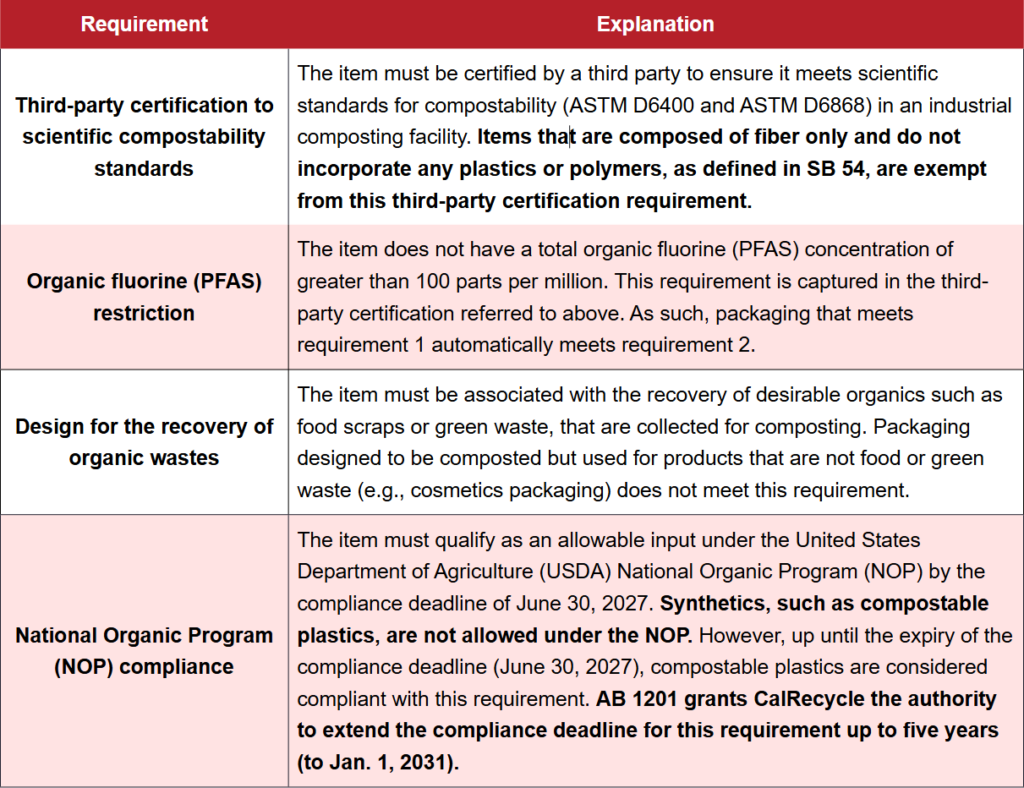
SB 54 requires producers to ensure that all packaging and food serviceware sold into California’s market is recyclable, compostable or reusable by 2032. Additionally, compostable packaging and food serviceware (“compostables”) must be labeled in accordance with AB 1201. Materials that are included in SB 54 are those Covered Material Categories (CMC) on CalRecycle’s list that are eligible to be labeled compostable, and meet SB 54’s Compostability Claim Requirements for Packaging (Table 1). There are 21 CMCs that are eligible to be labeled compostable per CalRecycle’s list, including: cardboard without a plastic component; papers and fibers with and without a plastic component; untreated wood; wood and organics without a plastic component; and rigid and film plastics and polymers designed for compostability. Of those 21 materials, 10 are both compostable and recyclable, and 11 are only compostable.
SB 54 does not cover all compostable packaging and food serviceware, and for materials that are both recyclable and compostable, there is no clear guidance for which approach to take.
The following items are explicitly excluded from SB 54 requirements:
- Single-use food serviceware items that do not incorporate plastic or polymers.
- Bags provided by stores (both at checkout and before checkout, such as produce bags).
- Compostable plastic liners sold for the containment of food waste in organics recovery programs.
Table 1. Compostability Claim Requirements for Packaging, per SB 54
Click here to expand this image.
CAA estimates that over 1 million tons of compostables were generated (i.e., entered the waste stream) in California in 2024. However, generation is only a proxy — producers pay fees for the end-of-life management of the packaging they supply, which is expected to be less than the amount generated as waste, partly due to statutory exemptions and exclusions, but also different methodologies for determining volumes. Total funding for the management of compostable packaging depends on the quantity supplied and fees paid by producers.
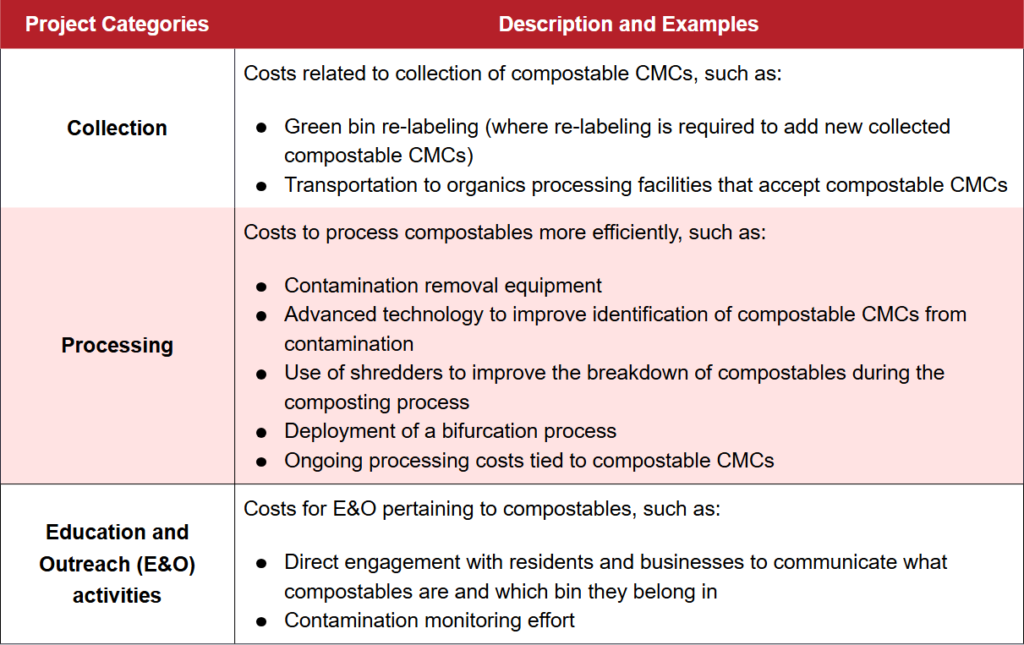
Local jurisdictions and organics processors who accept compostable packaging will be reimbursed for eligible costs, as described in Table 2.
Table 2. Eligible Covered Cost Project Categories Pertaining to Compostables
Click here to expand this image.
The Composting Capital & Operating five-year budget in CAA’s plan is $508 million, which is going to be reduced, according to CAA. In describing the budget line, the plan reads:
“These costs include payments to organics facility operators for the new and additional costs associated with accepting compostable packaging at scale and reducing contamination in incoming and processed material streams. These processing reimbursements will support the management of compostable covered materials and will include expenditures for acceptance payments, processing fees, design and labeling guidance, and any required research or studies to inform effective implementation of SB 54 requirements.”
Some eligible costs will require clarification (e.g. ”acceptance payments,” “new and additional costs,” “accepting…at scale”). Producer fees are set based on covered materials, not how they’re processed. For materials that are both recyclable and compostable, CAA has not yet developed a fee schedule specific to composting those materials, but plans to. These missing details make it difficult for a composter to determine exactly how much they could be reimbursed if they accept compostables under the new EPR scheme.
Barriers to Compliance
In January 2026, CalRecycle released a statewide Needs Assessment for meeting SB 54 requirements. Additionally, CAA conducted interviews with over 40 stakeholders to understand the barriers specific to compostable packaging. Interview findings agreed with the Needs Assessment finding that “acceptance of compostables in local jurisdiction organic waste collection programs and at organics processing facilities was generally low.” Rates of acceptance were higher for paper and fiber packaging and untreated wood than for compostable plastics and waxed cardboard.
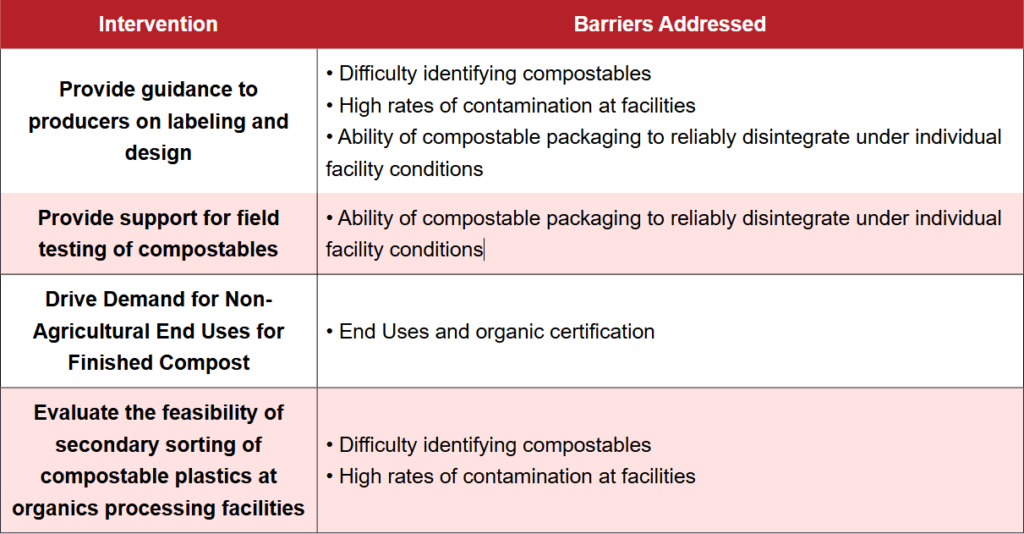
The barriers to facilities accepting compostables are well-known and clearly identified in the strategy. Based on the needs assessment and CAA interviews, the barriers are, in order of significance:
- Difficulty in identifying compostables
- High rates of contamination at facilities
- End uses and organic certification
- Ability of compostable packaging to reliably disintegrate under individual facility conditions
SB 54 requires local jurisdictions to manage CMCs, but they may apply for an exemption for up to two years plus renewals if local conditions make it challenging or impossible to meet that requirement, such as the absence of a facility that accepts compostable packaging. CAA will work with local jurisdictions and organics processors to address barriers to accepting compostable packaging, hoping to garner support for managing compostables before local jurisdictions apply for the exemption. However, CAA expects “most jurisdictions and service providers to apply for an exemption from the requirement to include compostables in their collection programs.” Due to low current acceptance, CAA is pursuing a Unique Challenge Exemption (UCE), submitting a “phase-in plan” along with the Program Plan for compostable packaging. A UCE would extend the compliance timeline for compostables to allow the infrastructure to catch up.
But a longer timeline might not be enough to overcome some of the barriers identified, such as including compostables as an allowable feedstock in compost for certified organic agriculture. If CalRecycle does not extend the National Organic Program (NOP) compliance deadline beyond the current date of June 30, 2027, then there will be no option for meeting SB 54 requirements for compostable plastics. Casey Angel, CAA’s Director of Strategic Communications, says that “If the National Organic Program (NOP) related compliance pathway ceases to be available, compostable plastics would no longer qualify for the composability pathway under SB 54. CAA is evaluating the appropriate Unique Challenge Exemption (UCE) and transition approach for affected covered material categories, subject to the governing law, CalRecycle’s review and the final program plan.”
Despite the vote from the National Organic Standards Board earlier this year to recommend that USDA not add compostable plastics to the NOP list as acceptable feedstock in compost certified for use in organic agriculture, Alex Truelove, Senior Policy Manager at BPI, is hopeful. “The NOSB vote earlier this year was not a final determination, it was a recommendation to the USDA,” says Truelove. “The NOSB is an advisory board to the USDA, and rather than advancing their recommendation, the USDA has initiated an Advance Notice of Proposed Rulemaking (ANPR) to gather information and stakeholder input on compost standards before determining whether any regulatory changes are warranted. This shows movement towards an actual ruling on this issue.” The earliest a ruling would come is August 2027, which means an extension of the AB 1201 NOP compliance deadline is still needed.
CAA’s strategy describes interventions it will support to address the barriers identified (see Table 3), including expanding end market options for compost beyond agriculture, into sectors where organic certification doesn’t matter.
Table 3. Interventions and Barriers Addressed
Click here to expand this image.
If most local jurisdictions apply for an exemption from managing compostable CMCs, then the budget expected to be generated by producer fees will not be spent on reimbursements to eligible collectors and processors. CAA proposes to spend those funds on education and outreach around compostables, and field testing in California. While BPI supports funding for education and outreach, and field testing that is grounded in science and research, BPI also prefers that funding would go directly toward supporting haulers and processors who already accept compostable packaging and food serviceware to expand their capacities. However, “if composters opt out… then we agree with CAA’s proposal,” says Truelove. “If given the opportunity to weigh in, we’d emphasize the importance of education and outreach that is grounded in science and research. We would also advocate for all field testing to be conducted with full transparency and in adherence to the latest ASTM field testing standards, D8618 and D8619.” Truelove notes that, “CAA claims that some compost facility operators say that certified compostable packaging does not break down during their process. However, they do not cite any reliable scientific evidence to support such claims….We believe CAA should reclassify this barrier as a perception of challenges to composters or provide scientific evidence.”
Gaps and Next Steps
Given California’s complex organics regulatory landscape, another lingering question is how SB 54 and SB 1383 will work together. Arguably the most impactful compostable product for increasing food waste collection — compostable plastic liner bags — is excluded from the EPR plan, meaning that composters cannot receive funding through the EPR scheme for managing liner bags.
Anaerobic digestion is no small part of California’s organics recycling infrastructure, and most compostable packaging is not designed to break down in anaerobic environments. What role AD will play in managing compostables under SB 54 remains to be seen, but AD facilities are Responsible End Markets under CAA’s plan, and CAA sees some AD facilities as potential participants in the EPR program.
CAA’s California program plan is still under development and is subject to further revision, applicable governance approvals, and CalRecycle review. For example, the draft plan requires a producer’s compost to be certified by the U.S. Composting Council’s Seal of Testing Assurance (STA) program to be eligible for reimbursement, but that requirement is being eliminated, according to Angel. “Instead, facilities must ensure that compost or digestate complies with applicable environmental health and handling standards, as well as any requirements established by regulation for material processing and decomposition under EPR laws. CAA may provide financial support to facilities where meeting those requirements presents a challenge.”
Although the California plan is one of the most comprehensive for compostable packaging and food serviceware among existing EPR programs in the U.S., these materials are far from the central focus. The system and rates for reimbursement are still being worked out and it will take time before the cost benefits for organics processors to accept compostables are known. It will be an iterative process, and Angel notes that “CAA is committed to working transparently with interest holders to assess opportunities, address challenges and support informed decision-making as the program evolves.”