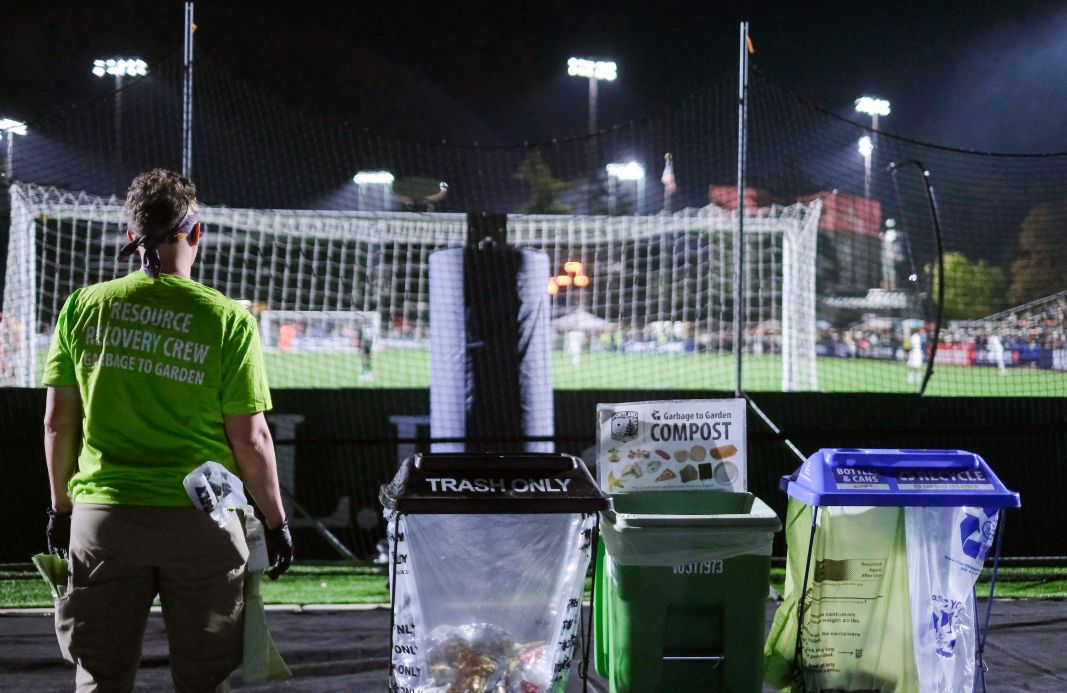
Top Photo: A volunteer staffs a 3-bin collection station at a zero waste event venue in Maine. Photos courtesy of Garbage to Garden
Juliana Beecher
Garbage to Garden started collecting food waste in Portland, Maine in 2012. Fourteen years later, the collection service has expanded into the Boston area, and the company has its own composting site in Windham, Maine. Its model includes a combination of subscription-based residential and commercial service, municipally-funded collection programs, and community drop sites. Garbage to Garden (GtG) has collected over 100 million pounds of residential and commercial food scraps for composting, and has started to grow into a more holistic waste and recycling company.
“When I started this, I hadn’t heard of anyone else doing it,” says Tyler Frank, the founder and CEO. “Because of that, we do some things differently than a lot of other curbside composting companies that I found out about later.” Accessibility is central to GtG’s approach. They try to keep fees low, and to offer free access to food waste collection when they can, through municipal contracts, community drop sites and volunteer programming.
Massachusetts Operations
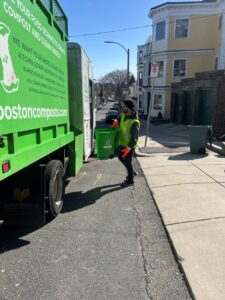
Boston’s curbside program started in 2022 and collects 250 tons/month of food scraps.
GtG expanded into Massachusetts in 2017. It currently offers collection service in Boston, Somerville, Medford and Melrose. The strategy is to prioritize deeper penetration in fewer areas. Programs in Somerville and Melrose are subscription-based, whereas Boston and Medford are municipally-funded programs, with food scrap collection included in the cost of trash and recycling collection for residents. (Somerville is currently running a city-funded pilot, exploring the possibility of a fully funded municipal collection program.)
Boston’s municipal program started in 2022, and GtG now collects over 250 tons/month from almost 30,000 households in the city. Medford’s municipal curbside collection program is among the most successful in Massachusetts, having reached over 50% participation (>10,000 households) in a little more than two years. If organics collection continues to go well, the city of Medford is exploring implementation of Pay-As-You-Throw (PAYT) for trash and reduce trash collection to every other week. Contamination has been low in the municipal programs, though there’s usually a learning curve for residents, Frank notes. These two city programs have seen success from combining separate food waste collection with curbside trash and recycling collection. That success has driven GtG to start collecting trash and recycling in certain areas where it already offers food waste collection by subscription, such as Bath, Maine, hoping to set the stage for municipally-funded curbside food waste collection. GtG is betting that adding trash and recycling alongside food waste collection will make them a competitive choice for municipal contracts.
The majority of food waste GtG collects in Massachusetts goes to partner farms to be composted. Some — a bit over half of what’s collected in Boston — goes to WM’s CORe depackaging facility in Boston (with which they have a supply agreement). Slurry from the WM CORe plant is hauled to a wastewater treatment plant digester. Commercial food waste also goes primarily to composting — about 90% — with the remainder going to depackaging and anaerobic digestion. Brick Ends Farm in Hamilton, Massachusetts, is GtG’s primary composting partner in the state. The farm’s windrow system churns out compost certified for organic use, sold in bags or in bulk. GtG is working with Brick Ends to develop an aerated static pile (ASP) system. If a customer in Massachusetts orders bulk compost, it comes from Brick Ends Farm; if they order bagged compost, it comes from GtG’s bagging operation in Maine.
Maine Operations
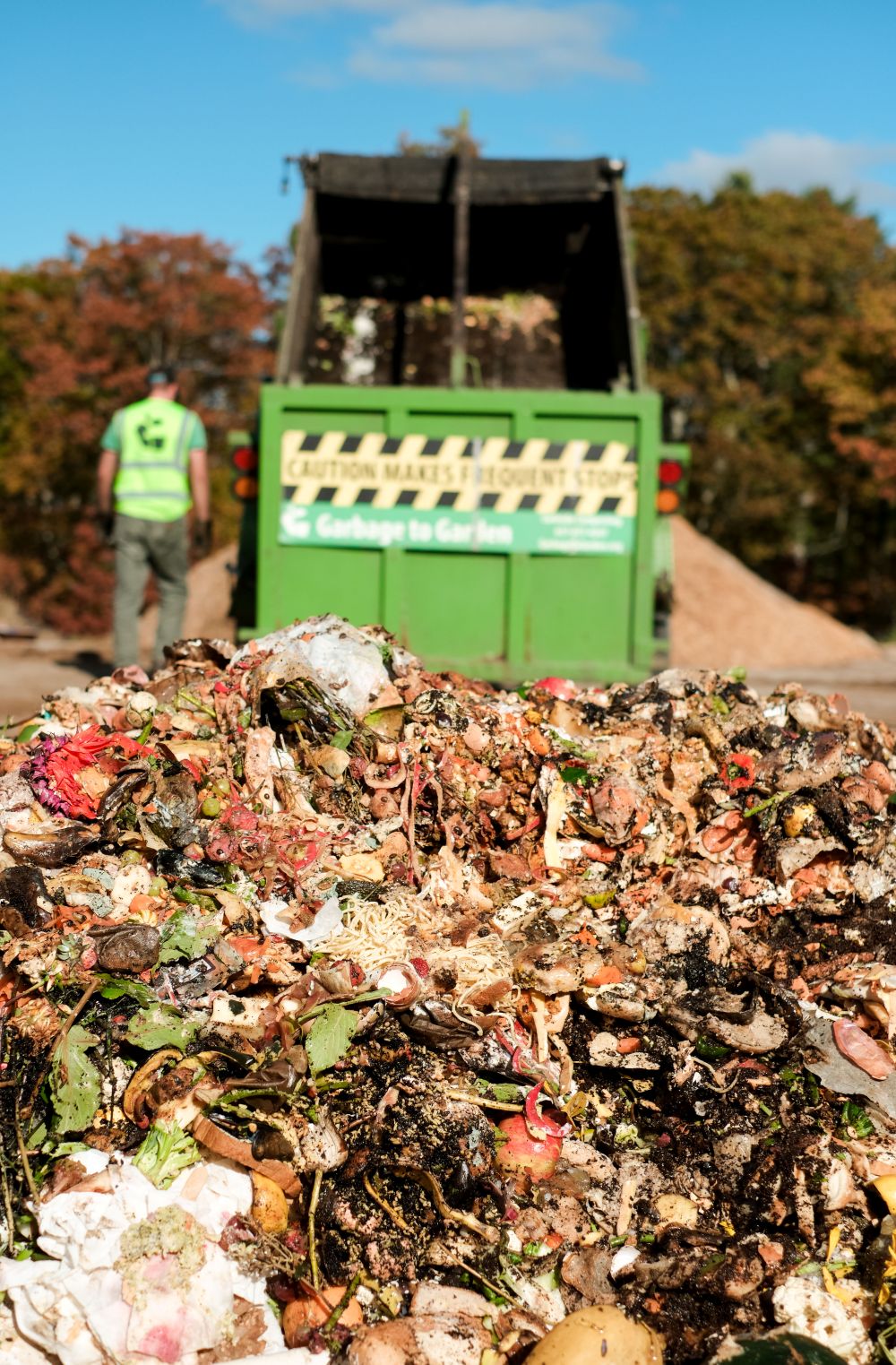
Food scraps are tipped at Garbage to Garden’s composting site in Windham, Maine.
In Maine, GtG offers subscription-based curbside collection in 12 municipalities, Portland being the biggest. In keeping with its mission of accessibility and in partnership with municipal governments, GtG offers free-to-use drop sites in most communities where it also offers curbside service, including Portland, South Portland and towns in Massachusetts. Drop sites feature several 64-gallon toters and clear signage about what to put in the bins. Frank notes that contamination is minimal, even without access controls in place (access is controlled at some sites in MA). GtG collects over 1 ton/week from Portland’s 10 drop sites. “We were a bit concerned about the impact on our curbside program because it is ultimately a business model that requires density and we thought this could really hurt us,” he says. “But it hasn’t. We have maintained 20% of the population subscribed to the curbside collection service.” Food waste collected in Maine goes to two composting sites: MB Bark in Auburn, and GtG’s own facility in Windham. (MB Bark used to run a collection service called We Compost It!, but sold the collection side to AgriCycle.)
GtG bought land for its facility in Windham in 2021. Two and a half years later, the first finished compost was produced using an ASP system. The compost is certified by the Maine Organic Farmers and Gardeners Association (MOFGA) for use in organic agriculture — which Frank notes is a real selling point, especially for its bulk compost. “The organic farm market is our bread and butter,” he notes. Bagged compost from the facility is sold at garden centers, and given away to residential subscribers. Subscribers in Somerville and in Maine can request a free bag of compost every week. GtG gives away roughly 75,000 free bags of compost per year. “If everyone requested a free bag every week, we wouldn’t have enough compost,” says Frank. Most subscribers get fewer than 10 bags per year.
Community Programs
In terms of access to food waste collection, free and curbside is the gold standard. Without that, GtG offers two other options: community drop sites, and volunteering. Subscribers can volunteer at Garbage to Garden’s shop, at a zero waste event, or with a partner nonprofit for at least four hours and earn a free month of curbside service.
GtG started its zero waste event program by offering free food waste collection at events, hoping to grow awareness. It saw the need and built out a formal zero waste event package that includes trash and recycling, and “top-sorting” at collection stations (removing contamination and putting items into the correct bins at regular intervals). “It’s a small piece of what we do as a company in terms of revenue, but it punches above its weight for impact and visibility,” Frank says. GtG is a major presence at Thompson’s Point, an outdoor music venue in Portland, hosting multiple concerts a week for up to 6,000 people throughout the summer. At zero waste events, GtG specifies the compostable food serviceware used by food vendors. That keeps trash to roughly 10% of all waste at Thompson’s Point; the rest is recyclable or compostable. Those organics streams go to MB Bark, where they’re kept separate from the feedstocks for organic-certified compost.
Expansion Plans
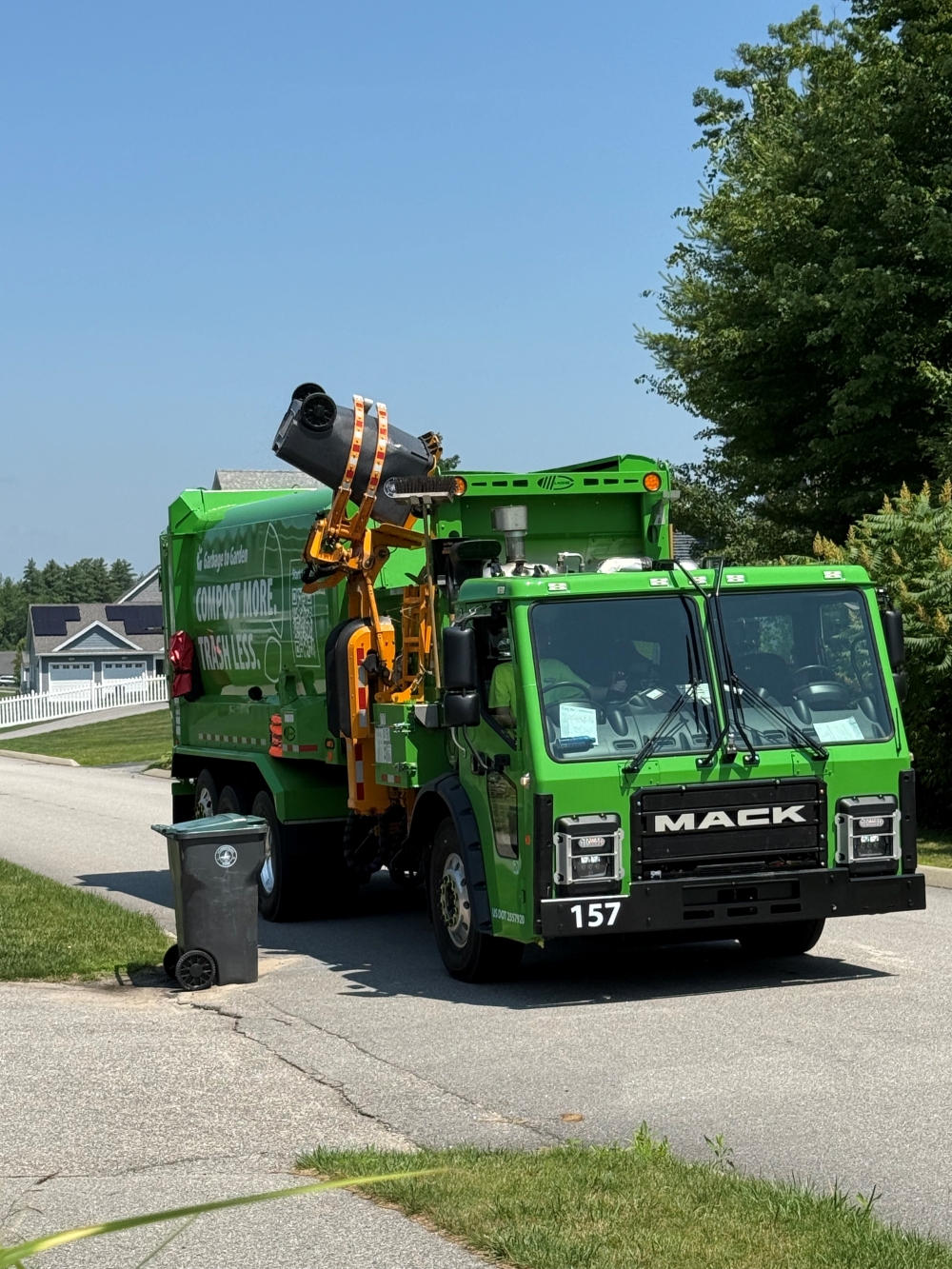
The company recently started collecting recycling and trash, as well as food waste in Scarborough, Maine. Organics and recycling are collected weekly in a split body truck.
Garbage to Garden recently started collecting municipal trash and recycling in Scarborough, Maine. Its new, automated trucks for trash and recycling collection have cameras to help identify contamination. Those same cameras will be able to identify non-compliant trash bags if PAYT is implemented in the future. Portland has had a 60% reduction in trash since PAYT was implemented in 1999, despite population growth. This is where Frank sees real opportunity to move the needle on participation: offering free curbside food waste (and recycling) collection when PAYT is implemented, perhaps with additional rewards for households that participate in food waste and recycling programs. The economics work even better when trash collection can be reduced to every other week, with food waste and recycling collected weekly.
In addition to more holistic municipal programs, Frank sees an opportunity to add community drop sites in Maine. GtG already traverses the state, servicing commercial establishments, including every Shaws supermarket. More drop sites would mean more access to composting for more Maine communities — in line with Garbage to Garden’s mission.