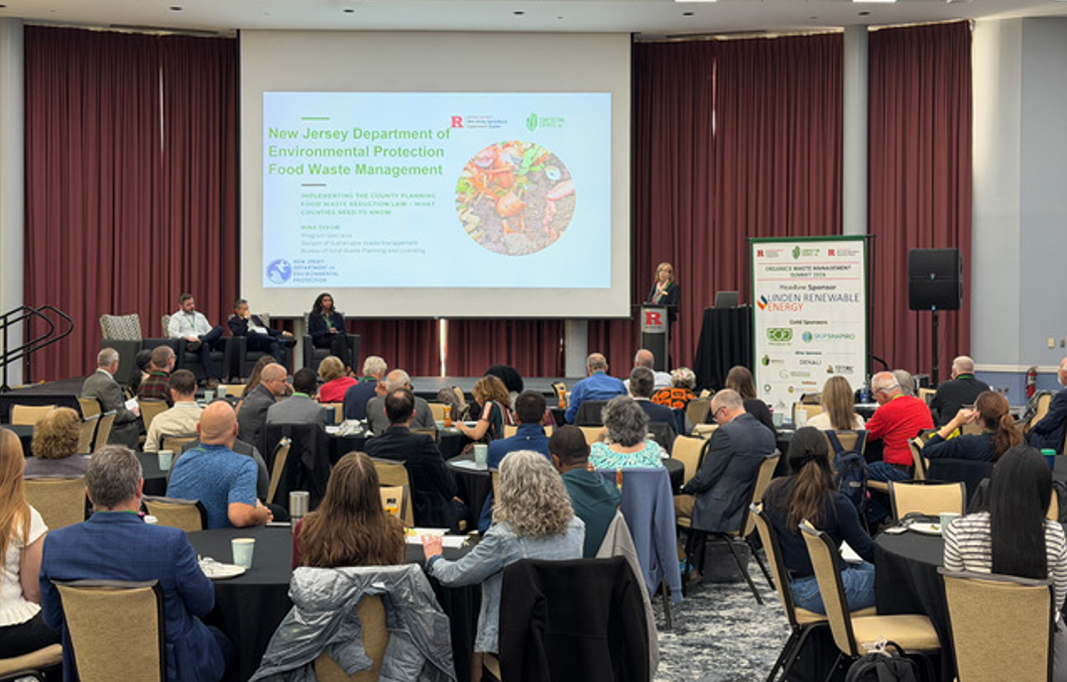
Top Photo: A full house at the NJ Composting Council’s 2026 Summit in New Brunswick, New Jersey. Photo courtesy of NJCC.
New Jersey’s counties have until the end of 2027 to submit plans for reducing food waste by 50% from 2022 levels by 2035. The requirement, established under S2464/A2090, has brought new urgency to conversations about organics recycling infrastructure. At the New Jersey Composting Council’s (NJCC) recent Organics Waste Management Summit, municipal representatives were particularly interested in how new collection and processing programs could be financed.
Developing processing capacity requires substantial upfront investment for composters, but access to feedstocks and the revenue needed to repay that investment are far from guaranteed.
Jay Fischer, who founded Ag Choice with his wife, Jill, has operated a composting facility in Andover, Sussex County, for 21 years. He cautioned attendees against building facilities without securing the business to support them.
“If you build it, they will come. Well, that theory works great if you’re doing a Kevin Costner movie,” Fischer said. “Other than that, it doesn’t work.”
Fischer has watched several large organics recycling facilities close within three to five years because they could not service their debt. Permitting and compliance costs add to the financial burden. According to Fischer, a new composting facility can face nearly $50,000 in permit fees during its first year and approximately $30,000 annually thereafter for compliance and monitoring.
Ag Choice expects to hold a Class C permit beginning January 1, 2027. Fischer welcomed NJDEP’s work on tiered permitting, a provision of A2090 that could help remove some regulatory barriers to developing in-state composting capacity.
“I can tell they’re listening,” he said.
Making Contracts Bankable
Ben Parry, CEO of Compost Crew, has spent years developing municipal food scrap collection programs. The company holds more than 20 municipal contracts and is financing a 20,000-tons/year composting facility in Utica, Maryland, using a combination of equity, private and state debt, and a USDA grant.
“Lenders and investors look for bankable contracts with creditworthy counterparties,” Parry told attendees.
The length and structure of municipal contracts matter because private investors need confidence that collection volumes and revenue will be sufficient to support new facilities.
“Private capital will build hauling and processing capacity if the demand is under contract,” Parry told BioCycle following the summit.
He recommends that municipalities establish contract terms long enough to support financing and pair collection agreements with requirements for multifamily and commercial generators. Those commitments can help operators forecast volumes and justify equipment and infrastructure investments.
Parry also encouraged towns to reconsider how they evaluate bids. A program that costs more per home but gets more households participating can divert more tons per dollar. Rather than selecting solely on price, he recommends scoring proposals alongside price, setting a term long enough to finance, rewarding household sign-ups and tons diverted, and planning a fair path if the town later brings the program in-house.
“Low bids invite cut corners and bidders who will not grow the program,” he warned. And “moving a program in-house after a few years leaves the investor out and discourages the next one.”
BioCycle Managing Director Paula Luu discussed how financing needs change as organics recycling programs develop. Early pilots can establish participation rates, contamination levels, collection costs and diversion potential. Those results can help municipalities justify larger investments, while predictable contracts and revenue become increasingly important when operators seek debt financing for facilities.
What Municipalities Bring to the Table
Equipment suppliers and operators also see opportunities to structure partnerships around public resources already available.
“The town brings underutilized land and excess leaves,” said Betsy La Force of Green Mountain Technologies. “The private partner or hauler brings the operational capital.”
La Force pointed to avoided disposal costs as another potential source of funding. “If your town diverts just 1,000 tons of organics a year, you are avoiding over $100,000 in direct disposal costs,” she said. “You don’t need to find ‘new’ budget dollars.”
Jairo Gonzalez, President of NJCC, emphasized that successful public-private partnerships (PPP) require defined commitments from both sides. “Successful PPPs require more than technology or funding,” Gonzalez told BioCycle.
Municipalities can provide land, supportive policies, long-term agreements and procurement opportunities for finished compost. Private partners bring operational expertise, equipment and investment. Reliable feedstock volumes, contamination standards and clearly assigned permitting responsibilities are essential to making those arrangements work.
Gonzalez sees NJCC playing an ongoing role in connecting municipalities with operators, investors and other stakeholders as counties develop their plans. Those conversations can help identify opportunities for regional infrastructure, potential funding sources and workable business models.
Where Counties Should Start
For local officials preparing their food waste reduction plans, NJCC Vice President Matt Wasserman recommends starting with the data.
“You can’t cut something by half if you don’t know how much you have,” Wasserman told BioCycle.
He recommends identifying the largest generators, including supermarkets, hospitals, schools, colleges and food processors. Some are already covered by New Jersey’s 2020 food waste recycling law, making enforcement of existing requirements an immediate opportunity.
Wasserman also cautioned against treating A2090 exclusively as a recycling mandate.
“The cheapest ton of food waste is the ton you don’t generate,” he said, encouraging counties to prioritize prevention and food donation alongside recycling.
His third recommendation is to map existing processing capacity and begin conversations with haulers and operators now. For some counties, regional partnerships may make more sense than developing infrastructure independently. Municipal drop-offs and school cafeteria pilots can also generate useful participation and collection data before larger commitments are made.
The next year will be an important planning period for New Jersey’s organics recycling industry. Counties have a statutory reduction target, while composters and haulers need predictable demand before investing in additional capacity. As the summit discussions made clear, the contracts and partnerships developed during this period will help determine how much new infrastructure gets built and whether it can remain financially viable.