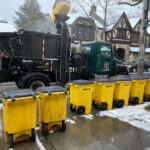

Top photo: Food scrap drop-off station in central Ohio. Courtesy of J. Boehm, L. Schroeder, K. Higginbotham and A. Booker
Ohio EPA has released its first Statewide Organic Materials Management Plan (OMMP), laying out 88 recommended strategies covering food scraps, composting, anaerobic digestion, biosolids, manure, food recovery, FOG (fats, oils, greases), yard waste and other organic materials and beneficial use byproducts.
The plan was adopted September 24 , 2026 and developed by Ohio EPA’s Division of Materials and Waste Management with SCS Engineers and other state agencies, and with guidance from U.S. EPA Region 5. (The project was funded with an EPA SWIFR (Solid Waste Infrastructure for Recycling) grant.) More than 800 stakeholders and organizations were invited into the planning process, which included four statewide sessions between May and August 2026. Ángel Arroyo-Rodríguez, Lead Environmental Specialist with Ohio EPA, served on the core project team.
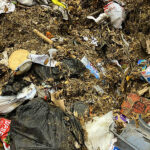
In 2025, Ohio conducted a waste characterization study, which is the basis for the OMMP. Compostable organic materials represented approximately 22.9% of the waste studied by weight, including food waste at 16.2%, compostable paper products at 6.5% and yard waste at 5.4%. Most of the food waste observed was unpackaged.
At the same time, the statewide data show how little food scrap material currently reaches permitted composting facilities. ReFED estimates more than 2 million tons per year of surplus food are generated in Ohio, while permitted composting facilities reported accepting 29,979 tons of food scraps in 2025. The plan cautions that those numbers are not directly comparable — the generation figure is modeled and the composting data exclude food rescue, animal feed, AD and other diversion pathways — but the difference illustrates the data and infrastructure questions Ohio is trying to address.
“While the need for more organics infrastructure wasn’t a surprise, we found a lot of opportunities to better connect existing systems and co-manage materials,” said Arroyo-Rodríguez. “We also identified important data gaps and saw strong interest from stakeholders in working together to build a more coordinated organics system.”
Stakeholders identified uneven access to food scrap collection and processing, limited local processing options, transportation costs, contamination, inconsistent acceptance criteria and uncertain end markets. Recommended responses include expanding appropriately scaled composting and digestion capacity, increasing collection and drop-off options, and strengthening compost and soil product markets.
The plan does not prescribe a single buildout model. Its infrastructure priority calls for a mix ranging from community-scale facilities to larger regional systems, reflecting differences in geography, feedstock and existing capacity in the state. Other strategies are more specific. Ohio proposes a GIS-enabled resource-shed planning system that would map generators, feedstocks, processing capacity, hauling routes and infrastructure gaps, along with a separate siting platform incorporating land use, environmental constraints, infrastructure and generator proximity.
Permitting and zoning also receive their own strategies. The plan calls for statewide zoning guidance and multi-agency permitting guidance covering composting, AD, transfer operations, community-scale systems and on-farm activities. Current projects may touch solid waste, water, air, agriculture, energy, public health and local zoning approvals, a fragmented process the plan says can create inconsistent expectations and development delays.
Food Scrap Strategies
For food scraps specifically, five strategies focus on statewide terminology, data and mapping, institutional organics diversion, source-separation education and performance standards for food waste depackaging. The implementation notes recommend establishing terminology first, followed by the data framework; institutional diversion and source-separation work can advance alongside that effort, with depackaging standards building on earlier work.
The plan also calls for public-private partnerships to expand collection, transfer and processing capacity, particularly in rural areas and smaller solid waste districts. Rather than create a new funding program, the strategy would help public and private entities identify regional needs and make better use of existing grants, loans and economic development programs for co-developed facilities, shared services and regional infrastructure.
For Arroyo-Rodríguez, the most important first steps are the foundational ones. “My choice would be foundational actions, such as developing a publicly available statewide organics resource-shed planning system and addressing data gaps needed for that system to function effectively,” he told BioCycle. “Providing better planning data and reducing barriers to siting new facilities will put Ohio in a much better position to grow our collection and processing capacity.”
He also pointed to zoning and permitting as an early priority, noting that stakeholders across organic material streams consistently identified those barriers alongside better statewide planning data as critical to infrastructure growth.
The OMMP does not assign implementation responsibility or establish new requirements. Its recommended sequencing starts with better resource-shed data and clearer zoning and permitting guidance, giving processors, local governments and solid waste districts a clearer picture of where feedstock exists, where capacity is missing and where investment may make sense.