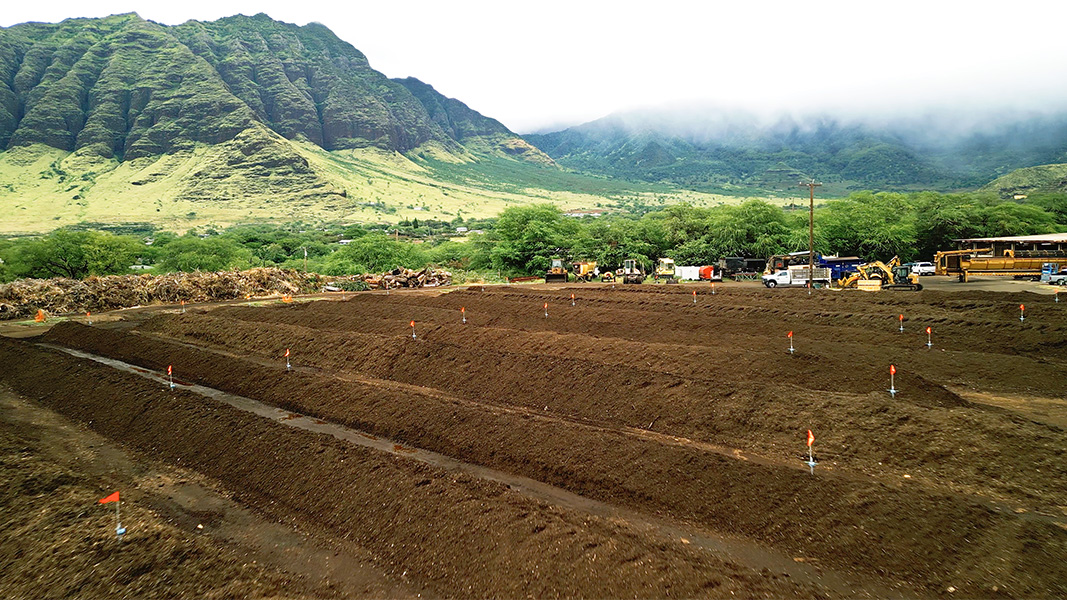
Top: Windrows at the Island Topsoil composting site in Waianae, Hawaii. Photo courtesy of Island Topsoil
The Hawai‘i Department of Agriculture and Biosecurity has opened its Compost Reimbursement Program for fiscal year 2027, offering $400,000 to help farmers and landscaping operations offset the cost of purchasing compost and getting it to their sites.
Eligible agricultural operations can receive reimbursement for up to 50% of qualified compost purchase and transportation costs, capped at $50,000 per purchaser. Applications opened November 2, 2026, and are due May 1, 2027. Funding will be distributed on a first-come, first-served basis while funds remain available.
The program applies to compost purchased between July 1, 2026, and May 1, 2027. Eligible participants include commercial farming and ranching operations as well as licensed landscaping contractors. Farming operations can include crop production, livestock, poultry, apiary operations and aquaculture, among other agricultural activities.
Transportation expenses are included in the reimbursement calculation, an important provision in a state where moving compost between processors and end users can add significantly to delivered cost. Applicants must submit invoices showing a separate compost-only cost breakdown, along with the required application forms, tax documentation and supporting information about their farming or landscaping operations.
Compost must be purchased from a permitted processor, dealer, retailer or wholesaler licensed to do business in Hawai‘i. Hawai‘i-based compost processors participating in the program must be regulated under the state Department of Health Solid Waste Management Program. Mulch is explicitly excluded. Eligible compost can be made from feedstocks including pre- and post-consumer food waste, green waste, crop residues, animal food processing wastes and vegetable processing wastes.
The current program grew out of legislation enacted in 2022 that established a permanent compost reimbursement program within the state agriculture department. Hawai‘i has continued funding the program in subsequent fiscal years, including $400,000 for the current FY2027 round.
The reimbursement structure is designed to strengthen demand for locally produced compost by lowering one of the barriers to agricultural use: delivered cost. For compost producers, the program creates an additional market incentive tied directly to end users rather than subsidizing processing infrastructure itself.
Applications and supporting documentation must be submitted to the Hawai‘i Department of Agriculture and Biosecurity’s Plant Industry Division by May 1, 2027. The state’s FY2027 fact sheet lists a noon HST deadline for required documents, while the agency’s online program page says mailed applications must be postmarked by May 1.