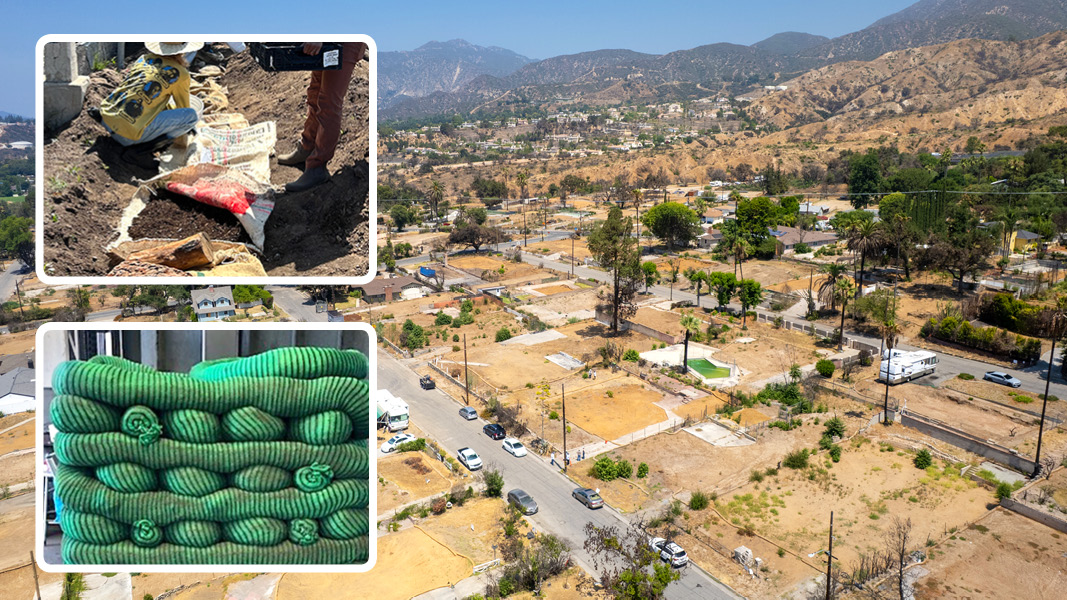
Top: Burlap coffee bags are filled with compost and biochar at the Altadena Community Garden (top inset). Photo by Lynn Fang, courtesy SoilWise. Palletized compost filter socks at San Pasqual Valley Soils (bottom inset). Photo courtesy San Pasqual Valley Soils. Residential area in post-fire Las Flores, California (background). Photo by Andrew Starns, courtesy Natalie Levy, UC Agriculture and Natural Resources Division.
Juliana Beecher
This BioCycle article series focuses on use of compost filter socks and other compost products in disaster recovery, starting with the Camp Fire in 2018 and subsequent research by Chico State, University of Nevada Reno, and CalRecycle (Part I). Part II examines use of compost-based products following the Los Angeles fires in 2025.
LA Fires Context
Fourteen wildfires burned in Los Angeles (LA fires) and adjacent counties from January 7th through 31st in early 2025. The most destructive fires were the Eaton Fire, which ravaged the neighborhood of Altadena in the east, and the Palisades Fire in the beachfront community of Pacific Palisades. Those two fires burned almost 40,000 acres and 16,000 structures.
On January 7th, California Governor Gavin Newsom requested Fire Management Assistance Grants (FMAG) from the federal government for the three largest fires. Approval for FMAGs allowed the Federal Emergency Management Agency (FEMA) to provide funds and support for fire response. In the following days, President Biden declared a major disaster for the wildfires in southern California and pledged that the federal government would cover 100% of costs associated with debris removal and emergency protections, as well as other costs, such as individual assistance for temporary housing and home repairs not covered by insurance.
Most California wildfire responses are led by the Governor’s Office of Emergency Services, which tasks other state and local agencies to carry out specific aspects of disaster response and cleanup. For example, the Department of Toxic Substances Control (and its contractors) usually carries out Phase 1, removing hazardous materials before CalRecycle (and its contractors) removes debris, cuts hazardous trees, and deploys erosion control measures in Phase 2.
In the case of the LA Fires, FEMA led the disaster response, tasking other federal agencies with emergency support functions, such as communications, public health, search and rescue, and “mass care,” housing and human services. The U.S. Environmental Protection Agency (EPA) led the “oil and hazardous material response,” removing hazardous materials and assessing and mitigating contamination — responsibilities essentially equivalent to Phase 1 of California’s response structure. The U.S. Army Corps of Engineers (ACE) was tasked with Phase 2 responsibilities, which included debris removal, along with removal of up to six inches of soil from burned properties.
During the fires, smoke and ash spread throughout the area, blown by the same Santa Ana winds that fueled the flames. Since then, Los Angeles (LA) has seen a rainy season and the return of dry conditions, which can yield dust and higher levels of particulate pollution.
Compost Filter Socks
Rainstorms partly helped extinguish the LA fires in late January. Compost filter socks (CFS) were deployed to retain and filter sediment, ash and contaminants in stormwater runoff. Filtrexx, the largest CFS manufacturer in the U.S., received orders for 1 million linear feet of CFS — mostly 5-inch diameter sock, but also some 8-inch diameter. (Five-inch was preferred because it’s lighter and easier to handle.) Compost used in the CFS had to meet Filtrexx’s 5.1 FilterMedia™ design specification. With the immediate threat of winter rains, CFS had to be procured and deployed quickly.
Filtrexx, which is owned by MKB Company, contracts with 17 different compost manufacturers across the U.S. to produce CFS. The company’s basic filter sock is branded as SiltSoxx, and filled with either a composted filter media or an “alternative” filter media (e.g. wood chips). Composted filter media is preferred when filtering for invisible contaminants such as heavy metals and PFAS, as in post-fire settings.
San Pasqual Valley Soils (SPVS) in San Diego County is Filtrexx’s only CFS manufacturing partner in southern California. Craig Kolodge, currently employed by SPVS, previously worked for Filtrexx for 10 years as a technical advisor and business development specialist west of the Mississippi before Filtrexx was acquired by MKB Company in 2022. SPVS became a Filtrexx CFS manufacturer in 2023, partly because Kolodge believes strongly in the technology and maintains a close working relationship with Filtrexx. For composted filter media, SPVS uses overs screened out of compost that meets STA testing requirements and has completed PFRP.
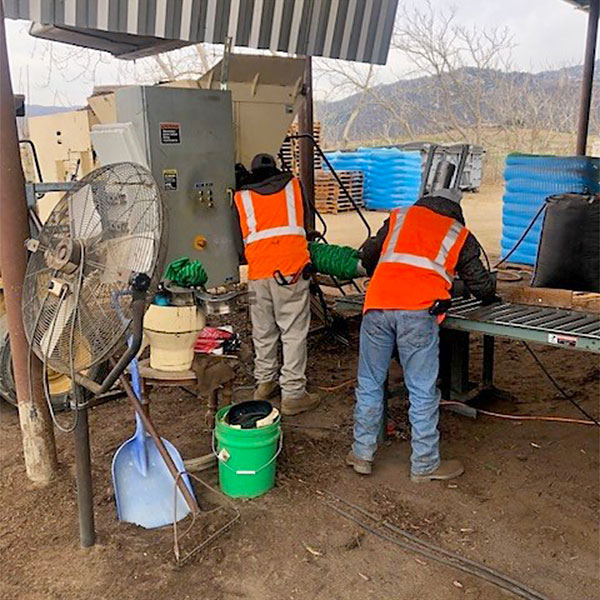
Filling compost socks at San Pasqual Valley Soils. Photo courtesy San Pasqual Valley Soils
To help fulfill the CFS order, the SPVS team worked six days a week, 10 hours a day “cranking out compost filter socks,” notes Kolodge. “We shipped a truckload of 26 pallets approximately every two days for a total of six to seven truckloads over roughly a three week period.” Each pallet contained 400 linear feet of CFS, meaning SPVS produced approximately 72,800 linear feet in total. Filtrexx sourced the rest of the CFS from contracted compost manufacturers in northern California, Arizona, Colorado, Minnesota, Pennsylvania and Wisconsin.
The Governor’s Office of Emergency Services tasked the California Conservation Corps (CCC) to carry out watershed protection. With 32 crews, and in collaboration with state and local agencies, CCC deployed CFS, straw wattles, and silt fences around burned sites, along roadways, and around storm drains to capture and filter sediment and contaminants in runoff.
Gwen Madrid, the National Director of Engineered Solutions for MKB Company, notes that MKB/Filtrexx has more than a decade of experience “efficiently providing product to emergency fire sites,” mostly in California but also elsewhere, including in Maui, Hawaii, following the Lahaina fire in 2023. Though compost is manufactured all over the U.S., California has a unique opportunity and need to grow the compost marketplace with SB 1383, the state law requiring the recycling of organics and the procurement of recycled organics (e.g. compost) by jurisdictions. Combined with an increase in the frequency and intensity of wildfires in California, the state is well positioned to be a hub for the manufacturing of CFS and other compost-based products used for erosion control, stormwater filtration, soil remediation, revegetation, etc.
Most of the CFS deployed in LA were removed over the summer. A few remain around private properties where the next phase of recovery has yet to begin. When CFS used to filter potentially contaminated stormwater are collected, they are generally treated as hazardous waste and must be disposed of accordingly.
Soil Contamination And Analysis
Other measures to prevent soil erosion and the spread of contaminants have been slower and piecemeal. ACE completed cleanup of residential sites near the end of August — a speedy timeline for nearly 10,000 properties whose owners registered for the federal cleanup program. Sites cleaned by ACE had six inches of soil scraped off in order to remove expected contaminants such as heavy metals, hydrocarbons, dioxins and furans, PFAS and more. Complaints about inconsistent and haphazard work filed by residents plagued the process, and have given way to worries about what remains in the Army Corps’ wake. Breaking with California’s standard protocol following wildfires, ACE did not test the soil on scraped sites for lingering contaminants, despite “confirmation sampling” following Phase 2 of previous wildfires showing six inches of soil removal is not always sufficient for decreasing contamination.

Natalie Levy taking soil samples during the Las Flores Drive pilot project following Phase 2 clean-up by the Army Corp of Engineers. Photo by Andrew Starns
Public agencies and research collaboratives stepped in to offer free soil testing services to residents. The LA County Department of Public Health is funding testing for lead in soils of properties affected by the Eaton Fire. A group of researchers out of the University of Southern California (USC) formed CLEAN — Contaminant Level Evaluation and Analysis for Neighborhoods — to monitor lead levels in LA County after the wildfires. CLEAN researchers analyze soil samples contributed by community members, and track sampling locations and lead levels on a map. Lead is common in soils across the U.S. and has historic origins in lead paint and leaded gasoline, meaning higher concentrations can be found in urban areas, near buildings and roads. As of late August 2025, CLEAN had tested about 3,000 soil samples from home sites that had soil scraped off. Its analysis (shared via a webinar) shows 50% of samples tested have lead levels at or below California’s safety screening levels for residential soils of 80 ppm, and 88% had levels at or below the EPA’s threshold of 200 ppm. Higher lead levels have been found in soils affected by the Eaton Fire than in soils affected by the Palisades Fire, perhaps because of the older housing stock (more likely to contain lead paint) in Altadena.
Community Action Project LA (CAP.LA) is a group of researchers from the University of California Los Angeles (UCLA), Loyola Marymount University, and Purdue University. CAP.LA’s testing program includes 17 metals, PFAS, PAHs (polycyclic aromatic hydrocarbons), VOCs, and SVOCs (semi-volatile organic compounds) in water (pool and tap), soil and air in areas within and adjacent to burn zones. As of late August, the group had tested nearly 500 out of the almost 3,500 residential sites enrolled for testing. CAP.LA samples three types of residential properties: sites with standing homes (i.e. that didn’t burn) within the burn zones, burned home sites before Phase 2, and burned home sites after Phase 2 of cleanup was completed. Its soil testing results (also shared via a webinar) from Altadena show that 55% of unscraped burned homes (i.e. no soil removed yet) and 48% of scraped burned homes (i.e. six inches of soil removed) have lead levels above the California screening threshold of 80 ppm.
Testing is the first step toward remediation, whether with compost-based products, other bioremediation techniques or conventional materials. Many studies have shown the application of compost and other organic amendments can reduce exposure to lead and other contaminants by diluting concentrations, decreasing bioavailability, and creating a barrier between the soil surface and contaminated soil below. Ash from wildfires is very alkaline and it takes a long time for the pH to naturally rebalance. Compost, which is more acidic, can help. “Mother Nature works too slow for most people, so we enhance Mother Nature’s process by using compost,” says Bill Camarillo, the CEO of Agromin, California’s largest compost manufacturer. Agromin has worked with clients all over California to remediate fire-impacted soils, restoring use as farmland, rangeland, or for landscaping.
Research And Remediation
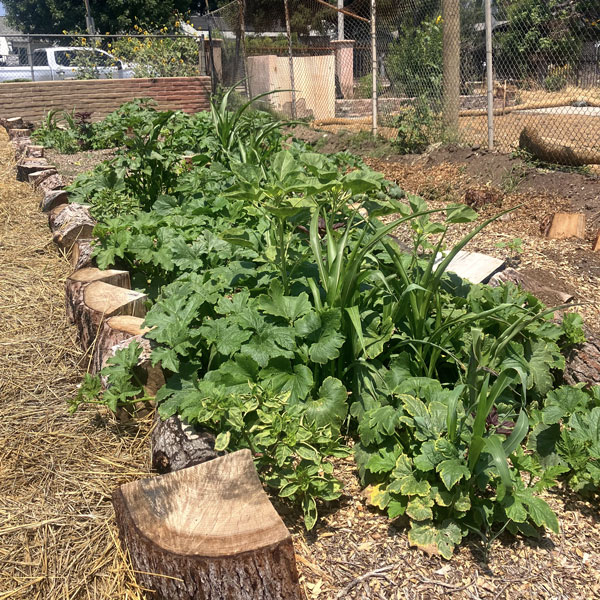
Phytoremediation at the Altadena Community Garden. Photo by Lynn Fang, courtesy of SoilWise
Even where contaminant levels are not a concern, soils have been burned, scraped, compacted and stripped of “biology.” Across LA County, soils need remediating. “Ideally that happens before rebuilding,” says Lynn Fang of SoilWise, an ecological landscaping, soil health analysis, and community education business. She has been working with residents and community groups to experiment with bioremediation options, including compost. “Compost is great for general soil health recovery, and for degrading hydrocarbons and supporting phytoremediation,” notes Fang.
She and her team have also been trialing treatments of compost-based blends inoculated with native soil fungi, and amendments such as zeolite and biochar. At the burned site of the Altadena Community Garden, they placed homemade filter socks filled with compost and biochar after the site was scraped, to protect from runoff from neighboring sites. They spread horse manure compost and are testing cultivated white rot fungi, native soil fungi, and plantings for phytoremediation to target different contaminants for degradation and sequestration. SoilWise is starting to collect some preliminary post-treatment data. “We have demonstrated PAH bioremediation with the native soil fungi cultivation,” reports Fang.
There has been a good amount of public interest in SoilWise’s bioremediation efforts and addressing the presence of contamination in general. Fang thinks more field research and case studies are needed to help develop best practices and build confidence in the effectiveness of compost application and other bioremediation strategies to restore fire-impacted soils.
Natalie Levy agrees with the need for more field research. She’s a soil health and organic materials management advisor for the University of California’s Agriculture and Natural Resources Division. Her goal is to tie the application of recycled organics to improving soil health, building upon the research and experience of practitioners like Craig Kolodge of SPVS, and David Crohn of UC Riverside, whose research on the use of compost blankets to reduce soil erosion and improve runoff water quality provides a foundation for Levy’s current project. She’s planning to pilot compost blankets to reduce soil erosion from wind and rainfall — a request brought to her by Master Gardeners in Altadena who lost their homes in the Eaton Fire. During Phase 2, ACE applied hydromulch to sites to keep down ash and dust. “It was just wood fiber mixed with a tackifier — it’s meant to degrade, to be temporary,” Levy explains.
Months later, that hydromulch has degraded, leaving soil exposed to erosion from wind (causing dust) and stormwater — and the rainy season is closing in. “We don’t know what the rain will look like, but it’s coming, and we need to cover the soil before then.” On September 17th, there was a flood watch issued for the first rainstorm of the season. Levy, who has a background in stormwater management, worried what could come without erosion control measures like compost blankets and compost filter socks in place. Compost blankets will also keep down dust, limiting exposure to contaminants via inhalation.
Levy is working with LA County Public Works to procure the compost, which could count toward the jurisdiction’s SB 1383 requirements. She is hoping Public Works will source composted mulch for the blankets from Agromin and make it available for free to residents. Composted mulches provide both the benefits of mulch (reduced soil erosion, weed suppression, cooler soil temperatures, better moisture conservation) and the benefits of compost (plant nutrients, greater water holding capacity, lower combustibility). Once procurement is figured out, the challenges will be last-mile transport and spreading the compost. “A couple inches spread across the bare soil of an average 9,000 square foot home site — that’s 55 cubic yards or more, which is a lot of material to move,” she exclaims! Currently, residents of the city of LA can access free green waste mulch (uncomposted) from the City of LA Sanitation District, which they have to pick up by the bucket load. However, Altadena is in LA County’s jurisdiction, not the City’s, meaning Altadena residents don’t have access to those resources.
Some residents in the pilot already have start dates for rebuilding, so Levy plans to test a 1-inch application depth and its ability to reduce runoff and protect the soil through the rainy season. “Two inches would give people more time with a protective top cover [blanket] before rebuild, but many folks might not need that,” she says, adding that the rebuilding phase is rapidly taking over, with construction start dates and permits issued and not enough time and attention given to remediation. In addition to the hydromulch, Levy wishes compost had been brought into the community and made available sooner after cleanup to help residents protect their soils from erosion and reduce heavy metal exposure risks. “A compost blanket would have kept the soil moist, stayed in place longer, and would have had the benefit of enhancing soil biology, too,” she notes.
Communication And Education
The Eaton and Palisades Fires were the second and third most destructive in California’s history, respectively, after the Camp Fire. “Paradise has recovered beautifully,” says Kolodge, “LA is trying to learn from them.”
Groups like the Department of Angels and Altagether have sprung up to organize and educate community members about the recovery process, including soil testing and remediation. The LA Fire Health Study and Community Oriented Network for Scientific Observation, Recovery and Tracking of Impact from Urban Megafires (CONSORTIUM) — which includes USC and CAP.LA — are tracking the environmental and public health effects of the fires.
Education about the potential of compost to aid in soil health recovery is slowly making its way into the public discourse. The LA Times has taken interest in bioremediation efforts, and even did some soil testing early on. But experts agree that more community education is needed. “There’s still a lack of awareness in the general public regarding compost use post-wildfires,” says Fang of SoilWise, which along with LA Compost, Prospering Backyards and the Institute for Local Self-Reliance (ILSR), developed a new toolkit on assessing and remediating soils and compost following wildfires. The Soil + Soul Healing Toolkit: Compost Issue describes the types and sources of contaminants, and suggests actions individuals can take to remediate their soils:
- Apply compost and mulch to cover bare soil.
- Use compost to create a barrier and sequester heavy metal.
- Grow plants for phytoremediation.
- Place compost filter socks.
The adoption of compost filter socks as a state standard in wildfire response in California may provide hope for the future of compost blankets. With ample organics to recycle, SB 1383 procurement requirements, and increasing frequency and intensity of fires, the post-wildfire market for compost is ripe for expansion.
Juliana Beecher, a Contributing Editor to BioCycle, is a former ORISE Research Fellow with the U.S. EPA’s Office of Resource Conservation and Recovery. She works as a consultant based in Portland, Maine, focusing on bringing the food waste perspective to broader food systems conversations and efforts to build a more resilient food supply chain. Juliana extends her thanks to Harry Allen, U.S. EPA Region 9; Bill Camarillo, Agromin; Lynn Fang, SoilWise; Craig Kolodge, San Pasqual Valley Soils; Natalie Levy, University of California’s Agriculture and Natural Resources Division; and Gwen Madrid, MKB Company.