
Top: Tomatoes (left), dahlia (right), Photos by Sally Brown
 Sally Brown
Nitrogen is typically the nutrient that most plants hunger for. Plant looks yellow. Forget what your phone app may suggest, just give it more nitrogen. In the vast majority of cases, that plant will green right up.
Nitrogen is the fertilizer that farmers use the most. It is also a nutrient that composts do not necessarily supply in bulk. I talked about how much plant available nitrogen your compost is likely to have a few columns back. For many composts, the short answer is not enough. While under certain conditions that may be a detriment, in others it can be a bonus. Here I want to go through a few examples of where providing insufficient nitrogen can be a secret weapon. And for contrast, where — in some cases —adding excess N can be your ace in the hole.
Nitrogen 101
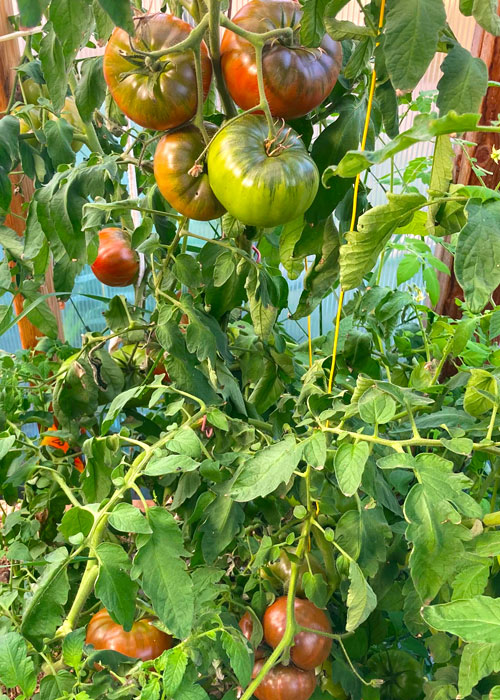
Planting tomatoes in soils rich in compost with a boost of supplemental N to start will often give you higher fruit yield.
Nitrogen (N) is the nutrient of eternal life. You give enough of it to a plant and that plant starts acting like it can grow forever, that the killing frost will never come. Starve a plant of sufficient nitrogen and visions of the afterlife come into focus. What better way to secure a wonderful life after death than through your offspring? In other words, if you are growing a plant for the fruit, think tomatoes, not having quite enough N can encourage the plant to enter the reproductive growth stage and put its energy into making fruit instead of leaves. Providing sufficient N to get plants going is a typical recommendation.
After they’ve established, recommendations often switch to adding other nutrients, primarily potassium in higher quantities than nitrogen. What that means for a compost producer is that planting tomatoes in soils rich in compost with a boost of supplemental N to start will often give you higher fruit yield — aka plenty of tomatoes for sauce, BLTs, and caprese salads. I can’t stand the thought of hungry plants, so my tomatoes are planted in a high N compost. I do get plenty of fruit but it is not always easy to find. If you can’t stand the thought of hungry tomatoes and have access to high N compost, I would strongly discourage planting zebra tomatoes. They look great and taste great but spotting green fruit can really be a challenge.
Another reason to use compost when planting tomatoes is a different kind of nutrient imbalance. Tomatoes are thirsty and in addition to just needing water, they need the calcium that is typically dissolved in it. Think of it as the soils’ version of Smart Water. If the water supply isn’t sufficient or consistent, the plants will not only wilt, the fruit will show signs of calcium deficiency. In a tomato plant, that deficiency is called blossom end rot and shows up as deformed fruit with brown at the bottom.
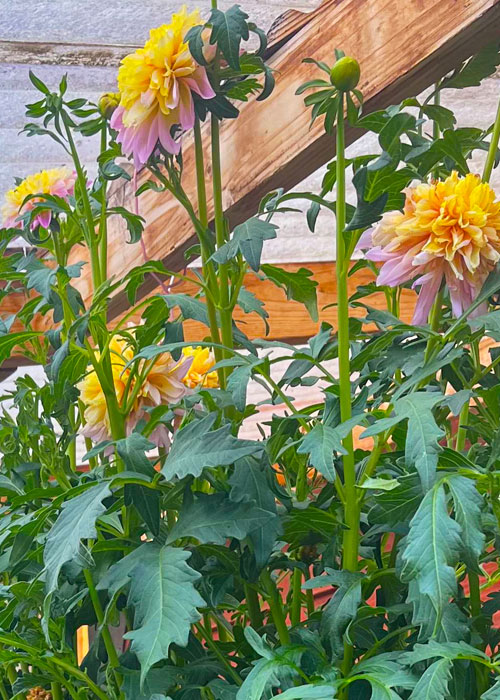
My dahlias are taller than I am with enough growth to fill the greenhouse.
One of the things that compost is best at is holding onto water. That means that a few forgotten waterings for tomatoes grown in compost-amended soils will not have the same deformed appearance as calcium-hungry tomatoes grown in regular soil. There is no extra nitrogen required here so any compost will do the trick.
Flowers have a different type of reproduction. If you want plenty of blossoms, it can also be a good idea to hold off on the nitrogen. Lovely dahlias are hungry dahlias. My dahlias are another example of my desire to feed to excess. The plants are taller than I am with enough growth to fill the greenhouse. Not only are the blooms few and far between they are too high for me to reach — excepting when the stalks that grew so big and fast have fallen over.
No More N For Native Plants
Restoration sites or native plant communities are additional examples of places where too much N or even enough N can be a bad thing. Native plants are typically adapted to soils where nutrients are lacking. If you add compost that is low in N to these soils, other soil properties will improve such as water holding capacity. Having enough water can give natives a leg up. Having too much N can give invasive species the upper hand. In many cases, adding a high carbon mulch or a low nutrient compost can help in an attempt to restore native vegetation to a site.
This can go two ways though. Often at disturbed sites invasives that can fix nitrogen will move in and take over. These are plants that associate with microbes that can basically create little nitrogen factories at the root interface. The plant gives them sugar and they give the plant nitrogen. We commonly know these plants as legumes, things like lentils and soybeans. In wildland soils there are also invasives that fix N. Where I live, early forests are filled with Alder, a tree that associates with a microbe called Frankea that can fix nitrogen. In a forest, an alder tree is just fine.
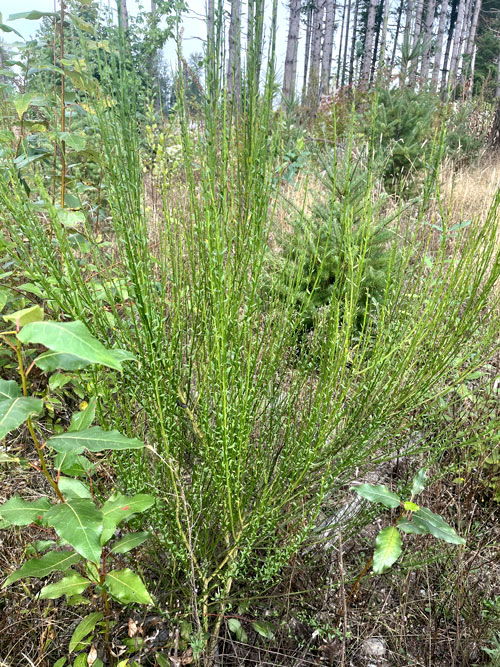
In some cases, nitrogen-fixing invasives are not a good thing. In disturbed sites in the northwest, Scotch broom (above) will often take over.
In other cases, nitrogen-fixing invasives are not a good thing. In disturbed sites in the northwest Scotch broom will often take over. This is a highly undesirable plant that has as its big advantage the ability to fix nitrogen. Adding excess N to these sites can allow other plants, very often grasses, to outcompete the Scotch broom. Grasses may not be the natives you were looking for but they are much preferred to Scotch broom.
The point of this column was to show that the absence of sufficient N to meet fertilizer needs is not necessarily a bad thing. It can even be a selling point. For compost, the fertilizer content is typically not the selling point. There are so many benefits to compost apart from its fertilizer content that any available nutrients could be considered icing on the cake. Or perhaps as a lovely bouquet of dahlias.
Sally Brown, BioCycle Senior Advisor, is a Research Professor at the University of Washington in the College of the Environment.