
Top: The denuded hillside at the Superfund site in Bunker Hill (ID), and the view after biosolids were applied and plant growth returned. Photos courtesy Sally Brown
 Sally Brown
My first ever article in BioCycle was back in 1997. It even made the cover. No snarky jokes or puns. I was dead serious with this one. Chuck Henry, who was with the University of Washington, and I wrote about using biosolids to restore the metal-contaminated, highly acid slopes of the hillsides in Bunker Hill, Idaho. At the time, Bunker Hill was near if not on the top of the U.S. Environmental Protection Agency’s Superfund list of contaminated sites. Decades of mining and smelting of metal ores, rich in lead, zinc and cadmium, had left that place looking like a moonscape. Multiple attempts over the years including fertilization, tree planting and terracing the slopes had minimal impact.

Click to enlarge
Working with Rufus Chaney from the U.S. Department of Agriculture and folks from the EPA Environmental Response Team, we got permission to try municipal biosolids in combination with wood ash from a biomass plant as a last-ditch effort. This was seen as a major pain in the ass by the site manager who already had plans to cap the site with imported topsoil. “The train has left the station,” was how she put it. It also was seen as a major public relations risk by Peter Machno, then head of the biosolids program in King County, Washington. He demanded a letter of invitation before he would load the trucks.
The Dream Team
But we pushed and the trucks rolled. We had the biosolids dream team on that project including Dan Thompson who went on to lead the Tagro program in Tacoma (WA), perhaps the most successful program in the country. We had operators from King County and Henry Campbell from Biogro — the predecessor to Synagro — who had potentially applied more biosolids than anyone else in the U.S. We had Clarice Robertson from Avista Utilities, source of the wood ash. She was able to get a front-end loader to the site with one quick phone call. John Tindal from the Idaho Department of Environmental Quality was with us to bless the project from his end.

Jim Ryan (left) and Rufus Cheney (right), who were at EPA and USDA respectively, visiting the Bunker Hill site.
Rufus had put me in contact with Chuck for this project. Chuck knew Rufus from his work on the EPA biosolids regulations. Chuck was from the Northwest where thinking on biosolids was advanced enough that they even had a Northwest Biosolids Management Association, the first regional association in the nation. With that dream team we were able to work miracles. The combination of biosolids and wood ash restored a plant cover to those barren hillsides. The train went back to the station and biosolids from Coeur d’Alene were used to restore the hillsides as the full-scale remedy for the site.
Persistent Remedies
The EPA officials at Bunker Hill came up with another challenge for us: a wetland that had been used as a mine tailings repository. The lead and zinc were so high in this stuff that they were measured in percent, not parts per million (12,000 mg kg Pb and 13,000 mg kg Zn, aka 1.2% and 1.3%). As a basis for comparison, the current acceptable level for soil Pb in California is 80 mg kg. Here we used biosolids compost mixed with wood ash and put it on top of the tailings. The EPA staff took bets on how quickly the compost would float away. I wish I had been in on those as I would have made a killing. The compost stuck and the plants came back. A greenhouse study showed that we had changed the form of the Pb to make it insoluble and not a threat to birds that use the wetland areas in their seasonal migrations.
EPA saw the success of this approach and we put together similar projects in Leadville, Colorado and Jasper County, Missouri. The soil and plant sampling that we did at Bunker Hill was replicated at Leadville and Jasper County, with additional measures including microbial fingerprinting, biomass yield and diversity, and wildlife trapping and analysis. You could tell by looking that the biosolids made the plants grow. The concern then was that the restored site would function as an “attractive nuisance,” causing harm to the animals that returned. We hadn’t taken away the metals (zinc, cadmium and lead) from these sites. We had just made them unavailable. The animal testing showed no evidence of harm from cadmium in the kidneys. Earthworms got fat in the treated soils and died in the controls. Subsequent samplings and testing have shown these to be persistent remedies. Worst case, if they need a little more biosolids, we are all still flushing.
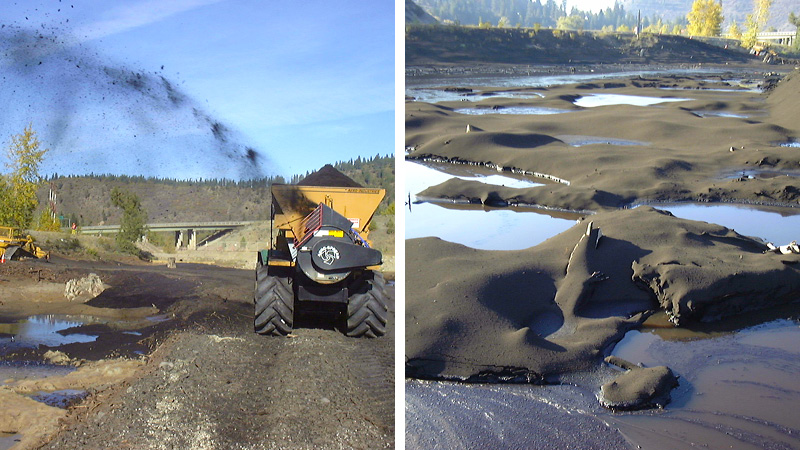
A biosolids compost mixed with wood ash was applied to a wetland (left) that had been used as a mine tailings repository. Bets were the compost would float away, but it remained in place on the tailings after the first application (right).
Why Reminisce?
There are several reasons that I am allowing myself to reminisce about these days gone by. The first one is a plug for science and research. Much of the initial concerns about biosolids were centered on the metals they contained. The research showed that the metals in biosolids were much less available than metals added to the soil via other means like car exhaust for lead. That binding capacity, demonstrated repeatedly in field trials across the country, formed the basis of the U.S. EPA Part 503 science-based risk assessment that is still in place today. In combination with pretreatment regulations, you ended up with a low metal, highly fertile amendment that was also able to bind metals. That binding capacity wouldn’t have been recognized without all of the research. The EPA Emergency Response Team would not have let us anywhere near that site without that research. And with that research, we restored multiple sites on the Superfund list and even wrote guidance for EPA.
Now with all of the hysteria about forever chemicals and microplastics, we will hopefully do the research and come to understand how these materials work in an organic matrix, be it compost or biosolids. If previous contaminants are any indication, the compounds in the biosolids will be less of a hazard than the ones in your French fry wrapping. As with metals, pretreatment can be a cost-effective way to bring concentrations to background levels.
The second reason is more personal. These sites were the scars showing just how effective we can be in destroying the earth. But they also showed that we can fix what we’ve broken. I am so proud of what we did at those sites. One of the reasons that I am such a proponent of biosolids is because of these sites — I have seen how they can literally bring something dead back to life. The fact that we can fix what we have broken and that we can do that so effectively by seeing the value in what so many still consider to be waste is why I do what I do, bad jokes included. We have a lot to fix but we also have the tools needed to do the work. I am talking about you — water reclamation plants and composting facilities. Use this as an inspiration to find your own sites to heal. No need for them to be on the Superfund list. Backyards, abandoned lots, overtired farmlands all qualify.

Another example of successful remediation was a swamp on the site — before biosolids application (top), and after, in the summer (bottom),
I went back through Bunker Hill this past spring with Chuck Henry. Not to fix another site, but to go fly fishing in Montana. That Bunker Hill site was fertile ground not just for the biosolids. That was where Chuck and I got started. We’ve needed a re-application or two over the years, but we are still doing OK. Looking at those hillsides and that wetland, seeing how they are just places now, green places with growing plants, literally made me cry tears of pride and joy.
Sally Brown, BioCycle Senior Advisor, is a Research Professor at the University of Washington in the College of the Environment.