
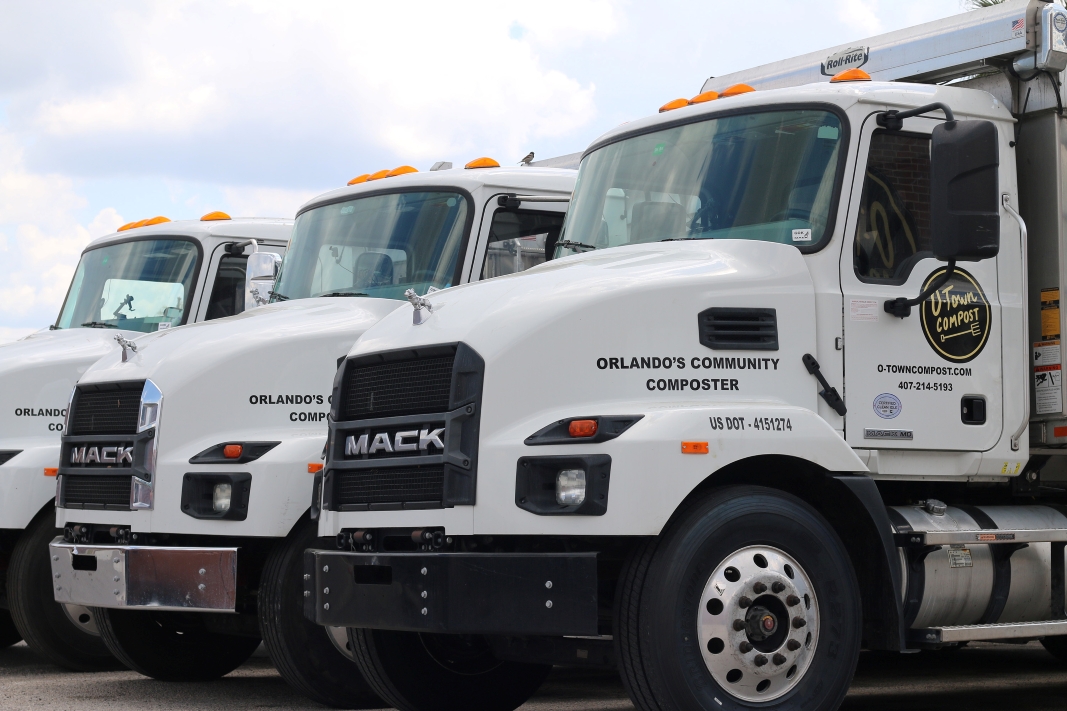
Top Photo: Courtesy of O-Town Compost
The City of Jacksonville, Florida is advancing a ‘State of the Food Plan” to address food insecurity and food deserts, increase urban farming, and reduce the 500 million pounds of food waste generated annually. Citizens are providing input and food waste collection and composting are being discussed. Local composting operators are emphasizing that the region may already have a foundation to begin scaling organics diversion if existing players are brought into the conversation early. O-Town Compost, which now services the greater Jacksonville area, is among the operators positioning to support that growth.
“There are already a couple compost sites local to Jacksonville, including Compost Jax that has thousands of tons of capacity for processing pre and postconsumer food waste, keeping it from the landfill,” says Charlie Pioli, Founder of O-Town Compost. “There are also 2 to 3 organics haulers in Jacksonville with plans for scaling, like O-Town Compost.”
For operators on the ground, the key question is not just how much food waste exists, but how the City chooses to phase in its diversion. Jacksonville’s food plan points to roughly 500 million pounds of food waste annually, but composters emphasize that capturing that volume will take time and coordination.
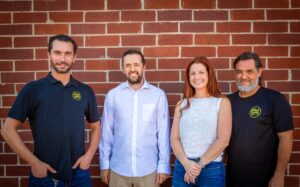
O-Town Compost’s team pictured: Erik Amnott (Fleet Manager), Charlie Pioli (CEO), Erin Schornagle, Orlando GM, and Stephen Howard (Warehouse Manager)
“I hope the City does its research and invites collectors and processors to the table in order to talk about the existing capacity,” Pioli adds. “All 500 million pounds aren’t going to be composted at once, and we can start by going after the low hanging fruit and work our way through the various generator sectors to maximum diversion.”
Local composters also see an opportunity to play a more integrated role in implementing the plan, particularly in managing inedible food streams and supporting soil health outcomes. Operators such as Apple Rabbit Compost, Compost Jax, and O-Town Compost are already active in the region and could help translate high-level goals into operational programs.
“There is a big opportunity for composters like Apple Rabbit Compost, Compost Jax, and us to play a role in implementing city-led food strategies based on what has worked in other municipalities and how we can complement each other with our strengths,” he says.
Pioli also points to workforce and operational differences between community-based composters and traditional solid waste systems.
“Community composters like ourselves tend to attract passionate employees and staff who are motivated to make an environmental impact, may not always have commercial driver licenses (CDLs), which aren’t necessary for operating our trucks, and are educated on what is compostable and not compostable,” he explains.
That enthusiasm may matter as cities consider how to operationalize food waste collection. “When a City’s Solid Waste Department figures they will start doing organics collection themselves because they’ve been told that food waste diversion is important to the City’s goals, they are often in for a rude awakening,” Pioli says. “Their drivers grumble about having to handle the food waste versus the trash, when composters actually relish the opportunity because they feel it’s making a difference.”
Looking ahead, Pioli emphasizes the role local policy and incentives will play in unlocking further growth. “As we scale, we’re looking for local governments in Florida to understand that composting is a public utility that increases the life of our landfills and is a better alternative to fertilizer that doesn’t cause harmful run-off polluting our waterways,” he says. “There are a million benefits to healthy biologically-active compost.”
He points to the City of Gainesville as a leading example in the state. “The City of Gainesville is leading the state with policy and public-private partnerships that focus on preventing food waste from going in the trash,” Pioli notes. “They use a combination of curbside Pay-As-You-Throw to incentivize waste diversion for households, and curbside composting. On the commercial/multi-family side, they have ordinances that mandate food waste collection, but haven’t started with education or enforcement yet.”
As those policies take hold, demand for diversion services is expected to increase. “We hope that once that starts, our phone will be ringing off the hook, and then it may require an infusion of capital to ramp up operations,” he says.
Ultimately, Pioli sees local governments as central to shaping the market. “Local governments have the toolbox with policy and incentives to increase the demand of compost and food waste diversion services,” he adds. “I hope they use them wisely, and work with the people, like O-Town Compost, that were founded specifically to do this type of work and are passionate about it.”
As Jacksonville moves forward, operators stress that success will depend on aligning policy goals with existing infrastructure and expertise already on the ground.