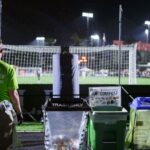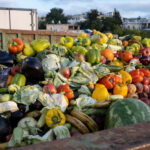

Top: Photos courtesy of LA Compost.
Los Angeles has spent the past several years asking residents to separate food scraps from the trash. Now the city is being pressed to answer the next question, which is where that material goes after it leaves the curb.
According to reporting by the Los Angeles Times, much of Los Angeles’ (LA) residential food scraps and green waste are currently traveling more than 100 miles for processing. LA City Councilmember Bob Blumenfield is advancing a motion intended to keep more of that material within city limits or closer to home. The goal is to cut greenhouse gas emissions tied to roughly 350,000 tons of organic waste a year while helping the city comply with California’s SB 1383 organics diversion requirements.
The motion, introduced by Blumenfield and seconded by Councilmembers Adrin Nazarian, Eunisses Hernandez and Katy Yaroslavsky, calls for LA Sanitation and Environment (LASAN) to prepare a Modern Organics Processing and Composting Master Plan. The plan would identify how Los Angeles can expand local composting capacity, support community composting, use public land for decentralized processing and prioritize local end uses for finished compost and mulch.
The problem is not that Los Angeles lacks organic materials. The problem is that the current system sends too much of the value out of the city. The motion states that LASAN produces approximately 350,000 tons of compost and mulch annually through green and food waste diversion programs, yet only a small percentage is used by the city. It also notes that ratepayers currently fund the distribution of finished compost to farms more than 100 miles away in the Central Valley, a practice the motion describes as environmentally and fiscally inefficient.
Ryan Jackson, Executive Director of LA Compost, framed the shift plainly. “LA seeks to keep 50% of organic material in LA for processing and application, meaning many more community compost sites and likely 2 City-run industrial composting facilities need to be created,” he said. “Curbside collections currently travel 100 miles north, with zero of the finished compost coming back home to LA. While this change will require further planning and a long-term implementation plan, the political will is now established, and we will make it happen!”
That 50% target mirrors Mayor Karen Bass’ Climate Action Plan, which calls for at least half of locally produced compost and mulch to be used within Los Angeles by 2030. The Council motion adds that only 25% to 30% of the city’s material is currently reapplied locally, leaving a large gap between the city’s climate goals and its organics infrastructure.
The most important part of the Los Angeles debate may be the shift from collection compliance to system design. SB 1383 pushed cities to collect organics. The next phase is forcing them to build the processing, procurement and land application systems that make diversion meaningful. A green bin program that moves material hundreds of miles away may technically divert waste from landfill, but it does little to show residents the soil health benefits of their participation.
The Los Angeles motion points to two recent state policy changes that could make a more distributed system easier to build. Senate Bill 279, passed in 2025, expanded California’s “excluded activity” tier, allowing public agencies to process up to 500 cubic yards of material without needing a full CalRecycle permit. Assembly Bill 2346 allows municipalities to meet 10% of their SB 1383 procurement obligations by sourcing from local community composters rather than relying entirely on large-scale external procurement.
Those changes matter because community composting has historically been constrained by permitting thresholds, land access and limited recognition in municipal procurement systems. The Los Angeles City Council’s motion directs LASAN to evaluate how the city can use these openings, including potential partnerships with adjacent public entities such as the Los Angeles Community College District to identify land within or near city limits for decentralized composting.
The motion also calls for recommendations to support the Mayor’s 2030 local use target by prioritizing finished compost for urban farms, community gardens and city parks, including projects that remove artificial grass and nonfunctional turf and replace them with natural landscapes. That detail is significant because it ties organics recycling to a visible local use, rather than treating compost as a product that disappears into distant agricultural markets.
Los Angeles is not alone in struggling with the second half of SB 1383 implementation. Across California, cities have expanded organics collection faster than they have built local processing capacity or reliable compost use pathways. The Los Angeles Times story gives that statewide issue a clear urban example, with banana peels and yard trimmings becoming symbols of a system that collects locally but processes regionally.
If LASAN’s master plan is adopted and implemented, Los Angeles could begin to move away from long-haul organics management and toward a more layered system that includes community composting, city-run industrial facilities and stronger local end markets. The work will take land, permitting, capital and operating discipline. It will also require the city to treat compost not as a compliance byproduct, but as infrastructure for soil health, climate resilience and neighborhood-scale circularity.