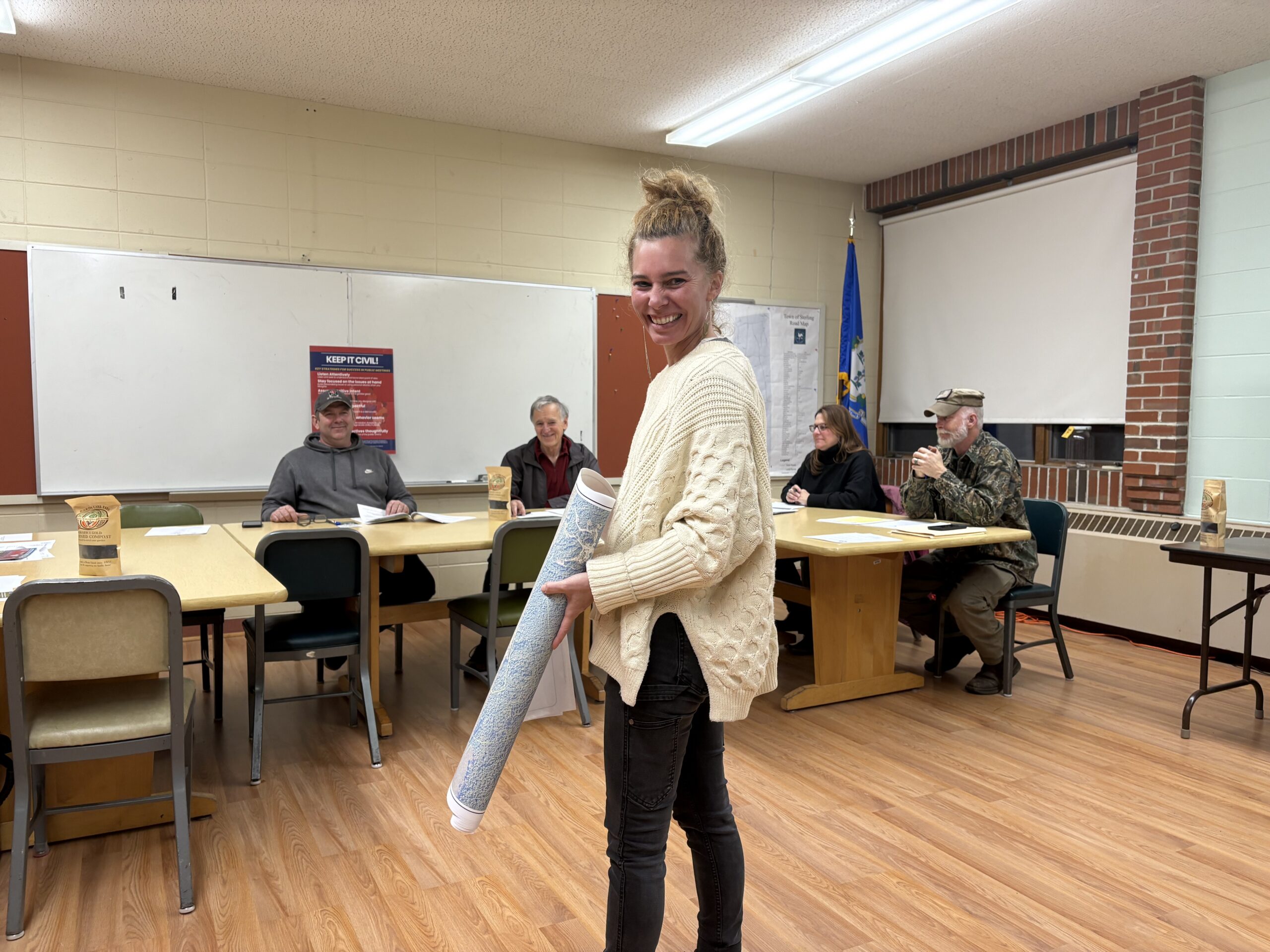
Top Photo: Jayne Merner, Owner of Earth Care Farm, presenting to the town of Sterling planning and zoning committee.
When Jayne Merner set out to expand Earth Care Farm, based in Charlestown, Rhode Island, she didn’t have a finance background. What she had was farm equity, years of QuickBooks records, and a willingness to figure out how to finance their second site in Sterling, Connecticut. The capital stack she assembled, spanning a mortgage, SBA loan, bridge loan, green bank financing, a grant, and a mission-aligned private lender, is less a success story than a field guide. And embedded in it are some clear signals about what the composting industry needs from regulators and lenders to make expansion possible at scale.
Building the Stack Layer by Layer
Merner started where most composters do, with what she already had. Equity in her existing Rhode Island farm became the collateral that helped her secure financing through Centerville Bank, enabling the land acquisition. She later layered in SBA financing as the project advanced. Merner supplemented those funds with a $250,000 grant and $500,000 from a mission-aligned private lender at flexible terms. Connecticut Green Bank, a quasi-public green finance institution, is also in the mix as Merner explores whether her project qualifies for green bond financing, a product the bank has historically reserved for solar.
Each layer of capital came with different expectations, different risk tolerances, and different timelines. “I’ve gotten a smattering of lots of different types of financing,” Merner said. “I’m figuring it all out.”
That smattering is, in fact, exactly how blended finance is supposed to work. Paula Luu, Managing Director of BioCycle, describes the capital landscape for composters in four broad categories: philanthropic grants, traditional debt, catalytic capital with flexible terms, and private equity. “Each category of capital provider is looking for different things,” Luu said. “Catalytic investors and philanthropic grant makers are really looking at the impact that the dollars will create. Lenders providing project finance are looking for predictable cash flows, and private equity investors typically take ownership positions in exchange for growth-oriented returns.” Knowing which category fits which stage of a business, and which story to tell to each type of provider, is itself a skill, and one the industry is still building.
Where the System Breaks Down
The most revealing part of Merner’s experience isn’t the capital she raised. It’s the bridge loan she never should have needed.
In Connecticut, the SBA required Merner to hold an active permit before approving her loan. The state, meanwhile, required her to own the land before issuing the permit. The result was a regulatory standoff with no clear path forward. “I was at a juxtaposition where I couldn’t get bank funding or permitting without owning the land and being permitted,” Merner said. “So I had to have a meeting and one of them had to give.”
Centerville Bank issued a bridge loan to carry her through the permitting window. It worked, but bridge loans are expensive precisely because they absorb risk that the system should not be generating in the first place. Merner has been carrying both the bridge loan and the mortgage for two years while permitting has progressed. “It’s been extremely difficult on my small family farm,” she said.
This is a structural problem, not an individual one. The permitting-financing sequencing conflict is not unique to Connecticut. Across the country, composters face regulatory timelines that don’t account for the financial cost of waiting, and lending requirements that assume a certainty that the permitting process hasn’t yet produced. State environmental agencies and SBA lenders are operating on parallel tracks that rarely intersect, and that gap lands hardest on small, independent operators who don’t have the reserves to absorb a two-year holding pattern.
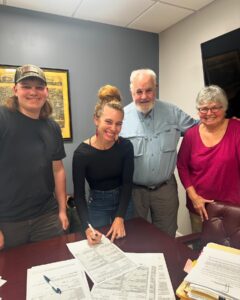
The Merner family at the land closing in April 2024.
What Lenders and Regulators Need to Understand
Luu is direct about where the education gap sits. “Lenders ultimately want to understand how the loan or injection of capital will change your business,” she said. That framing matters because composting doesn’t look like most businesses a lending bank has financed. Revenue is seasonal. Ramp-up periods are long, and Merner’s new site won’t turn a profit for three years. Permitting timelines are unpredictable. Jorge Montezuma, founder of Wanu and Compost Capital Network, puts the ask simply when he says, “We need smart money in our industry, educated money.”
One Centerville Bank representative, after touring Earth Care Farm’s Charlestown facility, told Merner he was tired of financing car washes and storage facilities. That reaction is encouraging, but individual enthusiasm at a single bank doesn’t change underwriting standards. What changes standards is systematic education, lenders understanding composting’s cash flow profile before they’re sitting across the table from an operator, and regulators understanding that permit requirements designed without the financing picture in mind create real and lasting harm to the small businesses they are meant to serve.
“There’s probably a composter that has gone through what you’re going through,” Luu said. “You’re not alone in this process.” That may be true, but right now too many composters are finding that out only after they’ve already absorbed the cost of navigating a system that wasn’t designed with their business model completely in mind. The better outcome is a lending community that understands what composting operations actually look like financially, a regulatory environment that accounts for the time and carrying costs built into permitting, and enough open conversation between composters who have been through this process that the next operator has a clearer road map than the one Merner had to draw for herself.
Paula Luu and Jorge Montezuma were guests on Season 4, Episode 11 of The Composter Podcast, hosted by Jayne Merner of Earth Care Farm.