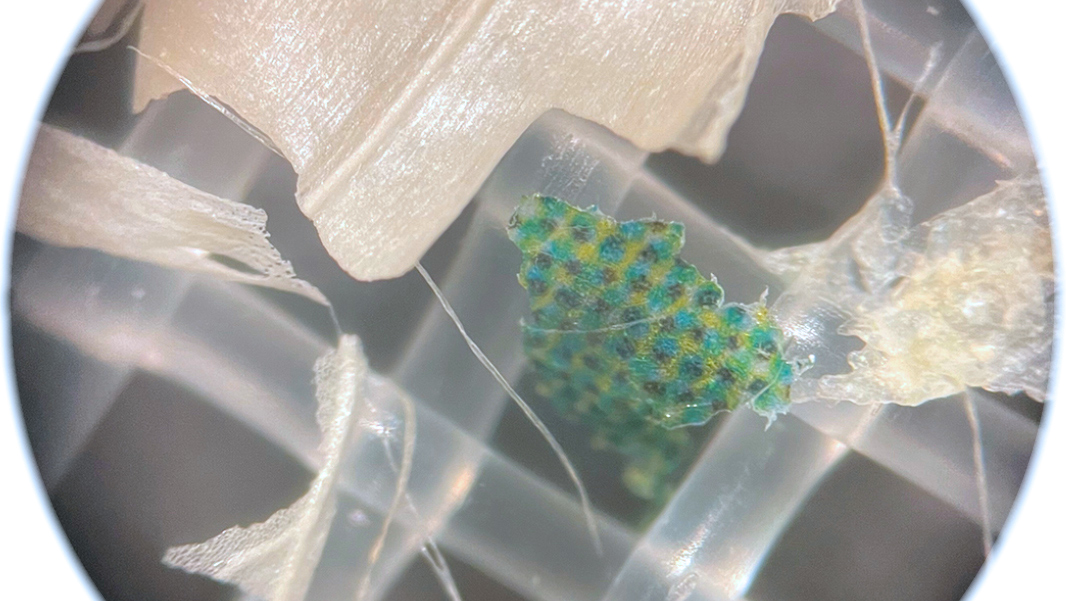
Top: Microplastics under microscope. Photo courtesy Kate Porterfield, University of Vermont
The Casella Center for Circular Economy and Sustainability at the University of Vermont posted a fact sheet in August 2025 — “Microplastics in Food Waste Recycling” — that provides a very helpful overview of the topic. “Plastic contamination from food packaging is a widespread challenge during the food waste recycling process,” states the fact sheet. “Despite efforts to separate plastics, microplastics (particles <5 millimeters (mm)) can remain in composts and digestates that are subsequently applied to agricultural soils. … Plastic contents in composts, digestates, and food waste vary widely, typically from 10s to 100,000s of particles per kilogram of dry material and from <0.001% to 0.1% or more by dry mass. Plastic contamination can include numerous polymer types, shapes (films, fragments, fibers), and particle sizes, making it difficult to detect and measure.”
The authors note that “no technology or processing strategy is inherently free from contamination risk and that there is no standard way to measure microplastics in food waste recycling materials, making it difficult to compare studies and establish regulatory limits.” They add that “more research is needed to understand how microplastics from food waste-based soil amendments impact soil health and contribute to overall plastic contamination.”
The fact sheet includes tips for reducing contamination, including these excerpts:
- Develop Standard Methods: “Some studies count plastic particles, while others measure their weight. Only weight-based measures are currently used in regulations, which limits the utility of count-based estimates. Furthermore, plastic particles can fragment into smaller particles over time, making plastic weight the more meaningful measure. It is important to establish consistent, practical ways to measure plastic contamination, especially by weight (% of total dry mass). Affordable screening methods for larger particles (>1 mm) and protocols for measuring smaller particles are needed to enable reliable tracking and regulation.”
- Consider Contamination Limits: “As evidence of microplastic contamination grows, policymakers should consider plastic contamination limits for agricultural soils and soil amendments. Given the fact that microplastic contamination thus far appears to be widespread with multiple sources, it would be best to ‘cast a wide net’ and first examine diverse soil amendment types, food waste recycling strategies, and potential pathways for plastic to enter agricultural soils. Monitoring programs will need to account for the practical challenges and time requirements associated with measurement.”
- Redesign Food Packaging: “Transition to biodegradable packaging materials that are tested and proven to decompose in soil environments without harming ecosystems. It is also important to evaluate the life cycle environmental impacts of alternative materials in comparison to conventional plastics.”