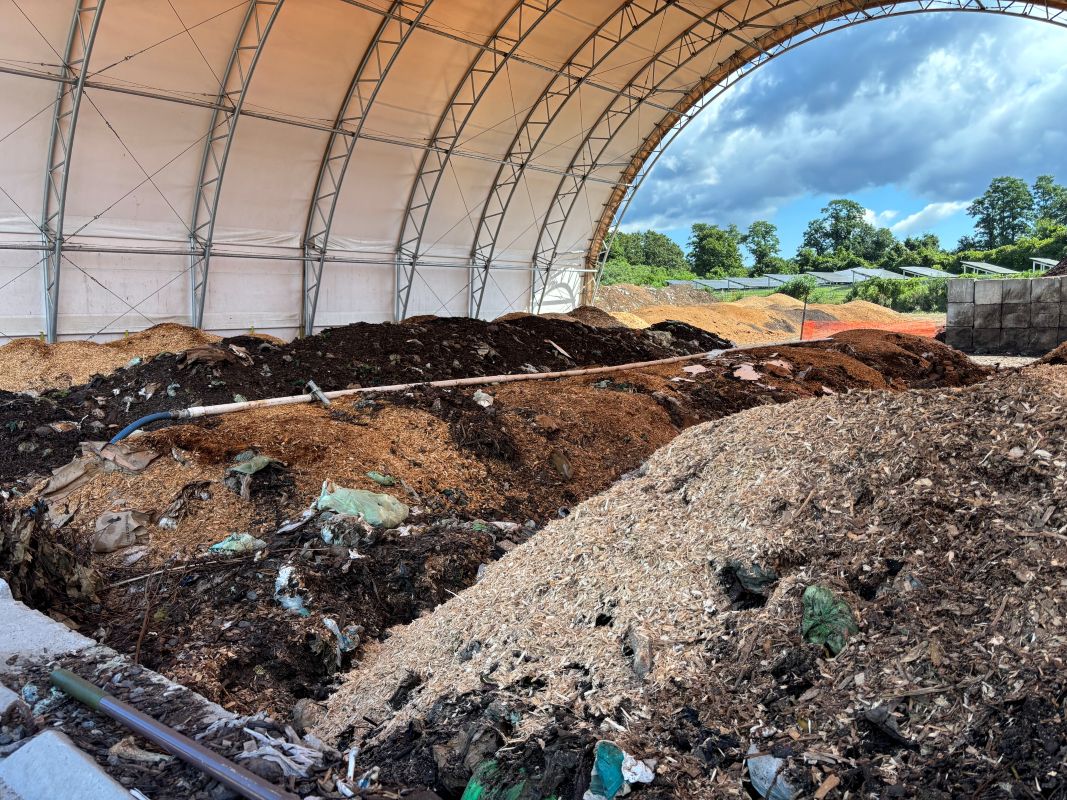
Top Photo: Incoming food waste streams are composted in four covered aerated static pile zones inside a fabric structure for four weeks, then moved into windrows for further composting and curing. Photos by Nora Goldstein and Robert Spencer
Nora Goldstein
The Windham Solid Waste Management District (WSWMD), located in Brattleboro, Vermont, has been composting food scraps, leaves and other residuals in turned windrows for many years. The District services 18 towns. The composting site is on a 3-acre parcel, and had been permitted by the Vermont Agency of Natural Resources (ANR) to receive 2,000 cubic yards (cy)/year of food waste, and 5,000 cy/year of all other organics. “The amount of food waste we were receiving was slowly increasing, and WSWMD wanted to upgrade the composting facility to handle more material on the same footprint,” explains Robert Spencer, WSWMD’s Executive Director. “To make that happen, we knew we had to switch to an aerated static pile (ASP) system for the active composting phase, versus our existing turned windrows.”
WSWMD applied for and received an ANR medium-scale composting permit to accept 5,000 cy/year of food waste and 40,000 cy of all other organics. A permit amendment enables the facility to take soiled paper and cardboard. Through a RFP process, Agrilab Technologies Inc. (AGT), a Vermont-based company that fabricates and installs compost aeration and heat recovery systems, was selected for the project. To facilitate operating during the cold weather months, the District also wanted to install a heat recovery system as part of the transition to ASP. It opted for the AGT Compost Hot Box 250-4R unit, which includes an aeration blower, temperature, air flow, back pressure and oxygen sensors, remote internet access, and programmable controls for four reversing aeration pipes serving four the zones. Start-up of the new ASP system began in early winter 2025, with a grand opening in March 2025.
Generators Serviced
The facility receives source separated curbside organics from around 3,000 residences in Brattleboro, and commercial and institutional food waste from restaurants, food manufacturers, colleges, schools, grocery stores, and several other generators (e.g., wool spinnery, cannabis growers, poultry breeder).
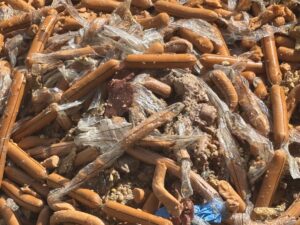
A recent load of incoming feedstocks included tofu pups.
BPI-certified bioplastics and fiber are accepted. WSWMD has a food waste drop-off site at its transfer station for households without curbside service, along with five other drop-off locations at transfer stations for residents and small businesses throughout the District. The composting facility’s permit is based on cubic yards of material, but the District has scales and weighs all materials coming into the site. “In 2025, we received 1,575 tons of food waste, with about 530 tons from the curbside program, 594 tons from commercial/institutional generators, 114 tons from the drop-off stations, 200 tons from a bread manufacturer, tofu plant and public events, and 110 tons from several other sources,” reports Spencer. “We have taken in about 3,000 cy of food waste to date in 2026, including about 1 ton/week of food scraps from the five transfer station drop-off sites and two schools.” There are over 20 schools in the District’s service area and Spencer anticipates serving more schools in the future.
Totes are used at the drop-off sites, versus dumpsters, to enable looking for contaminants. Last year, WSWMD procured a 12-cy trailer with a cart lifter to service the drop-off locations itself. “This has increased efficiency,” adds Spencer. “The District charges per container based on the distance. Doing this for our member towns is one-third to one-half less expensive than using a contracted hauler, and the organics are being processed at our facility rather than hauled out of the county.”
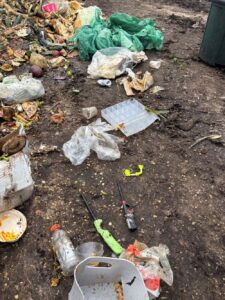
Incoming loads are examined for contamination. The quantity is estimated by sorting a portion into 5-gal. buckets. Click to view full-size image.
Commercial and institutional loads are brought in by area haulers. Food manufacturing residuals include a sludge from Lactalis, a yogurt and dairy manufacturer in Brattleboro. A holding tank at the Department of Public Work’s wastewater treatment plant receives yogurt waste, which is dewatered on a drying bed. A tanker truck delivers the sludge-like material to the District’s composting facility, where it is emptied onto a bed of carbon amendment, mixed with a loader bucket, and incorporated into a windrow. In some instances, this material goes to the ASP system. “The town pays a tipping fee, plus a $75 handling charge,” says Spencer.
The District’s medium-scale composting permit requires the facility to do incoming load inspections periodically. Four levels of contamination have been established:
- Low: 1-4 5-gallon buckets
- Medium: 5-10 5-gallon buckets
- High: >10 5-gallon buckets
- Load rejected
A $75 special handling fee may be charged on loads that are accepted but fall into the medium and high levels of contamination. To estimate the percentage of contamination in a load, District staff physically remove contaminants to document the number of 5-gallon buckets, but do not sort the entire load.
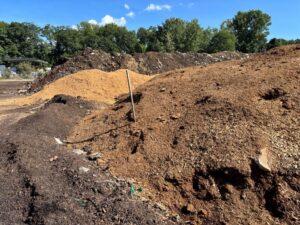
Chicken mortalities are composted in a separate windrow for a month. A high level of liquid in the mortalities requires a large percentage of carbon in the starting mix. Click to view full-size image.
WSWMD also has incorporated chicken mortality composting into its operations. Hubbard, LLC, which has a broiler breeding farm near the composting facility, brings its bedding and chickens culled from its stock based on bird quality. The farm had been hauling the mortalities to a renderer in Massachusetts at considerable expense.
The Vermont Agency of Agriculture, Food and Markets regulates livestock mortality composting. Its procedures for cows have been modified to cover chickens. The process involves building a 2-foot base of wood chips, laying the mortalities and chicken parts on top of that base, and then covering it with a layer of bedding or wood chips, followed by a layer of wood chips or compost. An additional lift of chickens is then added and then the pile sits for one month, after which it is further composted in the windrows using a 1:1 bucket mix with four week-old compost removed from the ASP building. Spencer notes there is a lot of liquid in chicken mortalities which is why a large percentage of carbon is required.
New Composting System
A new tipping area with a bunker and a gravel pad was constructed adjacent to the fabric-building that houses the ASPs. Incoming food waste loads are tipped, and immediately covered with amendments, including compost screen tailings. It stays in the tipping area for about a week, before being moved into an available bay. That material has already started composting, with temperatures in the 110°-120°F range. Since waxed cardboard and soiled paper are included with the loads of food waste, wood chips and leaves are mixed in at approximately 1:1 ratio. WSWMD has to purchase wood chips as there isn’t an adequate supply of leaves and yard trimmings.
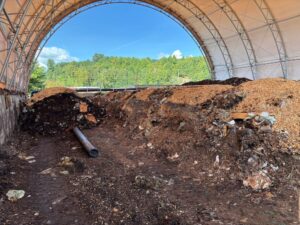
The aeration pad is made from engineered compacted gravel. Each pile contains 150-200 cy of material. Click to view full-size image.
The 5,000 square-foot open-ended building has space for four aerated zones. The pad is made from an engineered compacted gravel. The District evaluated installing a concrete pad with aeration trenches, but it would have been an added $100,000 expense, which wasn’t covered by the budget.
The HDPE compost aeration pipes come through a push wall at the back of the fabric structure. The pipes are coupled to the pipe stubs on the AGT Compost Hot Box, which is housed in an insulated 20-foot shipping container located behind the push wall. Aeration holes are drilled into the 8-inch diameter pipes at the 5 o’clock and 7 o’clock positions. It takes about three hours to remove the four-week old material and the 55-foot long aeration pipe and then load material from the tipping area and build a new pile. Each of the four zone piles contains 150 to 200 cy of material. A 6-inch capping layer of compost screen tailings or wood chips is placed on top of the piles to cover compostable bags and cardboard on the surface in order to minimize blowing litter and facilitate composting of the material.
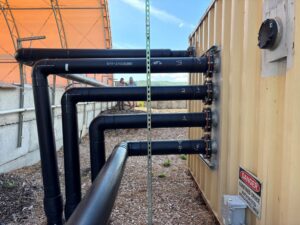
Aeration pipes are coupled to the pipe stubs on the AGT Compost Hot Box. Click to view full-size image.
The AGT system management software controls air flow by opening and closing valves that feed the aeration pipes. Each aeration zone has two valves, which can exhaust warm air from one pile into another pile, pull in fresh air, or direct air to the biofilter outside of the building. The biofilter is constructed with hardwood bark from an adjacent sawmill.
“Oxygen concentration and temperature in the exhaust is measured, and the levels influence the on/off times for positive and negative aeration,” says Spencer. “During the warmer months, we use ambient air in a new pile to get the oxygen level up to 10%-15%. The starting level is typically 2%-3%. Only one zone can get ambient air at a time. But over the course of the year, the balance may shift to less ambient air as the outside temperature gets cooler.” He adds that because of the diversity of food waste feedstocks received each week, each batch is significantly different so the airflow is continuously adjusted during the beginning phases.
Condensate from the ASP piles and leachate from active composting drains into a sump pump next to the Hot Box. These liquids are pumped back onto the piles for moisture addition.
The active composting phase in ASP is about four weeks. Material is then moved to a windrow for curing, which averages 6-10 months depending on the season and demand for finished compost. The windrows are turned as needed. Finished compost is screened in a trommel, typically to a half-inch size. The District has a three-eighth-inch drum that it uses to make potting mixes. Results from its most recent compost testing are shared on the District’s website.
Screened compost is sold to five lawn and garden centers in New Hampshire and Vermont for about $30/cy wholesale. The centers typically mark it up to $50-$60/cy. WSWMD also sells directly to contractors that take more than 10 cy/load.
Capital costs for the new infrastructure were about $800,000, broken down as follows:
- Engineering/Legal/Permitting: $175,000
- Site work and Construction: $196,000
- Fabric Building: $177,000
- Compost Aeration and Heat Recovery System: $196,000 (included installation)
WSWMD invested $307,233 in the project. Other sources of funding, which totaled $743,175, included:
- U.S. Department of Agriculture Community Facilities Grant: $150,000
- Vermont Department of Environmental Conservation Infrastructure Grants: $276,942
- Brattleboro Development Credit Corp.: $9,000
Storm Water Management Requirements
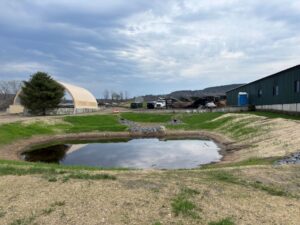
Storm water retention basin downgrade from the composting facility. Click to view full-size image.
As part of expanding the facility’s throughput capacity, the District had to get a new storm water permit and regrade the entire site. The new storm water management system includes a vegetated treatment area (VTA) downslope of the active composting pad. “All water from the pad, curing and screening areas flows to the VTA and then to the transfer station storm water system, and ultimately to the Connecticut River,” explains Spencer. “Per state regulations, storm water from areas upgradient of the compost pad is diverted around the compost pad to keep it from coming in contact with the compost area. It then flows to a storm water retention basin.”
Having the active composting area under cover reduces the amount of contact water that has to be managed. The facility is required to utilize compost/wood chip berms at the end of each windrow.
This past June, WSWMD, AGT and Sandborn Head & Associates (the District’s consulting engineer) received an Environmental Merit Award from the American Council of Engineering Companies of Vermont (ACEC-VT) for its innovative compost aeration installation. The successful integration of the ASP system into the existing composting site was a component of the recognition.
Food Waste Flow
Under Vermont law, food waste generated by all sectors, including residential, must be diverted from disposal. “The ban, which went fully into effect in July 2020, has definitely been the major driver in the flow of food waste into our site,” notes Spencer. “It’s also been good for the hauling industry, which benefits from new collection customers, cart and dumpster rentals, and the various fees for services.”
Another driver for the District, which preceded the state’s food waste disposal ban, was early adoption of residential curbside food scraps collection in the town of Brattleboro. “The municipality started with a pilot in 2013, which generated a couple hundred tons/year,” says Spencer. “In 2015, per Vermont mandates, it adopted a pay-as-you-throw rate fee, where food scraps and recyclables collection were free, but trash collection cost households $3/bag. The next big bump was when the town went to every-other-week trash collection in 2018, which incentivized households to put their food scraps out for weekly collection, especially during warm weather months.”
He notes that there are still a lot of organics “out there” to be diverted, but all in all, the ban has been effective and the facility is close to its design capacity for accepted organics. “We can handle surges of more material,” says Spencer. “We don’t really know our upper limit as we could reduce the amount of time a pile stays in the ASP mode once PFRP requirements have been met. That could be in as little as three days. But the reality is the site is limited in its space for the second phase of composting and curing in windrows. We designed our current operations to get more of the material broken down in the ASPs before it goes into windrows.”