
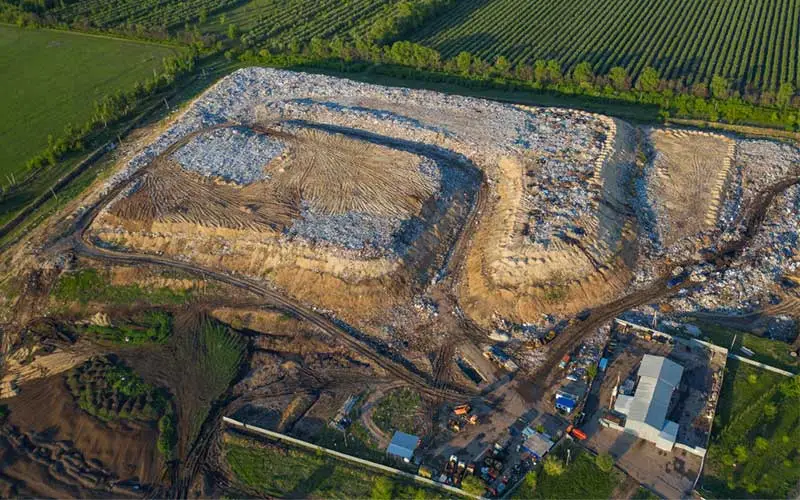
Top Photo: Courtesy of Conservation Law Foundation
The Northeast is running out of room for its own waste, and a new analysis from the Northeast Waste Management Officials’ Association puts firm numbers behind a trend that solid waste managers across the region have sensed for years.
A new report from the Northeast Waste Management Officials’ Association (NEWMOA) puts hard data to what solid waste managers across the region have been sensing for years.
NEWMOA’s new report from the Northeast Waste Management Officials’ Association (NEWMOA) on 2024 disposal capacity covers its eight member states of Connecticut, Maine, Massachusetts, New Hampshire, New Jersey, New York, Rhode Island, and Vermont, which together disposed of just under 33.56 million tons of solid waste during the year. Roughly 67% of that material was municipal solid waste, and the remaining 33 % was made up of construction and demolition debris, waste-to-energy ash, and other bulky wastes.
The squeeze on permitted capacity is already visible in the landfill numbers themselves. There are 92 landfills handling about 68% of the solid waste disposed of in the region, and landfills receiving roughly 23% of all disposed material are on track to reach their currently permitted capacity within the next five years. If no additional capacity is permitted, more than 7.6 million tons of waste now sent to those facilities will need to be reduced, recycled, or rerouted to new disposal locations before 2030. NEWMOA frames the available responses in three basic terms, since a state can develop more capacity, export the waste, or reduce the demand for disposal, and many state officials regard lowering demand through diversion as the most efficient of those paths.
New York carries the largest share of the looming loss by a wide margin. Closures anticipated there amount to 34% of the state’s own in-state capacity and account for 66% of all potentially lost capacity across the eight states. The largest landfill in New York, which received about 1.5 million tons in 2024, saw its permit expire in 2025 and has submitted an application for a valley infill expansion now under state review, an approval that could extend its operations to roughly 2040. Maine faces a more concentrated risk, because the Juniper Ridge Landfill handled close to half of all in-state disposal and is due to reach its permitted limit in 2028, placing an anticipated 53 % of Maine’s current disposal in question. Even if the New York expansion and a comparable expansion at Juniper Ridge both move forward, the regional shortfall would still leave about 5.2 million tons in need of a new destination before the decade closes.
Export has increasingly become the region’s pressure valve. About 12 million tons of waste, equal to 26% of all disposal-bound material, left the region in 2024 by truck or rail. Ohio accepted 4.2 million tons, Pennsylvania and Virginia took in close to 3 million tons each, and Alabama, South Carolina, Indiana, Michigan, and New Brunswick absorbed additional volumes, with another 1.2 million tons going to out-of-region locations that were not reported. Pennsylvania, Virginia, and Ohio stand as the dominant destinations for exported municipal solid waste, while Ohio is the single largest endpoint for construction and demolition debris. Out-of-region municipal solid waste exports have held fairly steady over the past decade, although an upward movement appears to have taken hold after the pandemic, with New York and Massachusetts posting the sharpest increases between 2022 and 2024 at 15 and 17%.
Waste-to-energy provides a measure of relief that purely landfill-dependent systems do not have. The region’s 27 active waste-to-energy facilities handled about 32% of total disposal volume in 2024, ranging from 10% of in-state disposal in New Hampshire to 72% in Connecticut. That fleet has thinned over time, falling from 31 facilities in 2018 to 27 in 2024, and NEWMOA cautions that there is no guarantee the remaining incinerators will continue operating. The ash stream carries its own downstream burden, since the 2.37 million tons of waste-to-energy ash that required landfill disposal in 2024 represented about 10% of all landfilled material, and 17% of that ash went to sites expected to reach capacity within five years.
Several of the underlying numbers have moved only modestly over the six-year window. Compared with the 2018 baseline in NEWMOA’s prior report, total solid waste disposed of in the region fell 5%, while the municipal solid waste share, the 12% of disposal imported from out of state, and the 23% of capacity anticipated to close within five years all held essentially flat. The structural mismatch between what the region generates and what it can permit to dispose of has therefore persisted across the entire period rather than easing.
The report reinforces a familiar reality that much of the region’s disposal-bound material could be diverted, making reduction and recycling critical as disposal capacity declines. As permitted landfill space contracts and more tonnage leaves the region at rising cost, the case for building out diversion infrastructure becomes harder to set aside, and the NEWMOA figures give that case a clearer empirical footing.