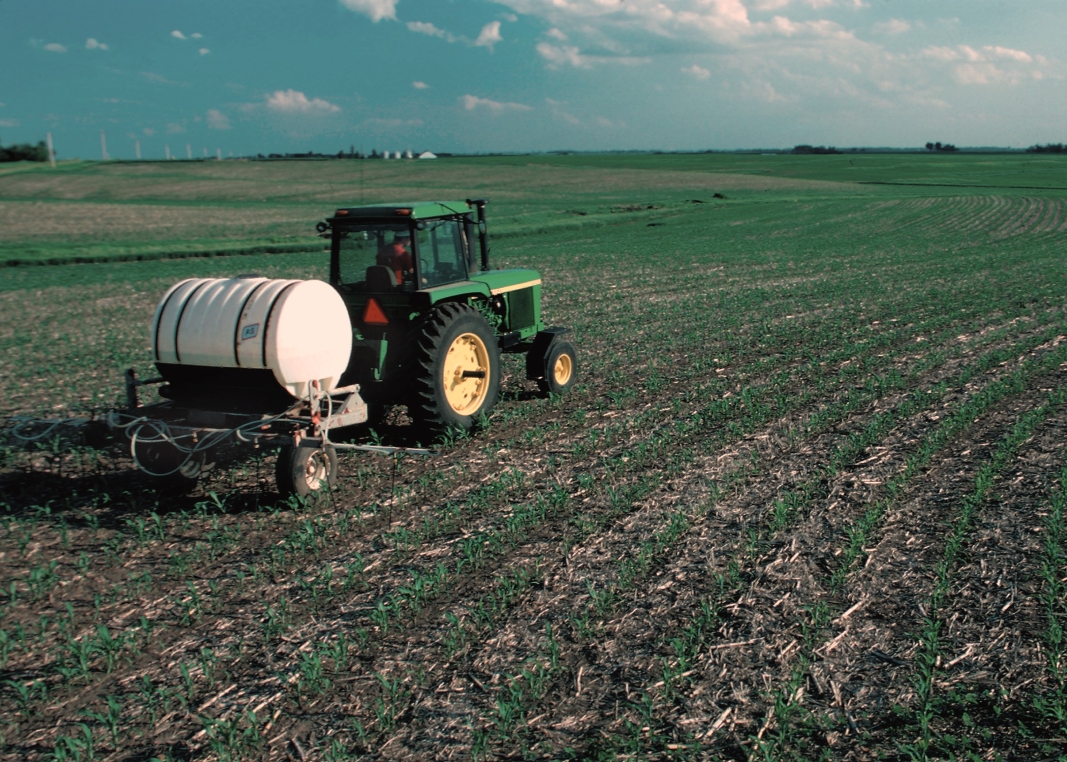
Top Photo: Photo from Natural Resources Conservation Service / US Department of Agriculture.
Update: An earlier version of this article implied that composting and anaerobic digestion projects were broadly eligible for funding through the USDA FIELDS Program. The program is limited to projects that manufacture commercially available fertilizer products and materially expand domestic fertilizer production. A coalition of compost producers, recovered-nutrient manufacturers, farmers, and organics recycling advocates is now urging USDA to explicitly recognize qualifying biologically derived and recovered-nutrient fertilizers under the program.
A coalition representing compost producers, recovered-nutrient manufacturers, regenerative farmers, organics processors, and rural businesses is urging the U.S. Department of Agriculture to clarify that qualifying fertilizers made from recovered organic materials are eligible for its new $500 million fertilizer manufacturing program.
In a July 30 letter to Agriculture Secretary Brooke Rollins, the coalition asked USDA to create a designation for “Critical Reclaimed Nutrient Resources” under the Fertilizer Investment & Expansion for Long-term Domestic Supply Program, known as FIELDS.
The proposed designation would cover qualifying fertilizer and fertility products derived from composting, anaerobic digestion, manure processing, agricultural residues, food scraps, green materials, and other organic residual streams. These products would still need to meet USDA requirements related to commercial readiness, nutrient content, manufacturing, testing, labeling, financial viability, and measurable increases in domestic fertilizer supply.
The coalition is not asking USDA to treat all composting or anaerobic digestion infrastructure as eligible. Rather, it wants the agency to confirm that a fertilizer is not excluded simply because its nutrients are recovered from organic residuals or produced through biological processing.
The letter was led by the People, Food and Land Foundation and signed by representatives of the U.S. Composting Council, California Compost Coalition, Association of Compost Producers, Californians Against Waste, Zero FoodPrint, Zero Waste Sonoma, and other organizations.
The coalition argues that compost, digestate, manure-derived fertilizers, biologically recovered nutrients, and other processed organic residuals can help diversify the domestic fertilizer supply when properly manufactured, tested, labeled, and distributed. These products may provide nitrogen, phosphorus, potassium, sulfur, micronutrients, organic matter, and stable carbon while improving nutrient cycling and soil function.
The request comes as USDA accepts applications for up to $500 million through Fertilizer Investment & Expansion for Long-term Domestic Supply (FIELDS) Program. Applications are due August 17, 2026.
Administered by USDA Rural Development through the Commodity Credit Corporation, the program is intended to expand independent domestic fertilizer manufacturing, strengthen agricultural supply chains, and give farmers more domestically produced fertilizer options.
FIELDS is not a general infrastructure grant for composting, anaerobic digestion, manure management, or organics recycling. To qualify under the current funding notice, a project must process manufacture a commercially available fertilizer and materially increase domestic fertilizer production capacity.
USDA defines fertilizer as an organic or inorganic material added to soil to provide macronutrients needed for plant growth. For this funding round, the listed nutrients are nitrogen, sulfur, phosphorus, and potash.
Some fertilizers derived from manure, digestate, compost, agricultural residues, or other organic residuals may meet that definition. However, feedstock origin alone does not establish eligibility. Applicants must demonstrate that they manufacture a commercially available fertilizer product that supplies eligible nutrients and is already in use.
USDA defines process manufacturing as physical, mechanical, or chemical operations that alter a fertilizer’s chemistry or physical characteristics or convert raw materials into a fertilizer product. Eligible processes may include drying, granulation, changes to particle size or moisture, altered nutrient-release characteristics, or nutrient coating.
Mixing, blending, repackaging, bagging, storage, distribution, or resale alone do not qualify. These activities may be included only when they support a larger eligible project that expands fertilizer manufacturing capacity.
FIELDS is expected to provide approximately 10 awards ranging from $15 million to $150 million. Each award requires a 50% nonfederal match. USDA will prioritize technically feasible, financially viable, implementation-ready projects with site control, matching funds, market demand, and the ability to increase fertilizer production.
Research and development projects, products not yet commercially available, and projects focused primarily on fertilizer alternatives are excluded.
For the organics recycling sector, FIELDS may represent an opportunity for a limited group of mature fertilizer manufacturers with commercial products, substantial expansion plans, secured matching capital, and construction-ready projects.
The coalition’s request would not turn FIELDS into a general composting infrastructure program. It would clarify that qualifying fertilizers made from recovered organic materials can compete when they meet the same manufacturing, readiness, and market requirements as other eligible products.