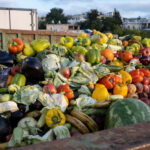

Top Photo: Three passive-aerated compost piles tested different carbon-to-nitrogen ratios (1:1, 3:1, and 1:3) to compare performance without mechanical turning.
For small and mid-scale farmers already stretched thin by planting and harvest demands, composting has often felt like one more labor-intensive task to manage. New research out of North Philadelphia challenges that assumption demonstrating that farmers can produce safe, nutrient-rich compost on-site using simple, low-cost, largely passive methods.
The year-long study, led by Sashti Balasundaram and the WeRadiate team at Urban Creators, an urban farm in Philadelphia, with funding from the USDA’s Sustainable Agriculture Research and Education (SARE) program, evaluated how different feedstock ratios affected compost heating performance, pathogen reduction, and final nutrient quality across seasonal conditions. Data analysis was conducted by Jane Wu of EcoData Solutions. The goal was to identify practical, replicable composting strategies that growers with limited labor, space, and resources could realistically adopt.
Balasundaram and Wu’s research point to the possibility that compost recipes can be far simpler than many conventional composting formulas would suggest. The findings show strong key insights that farmers can implement with passive composting while saving time, reducing input costs, and producing high-quality compost.
A Different Kind of Pile
The study tested three composting configurations: a control pile at a 1:1 carbon-to-nitrogen by volume (C:N) ratio, and two experimental piles at 3:1 and 1:3 C:N ratios, respectively. All three piles used a passive aeration system – PVC piping placed directly on the ground with the pile built over them inserted into the pile to allow oxygen exchange – with no mechanical turning. Feedstocks were deliberately straightforward and included leaves, crop residue, mulch, food scraps, and cardboard or coffee grounds – “the kind of materials most farms already have,” noted Balasundaram.
Traditional composting instruction tends to emphasize higher carbon ratios, closer to 25:1 or 30:1, to drive thermophilic activity, so the 1:1 ratio is a fascinating finding. Balasundaram was intentional about the departure from the usual ratio, wanting to create something simple for farmers.
EcoData Solution processed the study’s temperature, weather, and soil sample data. “[We wanted to understand] what the minimum viable amount of effort that a small farmer could put in and what would come out of that process,” explained Wu. The research informed that farmers could spend less than 10 hours of labor per month per farm – a fraction of what active composting operations typically demand.
What the Temperature Data Shows
On the temperature front, the findings are honest about what passive systems can and cannot do (Figure 1). None of the three piles reached the PFRP (Process to Further Reduce Pathogens) threshold of 131°F – a benchmark required for the US Composting Council’s STA-certified (Seal of Testing Assurance) compost and a key target for eliminating pathogens like E. coli and Salmonella, as well as weed seeds. Maximum temperatures over the study period were 96.7°F for the control, 93.3°F for the 1:3 pile, and 86.3°F for the 3:1 pile.
Figure 1. Temperature Over Time

Click figure to enlarge.
The research also tells an important secondary story. Statistical analysis confirmed that all three piles maintained temperatures significantly above ambient air, meaning biological activity was occurring across all configurations, across all seasons. The control pile consistently ran the hottest, with a Q3 average of 91.8°F compared to ambient air at 76.6°F that same period.
Balasundaram sees a path to closing the temperature gap. “If you can imagine a 50-acre regenerative agriculture site or farms that are thousands of acres, the volume would help increase those temperature loads,” he noted, acknowledging that the Urban Creators site is under one acre, and volume is a known driver of thermophilic conditions. Tarping piles and varying feedstocks are also on the table as tweaks that could push temperatures higher without dramatically increasing labor.
Nutrient Quality Holds Up
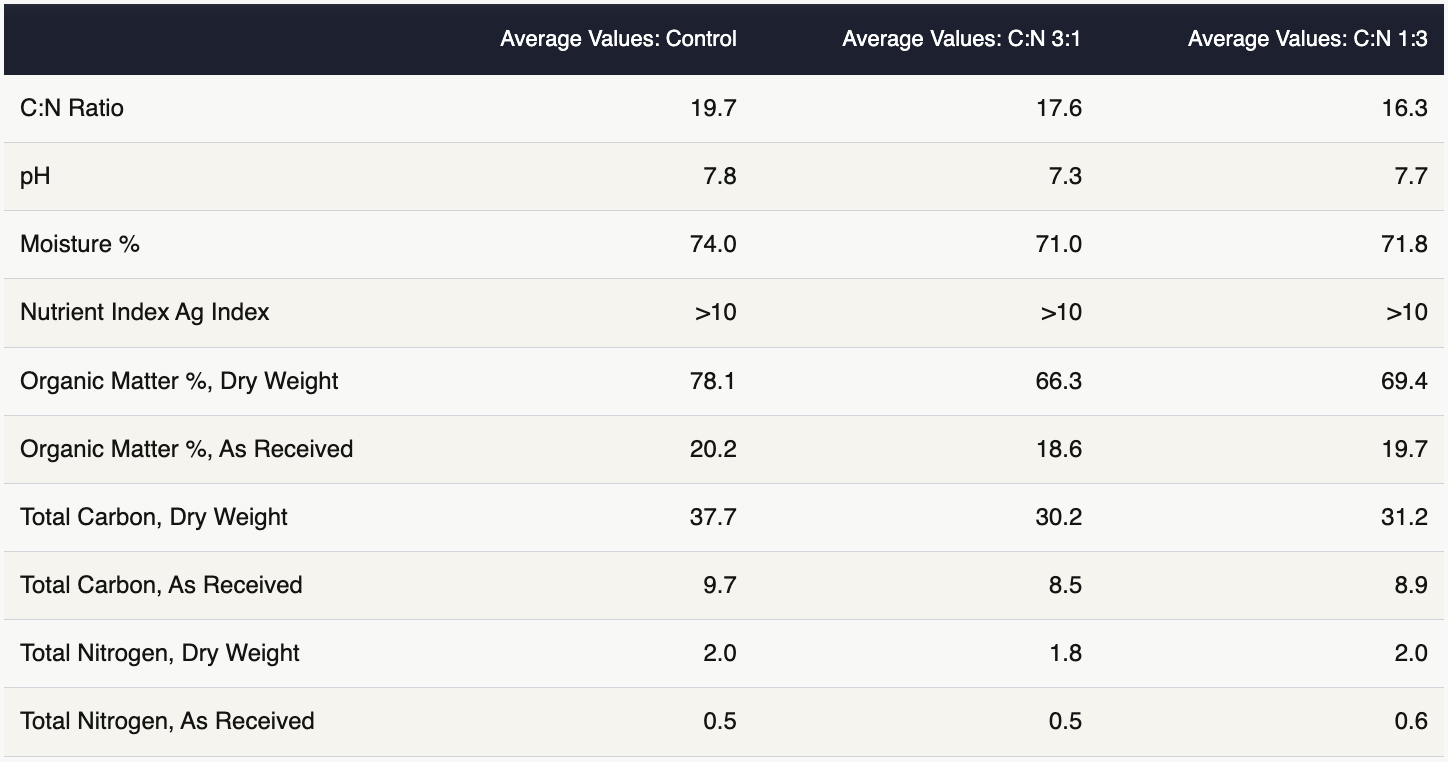
Perhaps the most promising data from the passive piles were nutritional output measurements. Quarterly soil samples sent to Midwest Laboratories showed that all three piles produced increasingly nutrient-dense compost over time. Table 1 shows the results. The control pile led across most metrics:
- 78.1% organic matter by dry weight,
- 37.7% total carbon by dry weight, and
- C:N ratio of 19.7, a useful agronomic range for soil amendment applications.
The C:N 1:3 pile came in second on most measures, outperforming the 3:1 configuration.
Table 1. Nutritional Averages by Pile
Click table to enlarge.
Implications for the Farm Community
The timing of this research lands in a particularly pressured moment for U.S. agriculture. Fertilizer prices remain elevated, and farms, especially those operating regeneratively, are actively looking for ways to reduce input costs. On-site composting has long been positioned as a solution, but the labor intensity of conventional systems has been a real barrier.
This study suggests the tradeoffs are manageable. Farmers who might not need STA-certified compost – those applying amendments to fields rather than selling product commercially – have a viable, low-maintenance option. The feedstock caveat is important. If weed seeds are present in inputs, targeted field application is advisable until future research establishes whether passive systems can reliably achieve pathogen reduction thresholds. But that is unlikely.
That question of whether passive piles could reach PFRP is exactly where WeRadiate plans to take the research next. We Radiate is actively exploring follow-on funding through SARE and other avenues to investigate pathogen reduction in low-intervention systems.
The data out of North Philadelphia offers a timely challenge to conventional composting wisdom, suggesting that with the right feedstock mix, appropriate ratios, and sufficient time, passive composting can be a practical and sustainable tool for small-scale growers and farmers.