
Paula Luu
In Greenville, North Carolina, a Starbucks partner (i.e., employee) named Chris Calderon spends his workweek managing data engineering and visualization for the company’s product lifecycle team, and a good share of the rest of it hauling roughly 1,000 pounds of spent coffee grounds away from four Starbucks stores in his own town. He is not doing it as a favor. As of this year, Calderon is a contracted hauler servicing those Starbucks stores through the same vendor structure that governs every other waste stream in the building. Since 2022, more than 60,000 pounds have moved through Calderon’s Hidden Leaf Farm.
Most organics haulers who have chased a national account know the saga of securing the contract. Procurement sits in one city, operations in another, the waste contract is already signed with a national broker, and nobody at store level believes they hold the authority to say yes. There is often an assumption that corporate diversion only happens when headquarters writes a mandate and pushes it down. Calderon’s project is a refreshing example that runs in the other direction.
Finding an Opening
Hidden Leaf Farm found an interesting starting point to secure the spent coffee grounds from a small network of North Carolina Starbucks stores. In this region, Starbucks contracts its waste and recycling through Rubicon, and Calderon’s hauling business holds its contract with Rubicon rather than with Starbucks directly. Knowing the internal Starbucks liaison to even explore the hauling possibility was an advantage Calderon had. After several conversations, Starbucks, as the customer, directed the coffee grounds go to Calderon and told its broker to set him up as a vendor. Rubicon then papered the relationship that lets him service the stores.
“It was definitely easy being an internal partner to get these doors opened for me,” he said. “If I wasn’t a Starbucks employee, it would have been much more difficult.” Rubicon’s role also appears to vary by region. When Starbucks has clearly directed that a store should compost, Rubicon helps move the process forward. But where there is no internal mandate, progress slows. In those cases, Calderon has had to go back to his Starbucks contacts then those contacts pushed Rubicon, and Rubicon then circled back to him.
In general, while the formal waste contract may sit with the broker, the real decision-making power often still sits inside the corporate entity. In practice, the hauler may need an internal champion at the corporation to activate the broker relationship and move a local program from interest to implementation.
Pilot at the store level

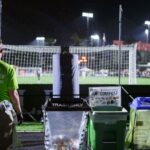
Hidden Leaf Farm supplies coffee ground buckets to each Starbucks store and grounds are picked up in dedicated green bins.
The operational design of the program is precisely what got it to start. Calderon knew that for stores without organics collection, baristas would dump spent grounds into the in-store garbage receptacle, which meant a porter later had to lift a soaked, heavy bag over their head into the dumpster. Calderon replaced that receptacle with ten-gallon buckets he supplied himself. Staff fill them from the espresso machine or the cistern, carry a light load a few steps, and empty it into a bin just outside the back door. Nobody lifts anything overhead, and the store’s labor hours went down rather than up.
The program’s design elements converted the pilot from a sustainability task into an operations win. “My main focus is to make it very difficult for them to say no to me,” Calderon said.
He took out trash and held doors and behaved like a partner rather than a vendor. The local store manager, Michael Lysaght, championed the program from the beginning and later co-presented it with him internally to a group of Starbucks partners. Once three stores were running and the labor math was visible, the district manager offered blanket access to the whole territory and an introduction to the regional director.
Almost all of the 60,000 pounds Calderon has collected so far has gone into windrows on his own property in Greenville, where Hidden Leaf Farm operates as a homestead first and a hauling business second. He runs a conventional aerobic pile and a vermicomposting operation seeded with European nightcrawlers, and he balances the nitrogen load with shredded cardboard pulled from the same Starbucks stores, which he collects informally and grinds down as a pure carbon source. Roughly 5,000 pounds of finished product has gone to the Pitt County master gardener program, where Calderon also teaches composting as a North Carolina State-credentialed volunteer. The rest feeds the vegetables, eggs, and produce his family eats, which is where the entire project started before a contract was attached to it.

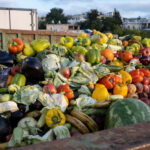
Coffee Grounds are taken to Calderon’s homestead where they are processed into compost. Photos courtesy of Chris Calderon
A Value-Added Proposition
Calderon is also in early-stage exploration on how to increase the valuation of the spent coffee grounds he collects. “Composting is definitely not the most valuable way to value-add coffee grounds,” he said, a position he traces to a research paper that broke spent grounds down at the molecular level and mapped where each fraction could enter an industrial supply chain. His near-term move is to dry the material and sell it as substrate to shiitake and oyster growers, which yields spent mushroom substrate on the back end and becomes, in his words, a gift that keeps on giving. Pelletized grounds already show up as smoker fuel, bagged grounds sell at Tractor Supply and Lowe’s as coop bedding that suppresses odor, and livestock operations are blending small fractions into feed for the residual fats, sugars, and proteins.
Higher up the value chain, the chemistry becomes more valuable, but also harder to access. Calderon pointed to several possibilities, from extracting residual caffeine for use in instant coffee or energy drinks, to recovering caffeic acid for antioxidant or pharmaceutical applications. He also noted that mannose sugars found in spent coffee grounds could potentially be used as thickening agents by food manufacturers.
Service Area Expansion
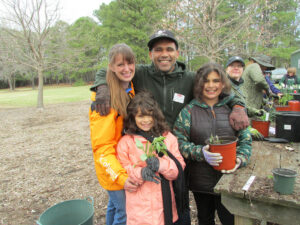 Calderon is clear-eyed that logistics are the limiting factor of scaling his current collections model. “The demand is there. It’s the logistics and ensuring that we have supply,” he said.
Starbucks may have roughly 10,000 U.S. locations, but those stores sit in very different operating environments, from rural strip centers with easy access to dense urban storefronts where staging a truck can be nearly impossible. At that scale, route density determines whether the model works. The question is not just how many stores want to participate, but whether enough generators are close enough together to justify the collection route.
Calderon’s next step is a 12-foot enclosed trailer, funded through a Starbucks grant, which would allow him to collect grocery and restaurant food waste in addition to coffee grounds. That would give him another nitrogen source for composting and help build more efficient routes. He also wants to add independent cafes and other coffee-generating businesses.
Hidden Leaf Farm found success by identifying the internal corporate champion who translated a sustainability goal into an operational benefit, designed the store-level workflow so it removed labor instead of adding it, got the broker relationship papered through the customer rather than approaching cold, and lined up end markets before the volume arrived. “All of these dots have to be connected,” Calderon said, “and unfortunately, there aren’t enough people like me who want to do this.” The composters and haulers reading this on BioCycle are the people best positioned to prove him wrong.