Top Photo: From BioCycle’s Digital Archive
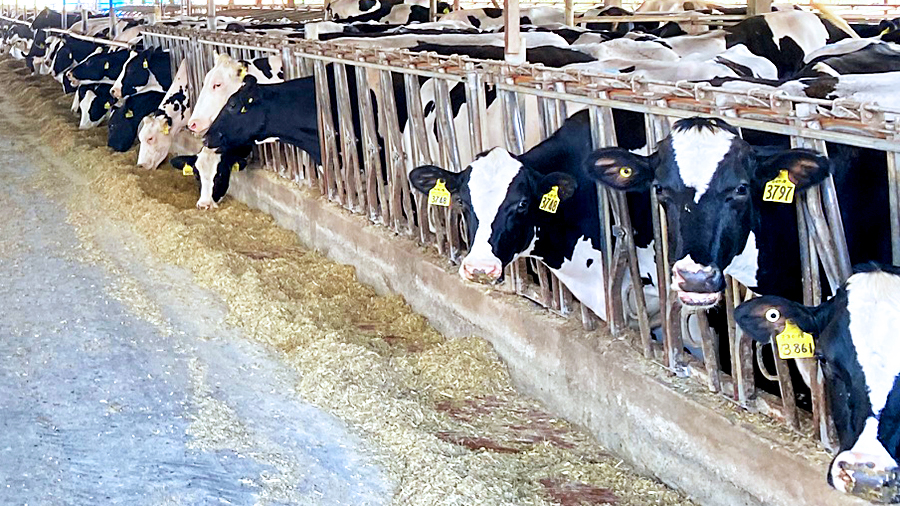
Washington State is a top ten dairy state, the country’s largest producer of a handful of specialty crops, and home to some of the most progressive greenhouse gas reduction targets on the books anywhere in the United States — 45% economy-wide by 2030, 70% by 2040, and 95% by 2050. It also has exactly five operational dairy digesters, down from nine, and has not permitted a single new one since 2015.
That gap is the subject of a December 2025 report from Energy Vision, which examines the dairy anaerobic digestion market in Washington State, titled Market Challenges and Opportunities for Dairy Anaerobic Digestion in Washington State. The report surveys nearly 40 dairy farmers and 10 developers or investors, and what it finds is not what you might expect from a state that has been talking about organic waste diversion and agricultural methane reduction for years. The problem in Washington is not that farmers don’t understand anaerobic digestion. It’s not that developers can’t find projects to evaluate. The problem is that the financial environment is unpredictable enough that both groups have largely concluded the risk isn’t worth taking — and the data behind that conclusion is damning.
A Willing Sector With Nowhere to Go
Seventy-one percent of farmer respondents said they were interested in learning more about anaerobic digestion. That is a significant share of a sector that is often characterized, somewhat unfairly, as resistant to new technology or environmental requirements. But interest and investment are different things, and the survey makes clear why the gap between them persists. “The most common reason for rejecting ADs — reported by 70% of respondents who had considered them — was ‘lack of clear financial returns,'” the report states. Sixty-five percent cited upfront capital costs. Fifty-five percent cited ongoing maintenance expenses.
When farmers were asked what would actually change their calculus, the answers were specific. Guaranteed purchase agreements for biogas or renewable natural gas (RNG) came first, cited by 74% of respondents. Capital cost subsidies followed at 61%, and reduced regulatory hurdles at 57%. Those are not unreasonable asks. They are, in fact, the building blocks of every successful dairy digester program that has operated at scale anywhere in the country.
The structural challenge in Washington is that most of its dairy farms are too small to support a stand-alone digester. About 64% of the state’s roughly 250 farms have fewer than 700 cows, a threshold that generally doesn’t generate enough manure to justify the capital investment on its own. Energy Vision identifies 80 dairies that are viable candidates for individual systems or multi-dairy hub-and-spoke configurations, with total capital expenditure across all 80 estimated at approximately $1.2 billion. Whether that capital ever materializes depends on whether the state can build a policy environment that makes 20-year project finance possible. So far, it hasn’t.
Developers confirmed what farmers suspected. “The overwhelming majority of developers saw two obstacles to dairy AD buildout as the biggest by far: market volatility for renewable energy credits (90%) and lack of certainty around carbon accounting (60%),” explains Energy Vision. Ninety percent is not a fringe concern — it is a near-unanimous signal from the people whose job it is to move capital into exactly these projects. When that many developers are citing the same barrier, the barrier is real.
The Clean Fuel Standard’s Broken Promise
Washington’s Clean Fuel Standard was designed to create durable market pull for low-carbon fuels, including dairy manure RNG, which can achieve a carbon-negative pathway by capturing methane that would otherwise be released from open lagoons and combusted as a transportation fuel. The program launched in August 2023 with credits trading at roughly $100 each. By June 2024, the price had dropped to about $40. By June 2025, it had fallen to approximately $28.
Energy Vision documents this collapse directly, noting that “average credit prices in Washington’s Clean Fuel Standard program have dropped precipitously from around $100/credit at the outset in August 2023 to $40 in June 2024 and around $28 in June 2025.” A 72% decline in two years does not just reduce project returns. It eliminates the ability to model returns with any confidence, which means it eliminates the ability to finance a project at all. The Clean Fuel Standard was supposed to be the mechanism that made Washington’s dairy digester opportunity fundable. At current credit prices, it is functioning as a deterrent.
What Washington Can Learn from California Before It’s Too Late
California is the obvious counterargument, and Energy Vision makes it explicitly. The state’s Dairy Digester Research and Development Program (DDRDP) has done what Washington’s policy framework has not — it paired capital grants with a credit market stable enough for developers to build a financing model around. Drawing on California Air Resources Board data, Energy Vision reports that the DDRDP has reduced 2.4 million tons of CO2-equivalent annually at roughly $9/ton abated, compared with an average abatement cost of $101/ton across California’s broader Greenhouse Gas Reduction Fund portfolio. One hundred thirty-eight dairy digester projects have come online under the program; 93% of them are producing RNG.
The cost-effectiveness of that outcome should register for Washington policymakers. Nine dollars per ton abated is an exceptional return on public investment in a sector where abatement is difficult and expensive by almost any other method. Energy Vision recommends that Washington adopt a comparable direct capital support program, introduce an auto-acceleration mechanism to stabilize Clean Fuel Standard credit pricing over time, and deploy Cap-and-Invest program funds through the state’s Green Bank as low-interest financing and loan guarantees for projects that cannot access conventional capital. These are not speculative interventions. They are adaptations of tools that California has already proven work.
Agriculture and organic waste together account for more than 11% of Washington’s total greenhouse gas emissions under a 100-year global warming potential. With state climate targets ratcheting tighter through 2050, the dairy sector’s methane burden is not a problem Washington can defer indefinitely. The farms are there. The interest is there. The technology has been commercially proven for decades. What Washington has not yet built is the policy infrastructure that translates a willing sector and a documented opportunity into operating projects.