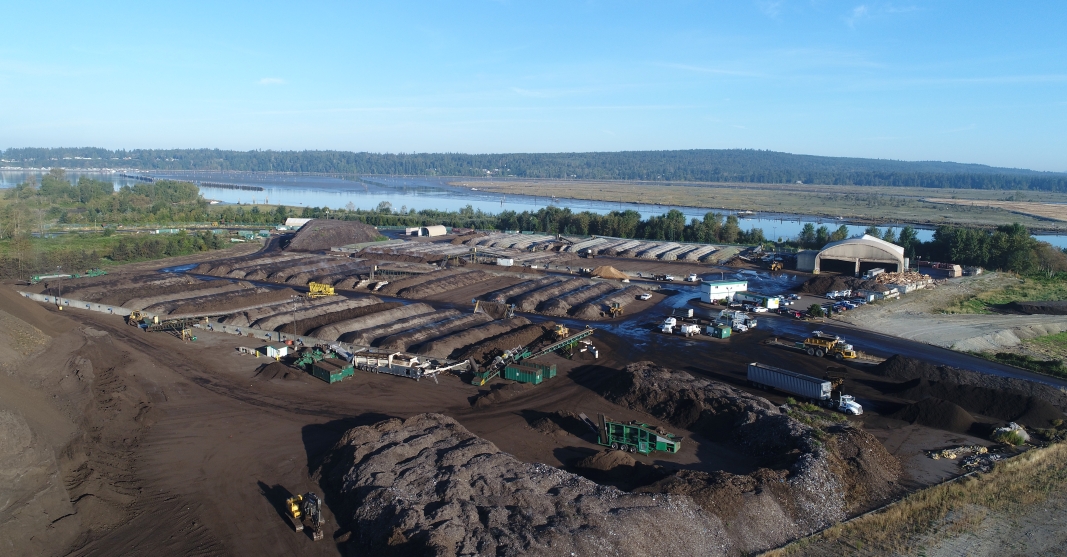
Top: Aerial shot of Cedar Grove’s composting facility in Everett, WA, courtesy of Cedar Grove.
Nora Goldstein
A Washington State law enacted in 2024 established the schedule for rolling out the state’s organics diversion mandate. Included in the law was a requirement that the state’s Department of Ecology (Ecology) “must adopt new rules or amend existing rules adopted under this chapter … addressing contamination associated with incoming food waste feedstocks and finished products, for environmental benefit.”
To comply with the requirement, Ecology proposed amendments to the solid waste handling standards related to organic materials management under Chapter 173-350 WAC in December 2024. There were three rounds of public comments on the draft amendments, with the last one ending in mid-December 2025. Public comments were robust, and on June 22, 2026, Ecology released its latest draft.
A new round of public comments are being accepted through August 13, 2026; rule adoption, notes Ecology, is anticipated on November 19, 2026.
The Washington State rule making is being closely watched nationwide as state regulators and organics recycling stakeholders grapple with what meets the definition of source separation of organics, and if and/or how mechanical food waste depackaging needs to be regulated to prevent unintended consequences (e.g., increased generation of microplastics, reduction in recycling of food packaging). The June 2026 draft rule considers source separation to include food waste in its packaging, and prioritizes use of organic materials pre-processing facilities to process loads with >5% contamination prior to composting, anaerobic digestion and other methods of organics recycling.
Conversely, Vermont, which is also in the final round of rule making that addresses source separated and packaged food waste, leans into preserving separation of packaging and other contamination at the source — versus reliance on mechanical depackaging for all food waste streams. For example, Vermont’s final draft rule prohibits commingling of manually source separated food residuals with packaged food and treatment of manually source separated food residuals by mechanical depackaging. It also requires depackaging facilities to “provide sufficient staffing to manually remove outer film wraps, boxboard, cardboard and other non-food containing outer materials” in order to optimize recycling and reduce contamination, e.g., from film wraps.
In the fall of 2025, BioCycle was commissioned by NRDC to survey states on their approaches to regulating mechanical food waste depackaging. An April 2026 BioCycle article covers the findings of that survey project. This analysis of the most current draft of Ecology’s rules highlights one regulatory approach.
Increasing Incoming Feedstock Contamination Limit
The physical contaminant limits at all organic materials handling facilities proposed in the November 2025 draft rule states that feedstocks must contain 2% or less physical contaminants by volume. Enforcement of that limit would likely be by visual means. For organic materials pre-processing facilities equipped with mechanical depackaging, the 2% or less limit would be applied on the depackaged output.
The American Biogas Council noted in its December 2025 comments, as did others representing anaerobic digester companies, that the 2% limit was a positive step. “Ecology’s proposal accurately reflects the realities of modern commercial food waste, which routinely contains packaging that most composting facilities cannot remove. Strengthening the contamination limit from 5% to 2% and requiring pre-processing for packaged food waste are necessary measures to protect soil health and ensure high quality finished products.”
Comments submitted by the Association of Washington Cities (AWC) argued that the incoming feedstock contamination rate capped at 2% by volume is “arbitrary.” The Association explained that although Ecology is “directed to establish a permit requirement to address contamination, it is not required to set an incoming contamination threshold. The agency chose 2% based on what appeared to be a selective, anecdotal survey of smaller facilities in the state. … Setting an arbitrary statewide limit will defeat the purposes of the Organics Management Law by having loads rejected and landfilled. These increased costs will be passed on to the ratepayer.”
In the June 2026 draft, Ecology established a new contamination limit of 5% or less by volume for material coming into all organic material management facilities. “During our last round of public comment, we heard from the compost industry as well as local governments operating collection programs about the 2% or less contamination limit,” notes Dawn Marie Maurer, a Solid Waste Facilities Specialist at the Department of Ecology in response to a question from BioCycle. “Some in the industry said they were concerned they would lose contracts if the collected material did not meet the new limit. Local governments expressed concerns about the costs of public outreach and education, especially at a time when local budgets are tightening. They were also concerned outreach might not be able to sufficiently influence generators’ behavior. We decided that pre-processing – including depackaging, optical sorting technology, manual sort lines, and other methods – was a feasible option for removing contamination in incoming feedstocks.”
Maurer adds that Washington State’s existing rule allows composting facilities to accept material containing more than 5% contamination if there is a plan in place to reduce it to an acceptable level, and there are no limits for other technologies. “We are seeking to strengthen that rule by requiring facilities to manage such material through pre-processing,” she explains. “Our draft rule also proposes to extend the pre-processing requirement to all organic management facility types such as anaerobic digesters.”
The latest draft still includes the reduced physical contaminant limits in finished products. The existing requirement is ≤1% by weight total, not to exceed 0.25% film plastic by weight. The proposed changes are 0.5% or less physical contaminants by dry weight, not to exceed 0.1% film plastics by dry weight.
Source Separation Definition
Section RCW 70A.205.015, of the Solid Waste Management Act that established the organics diversion mandate states that “source separation” means the separation of different kinds of solid waste at the place where the waste originates.”
The November 2025 draft included the following example of what is considered source separation: “a grocery store that places packaged or unpackaged food for purposes of recovery of the organic materials within one container and other solid wastes the store generates in separate containers.” Comments submitted by Cedar Grove Composting in Everett, Washington on the November 2025 draft amendments called out this allowance stating that “Ecology proposes to relieve groceries of the requirement to separate plastic packaging from organics. …Ecology’s ‘improved’ definition would allow food retailers to commingle packaged and unpackaged food in one storage bin.”
Cedar Grove, along with other source separated organics composting companies in Washington State, have long-established programs with commercial food waste generators who have been effectively separating food waste from its packaging. This clause in the proposed amendments in the third rule making draft created an incentive for generators to utilize an organics collection service that allowed the packaging to be included in the source separated organics, which provided an advantage to processors with mechanical depackaging equipment.
In its comments, Cedar Grove noted it strongly supports the existing definition of source separation “as it has been one of the most effective tools for maintaining clean organics through clear, generator-level separation. From the standpoint of both collectors and composting facilities, this clarity is essential to producing high-quality compost.”
In its comments, the anaerobic digestion industry supported the proposed amendment to enable commercial food waste generators like grocery stores to commingle packaged and unpackaged food waste in one container, essentially relying on an organics preprocessing facility equipped with mechanical depackaging.
In the June 2026 draft, the definition of organic materials pre-processing is “the processing of source separated solid waste to remove physical contaminants and packaging prior to organic materials management.” The draft states that “Organic materials pre-processing facilities may receive only source-separated solid waste” but does not further define what is included in source separated solid waste. BioCycle asked Ecology for clarification. Maurer explains that “under our proposed rule, an organic materials pre-processing facility may only accept only source-separated waste. This precludes them from receiving unseparated municipal solid waste (MSW). Packaged food separated from MSW is source separated.”
How Contamination Will Be Measured
The June 2026 draft includes requirements for sampling organic materials after physical contaminants have been removed. “The proposed testing frequency [is] to be every three months or 5,000 cubic yards for solid and 1,000,000 gallons for liquids, whichever is more frequent, and use of an accredited laboratory,” states the draft. “An alternative frequency approved by the jurisdictional health department may be used.”
Some comments submitted in December 2025 point out that “the proposed rules will measure this incoming contamination by volume when the facilities are held to a weight standard for finished product.” The Association of Washington Cities called this “an apples to oranges measurement method.” As noted above, the proposed limits for finished materials “must contain 0.5% or less physical contaminants by dry weight, not to exceed 0.1% film plastics by dry weight.”)
Permitting Pre-Processing Facilities
The amended proposed rules include a permitting pathway for organic materials pre-processing facilities that are not co-located with a permitted organics materials management facility. Section WAC 173-350-215 outlines those permitting requirements.
Organic material pre-processing facilities that operate within and as an integral part of another organic material management facility requiring a solid waste handling permit or operating under a conditional exemption “must be covered under that permit or permit exemption and are not required to meet the permitting requirements,” states the June 2026 draft. Notes Cedar Grove in correspondence with BioCycle, “the new structure completely exempts depackaging from permit requirements/conditions if integral to a compost or anaerobic digester facility. These pre-processors can take whatever they want, recover as little as necessary, and landfill the rest including recyclables.”
Takeaways
Even though Ecology backed off of the 2% or less by volume contamination limit on incoming feedstocks and reverted to 5%, the allowance of packaged food waste to be considered source separated at the point of origin will likely render those loads with a higher than 5% level by volume of contamination. That triggers those loads having to go to an organic material pre-processing facility, either co-located with the management facility (e.g., AD or composting operation) or permitted as a stand-alone facility.
For certain food waste generators, e.g., grocery stores, not having to remove food waste from its packaging at the store or distribution center will be economically attractive. These are likely the same customers who have been source separating food waste for diversion to composting for many years.
Stakeholders can submit public comments until 11:59 pm on August 13, 2026 online or at one of two public hearings to be held Aug. 5, beginning at 9:00 a.m. and Thursday, Aug. 6, beginning at 5:30 p.m. Additional details are available at this link.