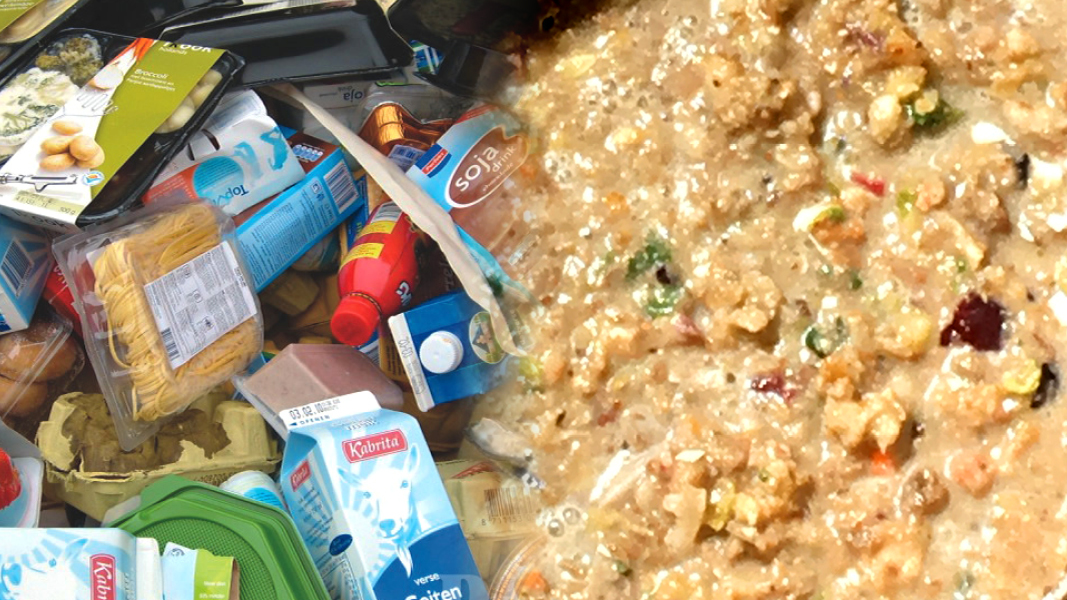
Top Photo: E.L. Harvey & Sons, Inc. based in Westborough, Massachusetts. Credit: BioCycle
Juliana Beecher and Nora Goldstein
Around the country, anaerobic digestion and composting facilities are installing food waste depackaging equipment or are being serviced by stand-alone depackaging infrastructure. This rapid technology deployment is being driven by three primary factors:
- Processing Facility Economics: Having the capability to process packaged food waste increases the quantity of feedstocks composting and anaerobic digestion (AD) facilities can receive, therefore increasing tipping fee revenue. For AD operations, increasing the quantity of food waste increases biogas production, which in turn boosts the supply of renewable natural gas and electricity, also revenue streams. Additionally, commercial-scale composting facilities are increasingly viewing depackaging equipment as a tool to remove contamination in incoming food waste feedstocks.
- Waste Generator Economics: Not having to separate wasted food from its packaging reduces labor (and training) costs.
- Food Waste Diversion Goals: Increasing hauler and processor capacity to handle packaged and contaminated food waste streams that generators are required to divert due to state or local food waste policies and/or corporate zero waste goals and/or climate commitments increases the tonnages of food waste diverted from disposal.
Utilization of depackaging units is facilitating development of privately-owned, large-scale food waste AD facilities in a number of states. Some of these ADs are stand-alone; others are co-located at dairies. For example, an AD facility under development near Newark, New Jersey will have capacity to process close to 1,500 tons/day of depackaged food waste. The project will be fed by a network of stand-alone depackaging operations. Elsewhere, organic waste management companies are marketing integrated food waste collection and depackaging services to national food retailers and other generators. For example, Denali has an arrangement with Walmart and Sam’s Club nationwide to collect food waste that is packaged or may contain contamination, and utilize depackaging for preprocessing before sending to (typically) composting and AD for processing.
This trend of large-scale food waste AD, enabled by depackaging, was captured recently in the U.S. Food Waste Pact 2025 Data Report, which identified an operational shift in how retailers manage food waste. Pact signatories that include food retailers reported increasing use of AD facilities when service providers offer integrated programs that combine hauling, depackaging, and digestion. That diversion pathway was up by 4% from the previous year, while diversion to composting remained the same.
The net effects of this trend include the following:
- Large (expensive) depackaging and AD facilities are under economic pressure to keep food waste feedstock flowing in.
- Food wholesalers and retailers have historically used source separation practices, but now are economically incentivized to send any food waste not destined for donation to depackaging (packaged or not).
- Building organics diversion programs based on source separation of food waste from its packaging is increasingly challenging from a competitive perspective — especially for composting facilities that rely on receiving clean, source separated food waste streams to make quality end products.
- On the spectrum of source separation on one end and mixed waste processing on the other, depackaging utilized as the sole food waste preprocessing and decontamination step moves organics recycling closer towards mixed waste management – potentially compromising the quality of the end products utilized as soil amendments.
- The lack of a standardized, regulator-ready method for measuring microplastics in depackaged food waste and the downstream end products leaves a critical data gap, creating uncertainty around impacts on compost and digestate quality while allowing rapid adoption of depackaging systems to outpace oversight.
In short, hundreds of thousands (if not millions) of tons of packaged food waste streams – along with unpackaged but contaminated streams – now start their recycling journey through a depackager, a major change in the organics recycling landscape. This new reality raises questions: How are states regulating these depackaging facilities? Are they being regulated at all? Are there model state regulations that could be replicated to level the playing field across the country?
In October 2025, NRDC (Natural Resources Defense Council) commissioned BioCycle to answer these questions, ones we have been wondering about for the last few years as we’ve watched mechanical depackaging systems be deployed across the country.
What Is Mechanical Depackaging?
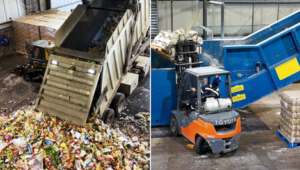
At the Generate Upcycle Cayuga Digester, loose food waste containing contamination is unloaded on the tip floor (left). On right, a skid steer loads a pallet of packaged food waste into the hopper that feeds the processing line that includes a depackager. Photos courtesy Generate Upcycle.
A food waste depackager uses multiple characteristics and mechanical processes to separate food contents from its packaging – most of which is plastic. The machines on the market today use variations on applied force, either in a tangential shearing action, a vertically-oriented hammering action, horizontal or vertical pressure through a metal sieve or screen, or some combination thereof. Drawing from the hammermills common in grinding wood, early depackagers used similar applications of force, but the splintering of the packaging allowed small particles to pass through the sieve/screen. Newer models are designed to separate the packaging with the least amount of applied force necessary, through fine adjustments like changing the angle of paddles mounted on a shaft, and to convey the separated packaging out of the machine with the least amount of additional handling.
The metrics used to evaluate separation efficiency are recovery and purity. Recovery is the percent of food waste recovered from the entire waste stream feed (i.e., percent food captured vs. total amount of food waste in incoming stream). Purity is the percentage of the desired recovered material in the total recovered waste stream (i.e., percent of actual food in the recovered food waste slurry destined for AD or composting vs. unwanted materials like plastic packaging).
The types of depackagers used have more to do with operator preferences than the machine designs themselves. Considerations include water usage, mobility, ease of changing out screen sizes, and physical space allowances.
As noted in a BioCycle article series on microplastics, there are no data available on which depackaging methods produce microplastics or in what quantities, but it is reasonable to assume that machines exerting more force on packaged foods risk higher production of microplastics due to shattering of brittle plastics like some high-density polyethylene (HDPE) and polypropylene.
Methodology
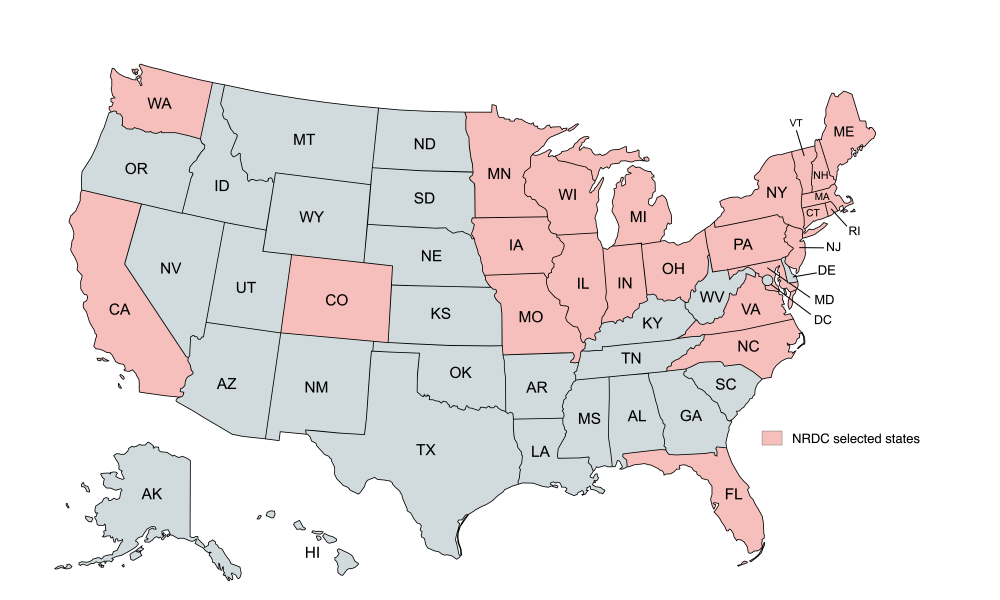
NRDC selected 24 states (Figure 1) for BioCycle to focus on for a range of reasons, some of which include: existing food waste diversion policies, e.g., California, Maryland and New York; or other active engagements to address food loss and waste policies and practices. Information also was collected on activity on tribal lands.
Figure 1. States selected by NRDC for the focus of this research
Outreach was conducted to each state’s solid waste and/or organics recycling officials. In addition, several subject matter experts were consulted regarding microplastics measurement, and how to optimize food waste depackagers to minimize the generation of microplastics. NRDC and BioCycle generated a list of research questions for the inquiries:
- What approaches are states taking with their existing regulations or in drafting regulations for depackaging operations?
- What are states’ current physical contaminant limits and do those reflect the typical particle sizes in depackaged food waste (e.g., do — or can — the limits capture microplastics)?
- Does the location of a depackager impact how it is regulated, e.g., a dedicated depackaging facility vs. a depackager at the wastewater treatment plant or at a farm digester?
- Are there restrictions, if any, on the types of food waste streams that are eligible for depackaging (e.g., “lightly” or “heavily” packaged)?
- Do any state food waste diversion policies include food waste depackaging facilities within the policy’s definition as a designated organics recycling facility?
- Are there examples of facilities operating depackagers that have to comply with contaminant limits in the slurried food waste?
- What is the level of food waste depackaging activity on Tribal lands and how is that regulated?
- What is the status of developing a standardized measurement method to test for presence of microplastics in a depackaged food waste slurry and in digestate or compost that includes depacked food waste?
- Do any of the existing state regulations, or ones in development, serve as examples of an effective, viable pathway to regulate food waste depackagers and the downstream compost and digestate?
The outreach resulted in 23 responses, 11 of which were interviews and 12 submitted via email to BioCycle’s questions. The only state that did not respond was Florida. The following sections of this article cover what we learned through our research.
How Are Depackagers Regulated?
Many states contacted are actively grappling with how to regulate food waste depackaging in a rapidly changing organics recycling landscape. The majority are using existing permit types to regulate stand alone depackagers as solid waste facilities or as materials recycling, transfer or processing facilities – intermediary steps before final processing. For depackaging co-located with existing composting or AD operations, depackaging is most often added to the existing facility’s permit. Table 1 summarizes the approaches different states are taking.
Table 1. State regulatory approaches to food waste depackaging
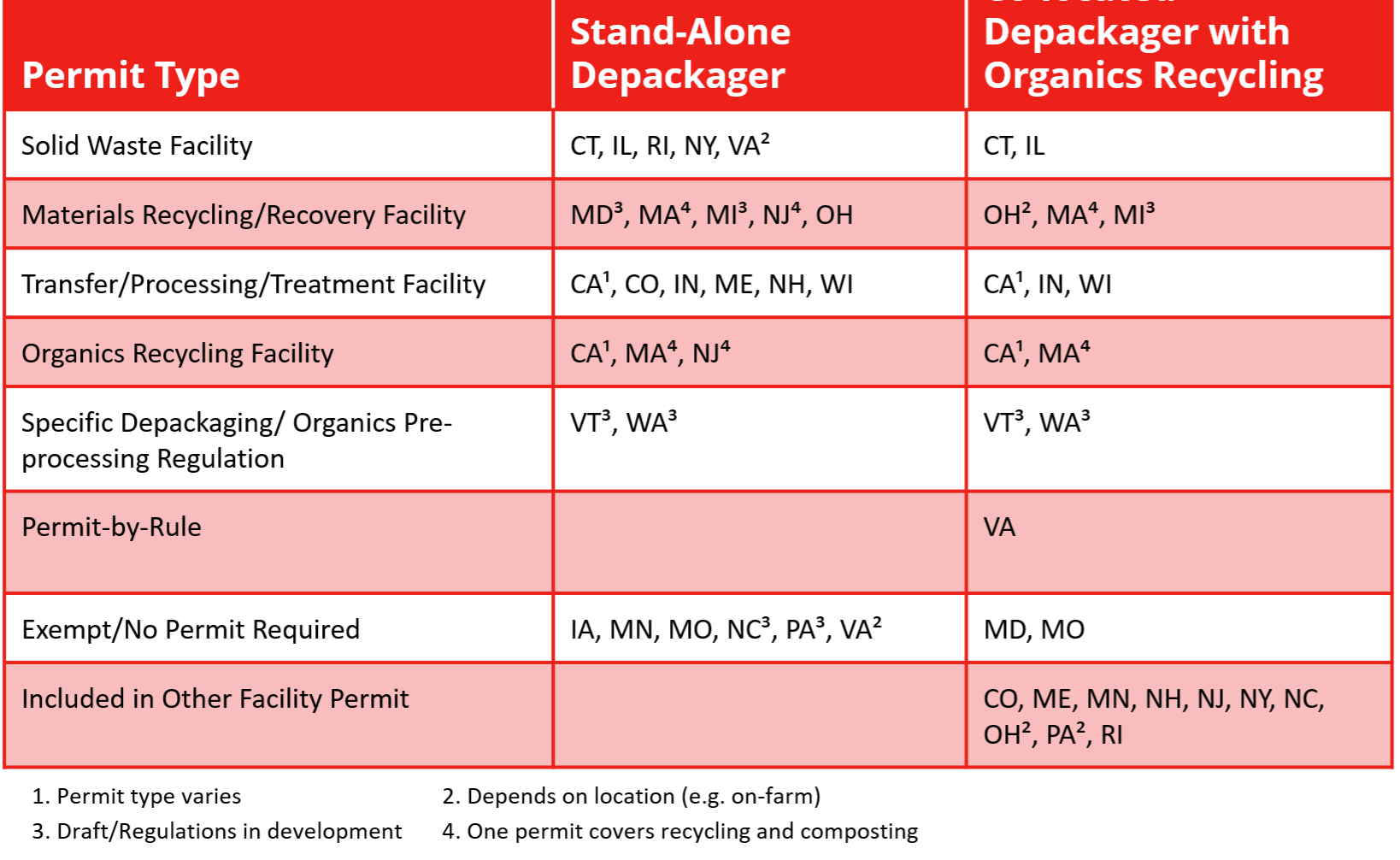
Click to enlarge.
Regulations that will affect depackaging are currently or shortly being drafted in Maryland, Michigan, and Pennsylvania. Regulations specific to depackaging as a preprocessing step are in development in Vermont and Washington.
The following list of examples captures the current state of state regulations for depackaging operations:
- Vermont considers stand-alone depackaging operations as designated organics recycling facilities.
- Colorado, Connecticut, California, Maryland, and New Hampshire consider depackaging facilities as processing and/or transfer facilities (vs. designated organics recycling facilities) because they do not perform final processing or end use/recovery.
- In Illinois, if a facility receives food waste and performs “depackaging or separating activities that constitute storage, transfer or treatment of solid waste,” it is regulated as a Pollution Control Facility and requires a solid waste permit.
- Some states’ existing regulations (New Jersey and Ohio) and regulations in development (Michigan) classify a depackaging facility as a materials recycling facility. Michigan anticipates adding language into its recycling permit to account for containment of liquids resulting from food waste depackaging.
- Washington State is drafting solid waste handling rules for organic materials that categorize food waste depackaging facilities as organics preprocessing facilities. These facilities prepare materials for organics recycling through composting, anaerobic digestion, or “other transformative processes” (terminology used by the state’s Department of Ecology). All organics recycling facilities (e.g. compost, AD), according to the current draft, will have to meet a limit of 4% or less contamination (by volume) in the incoming source separated organics. For depackaging facilities, that limit must be met in the material exiting the depackager. The final regulation will likely rely on visual “measurements” and will not stipulate lab-based measurement protocols for the depackaged stream prior to AD or composting.
- New York State’s food waste diversion policy considers proximity to a designated organics recycling or intermediary facility (currently 25 miles, to be increased to 50 miles on Jan. 1, 2027) when determining which generators have to be in compliance. Food waste depackaging facilities are considered intermediary facilities.
- In Ohio, if a depackager is located within the footprint of a permitted composting facility, it is considered part of the feedstock receiving area, included in composting facility permitting requirements and subjected to all operational requirements for management of incoming feedstocks, including managing contamination. Conversely, if the depackager is located outside the footprint of a permitted composting facility or is associated with animal feed manufacturing, rendering, or most AD, then it is most likely considered “legitimate recycling,” and is therefore exempt from solid waste transfer facility regulations. (A “legitimate recycling facility” stores, transfers, or recycles solid waste generated offsite and recycles no less than 60% by weight of received solid waste.)
- North Carolina is creating a “notification” form for depackaging operations in order to collect operational information, e.g., depackager type, maximum throughput, average daily or weekly feed amount, feed sources (e.g., grocery stores, schools), types of packaged food accepted, etc. Lauren E. Hill, an engineer with the NC Department of Environmental Quality (NC DEQ) Division of Waste Management Solid Waste Section, welcomes reviews and input on the draft notification form from officials in other states (by June 30) while it is in development. In addition, the NC DEQ will begin a Solid Waste Section Rule Review and Readoption process (targeted for 2027) that will “likely” include permitting requirements for depackaging facilities, according to NC DEQ. Currently, depackagers that are co-located at AD or composting facilities fall under those facilities’ solid waste permits and corresponding operations plans.
- Several states have depackaging facilities operating but do not have a depackager permitting structure nor plans to develop one in the near future. Included are Colorado, Iowa, and Minnesota.
Physical Contamination Limits
Some states’ regulations include limits or requirements for physical contamination that may restrict the presence of microplastics in organic material streams and final products. Current limits most commonly apply to compost, sometimes to digestate, and rarely to incoming food waste feedstocks or slurried depackaged food waste. Table 2 summarizes states’ physical contamination limits currently in regulation (or in draft). Limits are most often set by percent contamination (by dry weight) or particle size. Plastic particles ≤5 mm are considered microplastics, so particle size limits of 4 mm may restrict some of the larger microplastics.
Table 2. State Physical Contamination Limits

Click to enlarge.
The following examples capture the current state of state regulations for physical contaminants in compost, digestate and depackaged food waste. The effectiveness of any of these approaches comes down to enforcement, which varies across states.
- California and New York have the most stringent limits: a physical contamination concentration limit for compost and digestate of 0.5% by dry weight and a particle size limit of 4 mm. An additional restriction states that no more than 20% by dry weight of the 0.5% which is larger than 4 mm may be film plastic. In California, measurement of physical contamination in the final compost or digestate made with food waste slurries from depackagers is required if those end products are to be land applied.
- Iowa’s physical contamination concentration limit for compost is 1.5% by dry weight. The particle size limit for all “human-made inert materials” is 13 mm (about 0.5 inches), much larger than microplastics (≤5 mm or 0.20 inches). Enforcement is triggered by complaints about visible contamination in the field after application, though occasionally testing for physical contaminants is included in broader compost testing regimens.
- Two states’ limits differ by class of compost. In Minnesota, Class I compost may not contain more than 3% (by weight) of inert materials that are >4 mm (plastics, glass and metals). Class II compost may not contain more than 4% (by weight) of inert materials that are >4 mm. In Rhode Island, “foreign matter” (glass, metal, etc.) must not exceed 1% by dry weight for Class A compost, 2% for Class B, and 4% for Class C.
- Connecticut’s Department of Energy & Environmental Protection has authority to unilaterally modify requirements in permits, such as requiring additional testing for microplastics (or anything else) in final compost or digestate.
- In Indiana, food waste depackaging facility permittees are required to sample the slurry coming out of the unit for microplastics to confirm that the depackager manufacturers’ specifications are correct and the equipment is operating as indicated. The Indiana Department of Environmental Management explains that Title 329 IAC 11 references waste determination sampling, analyses, methods, frequencies, and reporting. Facilities are required to maintain complete records of any sampling or monitoring performed. Under Title 329 IAC 11‑2‑49.5, waste determination may be performed using the methods in 40 CFR 261 Subpart C, or other appropriate, technically supported methods. Applicants must document the sampling and analytical methods used. One permit holder in Indiana utilizes a filter canister setup to screen organics prior to getting pumped into a tanker truck for transfer to its processing facility. Preparation method US EPA 160.3 or a similar approved method is followed for this analysis using a No. 7 sieve (2.83 mm).
- Pennsylvania currently requires a permit only for on-farm anaerobic digestion with depackaging. No visible plastics in liquid or solid digestate destined for land application or animal bedding are allowed; similarly, no visible plastics are allowed on land where the digestate is applied.
- Vermont is focused on regulating incoming feedstocks to reduce contamination. Regulators recognize that current science and measurement standards don’t yet support setting up a monitoring/measuring regime for compost and digestate.
State of Microplastics Measurement
At this time, there is no standardized measurement protocol for microplastics in food waste streams, compost or digestate. Many states cited this as the biggest hurdle in regulating microplastic contamination.
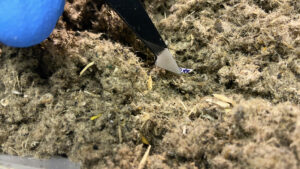
Picking microplastics from dried slurry that underwent mechanical screening through 5/32-inch mesh at a UVM lab. Photo courtesy UVM.
According to Drs. Eric Roy and Kate Porterfield, researchers at the University of Vermont (UVM) who have been leading the way on studying microplastics in compost, digestate and food waste, a challenge is that it is “difficult to measure microplastics in complex organic residuals in a time-efficient” manner. Some test methods, such as those for microplastics in water and soil, use density to separate out microplastics. But the range of densities for plastics and organic matter overlaps significantly, making density separation less reliable for materials like compost and digestate. Additionally, plastics in a compost sample are more aged, which makes them even closer to organic matter in appearance.
The team at UVM has established a protocol (Figure 2) that includes identifying and characterizing microplastics by hand under a microscope. The protocol works, but it’s time-intensive and therefore not cost-effective (read more about microplastics and research from UVM in this Biocycle series). Other researchers on microplastics have similarly developed their own protocols, but none that is currently a front-runner for standardization. “There is still a diversity of methods being tested and applied that are being reported in the literature,” notes Dr. Roy.
Figure 2. UVM’s Microplastics Measurement Protocol Process

Porterfield, K. K., Scarborough, M. J., & Roy, E. D. (2023). Organics recycling tradeoffs: biogas potential and microplastic content of mechanically depackaged food waste. ACS Sustainable Chemistry & Engineering, 11(28), 10422-10429.
Protocols like this are often developed by standards-setting bodies like ASTM International, or by the federal government. ASTM opened a work item last year (ASTM Work Item WK94491) to develop “an introductory guide on identification, assessment and cleanup of microparticles, including microplastics, in air, soil, surface water and groundwater.” This may be an early step toward the development of a standard for measuring microplastics in organic media like food waste, compost and digestate. (ASTM members shape the standards developed, and participation is fairly accessible and open to government, academic, industry and other interested parties.)
Other Research Findings
- Food Waste Stream Eligibility for Depackaging: To date, only Vermont is addressing restrictions on the types of food waste streams eligible for depackaging as part of a solid waste rulemaking update. The revisions to Act 170 by the Agency of Natural Resources (ANR) have created two categories – source separated and packaged. Once the rule is adopted (anticipated in 2026), guidance is expected to be issued for audits of incoming loads to keep source separated food waste from being put into the depackager hopper and maximize the capture of recyclables, especially cardboard boxes, prior to depackaging.
- Contaminant Limits in Slurried Food Waste: BioCycle’s research only found a handful of facilities operating depackagers that have to comply with contaminant limits in the slurried food waste.
- Depackaging on Tribal Lands: No Tribes are currently regulating food waste depackaging, nor food waste compost or digestate use, at a large scale. Dakota Prairie Composting, owned and operated by the Shakopee Mdewakanton Sioux community in Minnesota, has a depackager, but the facility is subject to state regulations, not Tribal or federal, due to its location.
Viable Regulatory Pathways
Our research found that many of the states surveyed are addressing food waste depackaging in their solid waste processing regulations – whether in internal discussions or drafting rules – providing a variety of examples of regulatory approaches. However, the absence of a standardized measurement protocol for microplastics in incoming food waste streams, slurried food waste, and the resulting end products (compost and digestate) is preventing states from establishing enforceable contamination limits.
Most current regulatory approaches, e.g., permitting food waste depackaging facilities as materials recovery facilities (MRFs), solid waste processing/transfer facilities, and/or including them in the general AD or composting facility permit, address physical contamination in finished compost, but do not address it in food waste slurry or subsequent digestate. Some state regulators noted that regulations could be updated at a later date when a standardized measurement for microplastics is developed.
Permitting depackaging facilities as MRFs or processing/transfer operations is based on the fact that the facility is not the final destination for the recovered material; i.e., additional/final processing is needed. This raises the question of who is accountable in terms of regulatory oversight for the depackaged food waste stream (and any contamination therein): the preprocessor or the final processor.
More independent data on the purity and recovery efficiencies of depackaging operations could help to enlighten regulators. A significant void is the lack of publicly available, third party lab testing data to verify claims by depackaging manufacturers and developers of large-scale food waste anaerobic digesters or large-scale composting facilities that their depackaging equipment yields a >95% to 99.9%+ clean food waste stream. BioCycle is not aware of publicly available third-party lab testing data to verify those claims nor the methodology they are using.
At this time – especially in states without any regulations/permits in place for food waste depackaging facilities – the notification approach being developed by the North Carolina DEQ (see #8 above in discussion about state regulatory approaches) enables tracking where depackagers are being installed. This creates an oversight infrastructure that states can use to collect annual reports on the tonnage and types of food waste received, where the material is processed, and how the end products that contain depackaged food waste are utilized. It also facilitates sampling of the food waste slurries for research studies, especially to compare the presence of microplastics in depackaged slurries versus in source separated food waste streams.
Conclusion: The Double-Edged Diversion Sword
Our research findings can be characterized as a “double-edged diversion sword.” On one edge is the reality – and perception – among state and local officials, generators, organics recyclers and food waste diversion advocates that depackaging is integral to increasing food waste diversion rates, especially in states with mandates and/or goals to reduce landfill disposal of food waste. Without a doubt, for generators with large quantities of packaged food waste and beverages, the ability to aggregate it as is – versus source separating – facilitates diversion to an organics recycling facility versus a disposal facility. Early on in BioCycle’s research, a sentiment was expressed that states are inclined to greenlight depackaging operations because of their facilitation of food waste diversion, and not tackle environmental impacts from potential microplastics because there isn’t a go-to measurement standard.
On the other edge of the diversion sword, defaulting to mechanical depackaging to recycle food waste is a slippery slope from the perspective of increased microplastics contamination, especially in contrast to the benefits accrued when food waste streams are source separated. This shift away from source separation to depackaging as a means for both capturing larger quantities of food waste streams and managing contamination is being acutely felt at small- to medium-scale composting facilities that have reliable systems in place to manage contamination (including food packaging) and produce a clean, high-quality finished compost. Not only do these composters have to compete with the economies of scale that larger facilities with food waste depackagers can reach by accepting higher tonnages, they also have to compete with haulers and processors that offer savings to generators by not requiring source separation. Meanwhile, we still lack robust scientific evidence of the increased risk and reality of microplastic contamination in food waste slurries, compost and digestate due to the use of mechanical depackaging until a standardized measurement protocol is adopted and more data are collected and made publicly available.
During several conversations with state regulators, we heard the concern that microplastics can be found in any recycled organic material if one looks for them. Another way of interpreting that concern: “Do you really want to open Pandora’s Box?” Given the combination of the rapid rise in adoption of food waste depackaging, the patchy landscape of state regulation of these operations, and the lack of available, economical, and reliable microplastic measurement tools, a major takeaway from this research is yes, Pandora’s Box needs to be opened. Researchers, state regulators and facility operators should use what tools they have at their disposal to track and understand how depackaging is changing the way food waste is managed and how to reduce the risk of knowingly adding microplastics to composts, digestates and, eventually, soils.
While the organics recycling industry awaits a standardized measurement protocol that can be adopted nationwide, objectively analyzing contamination loads in food waste streams provides necessary documentation to inform best management practices. Until then, monitoring contamination and defaulting to source separation should still be considered among those best practices.