
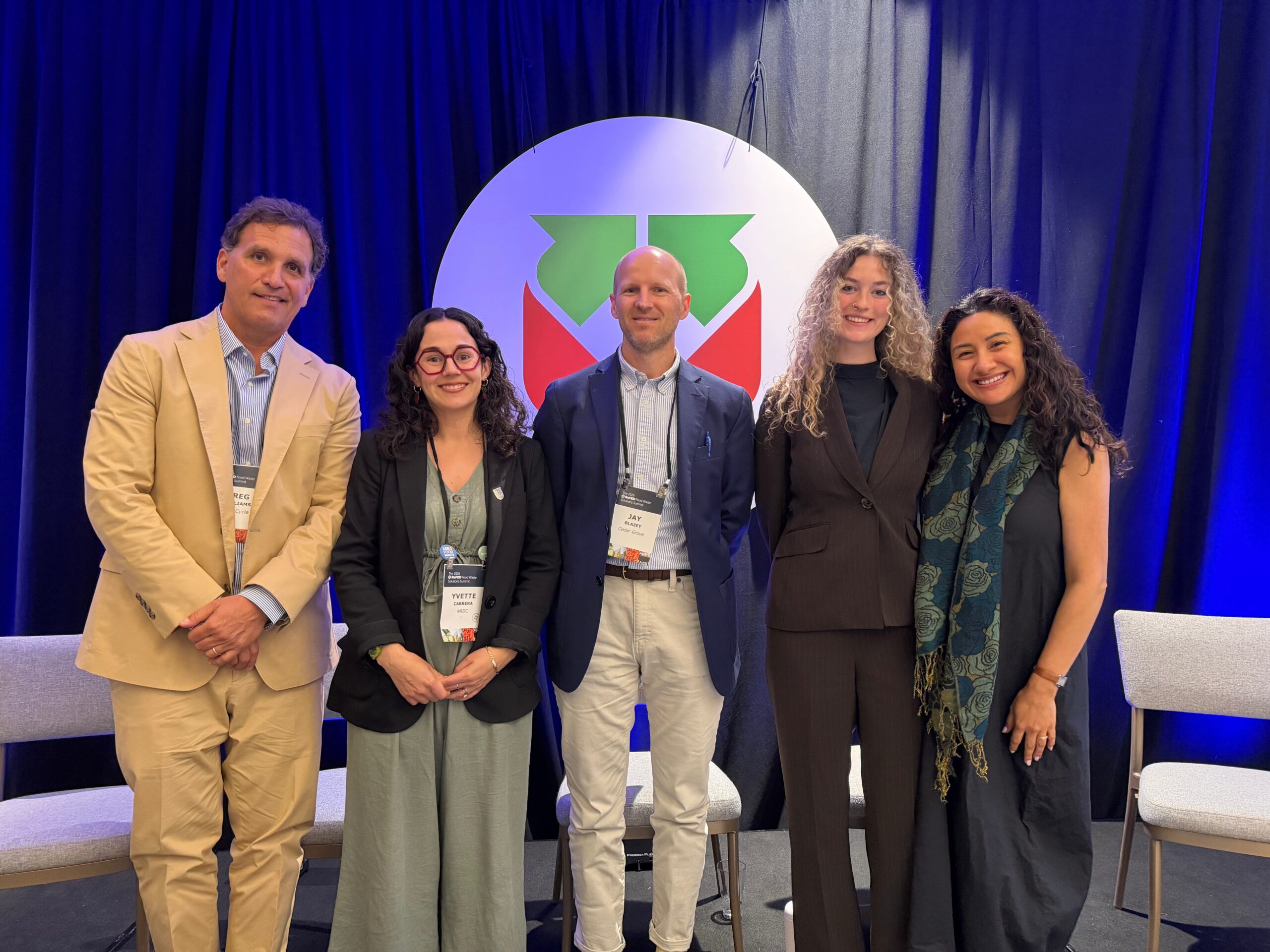
The conversation around food depackaging technology has matured enough that the industry can no longer avoid its tensions and harder questions. A session at ReFED’s annual Food Waste Solutions Summit in Charlotte in May brought together four voices representing operations, environmental advocacy, and state regulation to discuss those tensions and questions openly. And while the panelists didn’t resolve them, they moved the needle on where alignment is possible and where the real work still lies.
The panel brought together Yvette Cabrera of the Natural Resources Defense Council (NRDC), Jay Blazey of Cedar Grove Composting, Greg Williams of AgriCycle, and Lauren Hill of the North Carolina Department of Environmental Quality. The through-line of the conversation was a technology that has grown faster than the science and policy frameworks meant to govern it.
Depackaging systems, which mechanically separate food waste from its packaging at scale, have become an increasingly attractive solution for diverting large volumes of packaged food from landfills, particularly for retail recalls and industrial generators where manual separation is simply not feasible. Greg Williams offered a practical operator’s view of where the technology works well and where its limits are, while acknowledging that the industry has been operating largely without standardized benchmarks for what constitutes acceptable output.
That absence of standards is where Yvette Cabrera pressed hardest. The NRDC’s concern is not with depackaging as a concept but with what happens when the slurry or digestate produced by these systems gets applied to agricultural land. There is currently no standardized measurement protocol for microplastics in depackaging output — and without one, the industry is essentially asking regulators and the public to trust that it isn’t trading a landfill problem for a plastic pollution problem in the soil. She argued that the industry should develop a measurement protocol first and use the resulting data to inform enforceable standards.
Jay Blazey raised a concern that composting operators will find familiar. Cedar Grove has built its business on clean, source-separated organics, and the rise of “take-all” depackaging services creates an uneven playing field that disadvantages operators who refuse to cut corners. Beyond the competitive dynamic, Blazey pointed to a structural risk that the convenience depackaging offers to waste generators could gradually erode the source-separation habits and infrastructure that took decades to build.
One of the more underappreciated issues the panel surfaced was what actually happens to packaging once it exits the depackager. All packaging is screened out – including compostable packaging meant to be sent to compost sites, and fiber packaging and conventional plastics that might otherwise have been recyclable. The residue from the depackaging systems is typically too dirty and fragmented from the process to be accepted into recycling streams. The result is that all of it goes to landfill. Depackaging, in its current form, is often facilitating an increase in packaging sent to disposal rather than reducing it. Vermont’s regulatory approach, which in one draft introduced defined terms like “lightly packaged” vs. “heavily packaged” to draw clearer lines around what is appropriate to process, reflects an early attempt to address this gap at the policy level. Ultimately, however, the final draft rule does not permit the commingling of source-separated organics and packaged food waste during collection, and the proposed distinction between lightly and heavily packaged materials was not retained. Even so, Vermont’s effort to grapple with these questions offers an early glimpse into how regulators may approach depackaging in the future.
Lauren Hill described North Carolina’s current approach as a “notification” model — requiring facilities to register and report so the state can gather data before moving to formal rulemaking. It’s a pragmatic middle path, and she made a case for a hybrid regulatory framework more broadly: federal guardrails setting minimum standards for microplastic thresholds and testing requirements, with state-level flexibility to account for local recycling infrastructure and market conditions.
The audience brought its own layer of complexity to the conversation, particularly from the hauler community. Operators on the collection side pushed back on the assumption that separating source-separated organics from packaged food waste is simply an operational choice. In practice, it’s a logistics problem that the market hasn’t adequately solved. Route optimization remains a central constraint, as running separate collection routes for clean organics and mixed packaged waste adds miles, increases greenhouse gas emissions, and strains already thin margins. Aggregating both streams into a single route is often the only economically viable option, even when it creates downstream headaches. What emerged from this part of the discussion was a clear signal that meaningful progress on depackaging will require innovation on the collection side just as much as on the processing side — and that work has barely begun. BioCycle Managing Director Paula Luu, who moderated the panel, noted that advancing this conversation productively will require more rigorous testing on two fronts in parallel: the microplastics science that regulators need to set enforceable standards, and the collection side research needed to understand what separation is actually feasible in the field before the industry can determine where depackaging fits responsibly in the system.
Where the panel landed, and where there was genuine consensus, was on a set of principles the industry would do well to hold onto. More food waste needs to come out of landfills. The data and measurement infrastructure to guide that diversion responsibly does not yet exist at the scale needed. Operators and regulators both need to be more transparent about what is actually happening inside these systems, and depackaging and source separation are not competing philosophies. They are tools that will need to coexist, deployed with enough intentionality that one doesn’t quietly undermine the other.