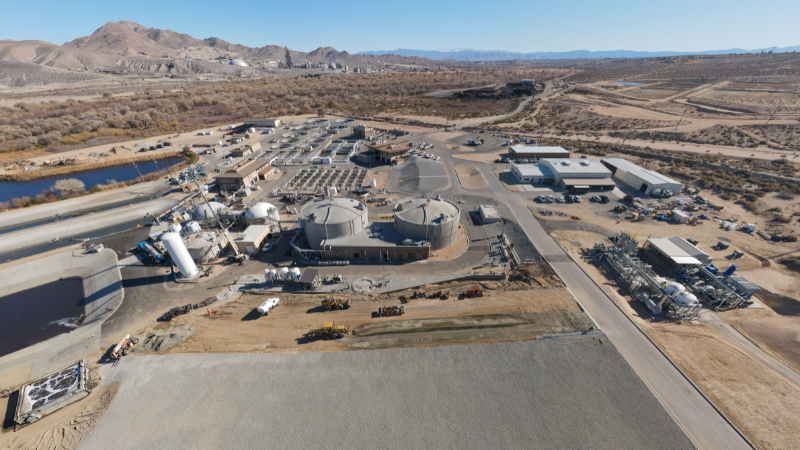
Top Photo: Aerial photo of Victor Valley Wastewater Reclamation Authority (VVWRA) in Victorville, California. Courtesy of VVWRA.
Kelley Devaney
Public-private partnerships (P3s) are gaining traction as a practical model for developing anaerobic digestion (AD) infrastructure across the United States. For municipalities facing rising disposal costs, organics diversion mandates, and pressure to decarbonize, P3s offer a way to build, operate, maintain, and in some cases finance complex infrastructure without taking on the full burden themselves.
The Shift to RNG
The most significant shift in the U.S. anaerobic digestion market over the past decade has been the move away from utilizing the biogas for electricity generation toward conditioning it for use as renewable natural gas (RNG). Roughly 95% of new biogas projects over the past three years have focused on RNG, according to the American Biogas Council (ABC).
Two policies have been influential to this shift. The federal Renewable Fuel Standard (RFS) established RNG as a qualifying transportation fuel pathway. California’s Low Carbon Fuel Standard (LCFS), though a state program, has had outsized national influence given the financial incentives it created for RNG production and pipeline injection.
RNG revenue depends on the value of associated environmental credits, although the credit market can be volatile. LCFS values have dropped from a high of around $200 per metric ton of CO₂ equivalent to approximately $60 in recent years due to credit oversupply. The Section 45Z Clean Fuel Production Credit, effective 2025 and scheduled to expire at the end of 2029 (subject to legislative change), provides additional federal incentives tied to lifecycle carbon intensity. Manure-based projects benefit most, achieving the lowest carbon intensity scores and therefore the highest credit values. AD projects can transfer environmental credits to third parties for financial benefit, increasing the overall return on investment (ROI).
Additional Markets for RNG
A corporate voluntary market for RNG is also emerging. L’Oréal signed a 15-year agreement to purchase approximately 40% of the RNG produced from Kentucky’s Big Run Landfill, targeting carbon neutrality across its U.S. facilities. AstraZeneca committed to purchasing 650,000 MMBtu per year of RNG from Vanguard Renewables (an AD developer) to meet nearly all the gas demand at its U.S. research and manufacturing sites. These deals signal that long-term corporate offtake commitments are achievable, and that voluntary buyer demand can provide a durable revenue stream independent of credit market volatility.
Another end market worth watching is marine fuel. Interest in using biogas to power shipping vessels is growing as stakeholders seek to decarbonize shipping. According to Patrick Serfass, Executive Director of ABC, even limited adoption in U.S. ports could create substantial new demand for biogas and support additional domestic AD development, with further upside as international marine fuel decarbonization accelerates.
P3 Structures and Risk Allocation
P3 AD structures can vary widely. Who owns the facility, who finances it, and how responsibilities are divided among partners depends heavily on the goals of the public agency, the appetite of the private developer, and the specifics of the project itself. What P3s share is a long-term contractual framework; in practice the mix of public and private financing, and the allocation of risk that goes with it, can differ from project to project.
In Akron, Ohio, the City and KB BioEnergy developed the Akron Renewable Energy Facility as a joint venture; KB BioEnergy built, operates, and maintains it under a long-term contract. At the other end of the spectrum, a private developer builds, owns, operates, and finances a facility on public land under a long-term lease or concession agreement. The P3 between a California wastewater treatment plant (WWTP) and an AD developer (see Victor Valley case study below) is an example where the P3 was accomplished at no cost to ratepayers. By combining private financing with a long-term gas utility offtake agreement under California’s SB 1440 Biomethane Procurement Program, the developer structured a deal in which it bears both financial and operational risk, with the public agency’s primary contribution being feedstock supply, site access, and underlying asset ownership.
For most municipalities, this division of responsibility is exactly the point. A predictable tipping fee structure and a solved organics diversion problem are worth more than capturing the RNG upside that they are not typically equipped to manage. The private operator takes on market risk and operational complexity in exchange for the revenue potential of RNG sales and environmental credits. According to the Association for the Improvement of American Infrastructure (AIAI), a nonprofit promoting P3 best practices, P3s are a risk sharing approach in which the private sector assumes key financial, technical and operational risks, while the public sector sets policy and retains ownership. How much authority they retain depends heavily on how the agreement is written, and negotiating it carefully is one of the most important things a municipality can do before signing.
Project risk continues to decline as the industry matures. According to ABC, nearly 2,600 biogas systems operate in the U.S. today, giving municipalities a deeper bench of experienced developers, operators, and lenders with documented track records than existed a decade ago. Landfill gas, extracted using a network of wells and a blower/flare system rather than through anaerobic digestion, accounts for 72% of all biogas captured across 599 projects. The food waste sector, smallest in project count at 124 facilities, saw investment more than double with biogas capture growing by 18%. The wastewater sector leads in facility count at 1,232 operational systems though growth remains modest. Says Serfass: “There’s the potential to develop at least 3,000 to 4,000 new biogas projects at wastewater facilities. And to develop those projects, public-private partnerships are going to become a lot more common because municipalities that have not already developed biogas systems are going to be much more interested in working with a third party to help distribute the risk and make the best use of their biosolids.”

The KB BioEnergy facility in Akron, Ohio is at the City’s wastewater treatment plant. Photo courtesy of KB Bioenergy
The P3 AD Landscape: WWTP and Food Waste Models
Within the P3 AD landscape, WWTP digesters are a common starting point. These projects can leverage existing infrastructure and consistent feedstock from biosolids processing. The Akron, Ohio WWTP digester, operated by KB BioEnergy under a public-private partnership since 2005, is an established example. Like many WWTP-focused projects, it uses biogas for on-site energy needs, generating enough electricity to power the facility itself and route surplus back to the city. The digester replaced a composting operation under a partnership that began in 1989.
This model has served municipalities well for decades, but the WWTP P3 has since evolved.
The Victor Valley Wastewater Reclamation Authority (VVWRA) in Victorville, California offers one of the clearest examples of what a well-structured P3 can accomplish in anaerobic digestion. Working with Anaergia’s SoCal Biomethane subsidiary, VVWRA retrofitted its existing digesters to co-digest municipal biosolids alongside food waste collected from commercial generators across the region. No new greenfield infrastructure was required, nor municipal capital investment needed.
The project layered a reliable baseload (wastewater biosolids) with a growing supply of diverted organic waste, now mandated under California’s SB 1383. Haulers collect and depackage the food waste, then deliver it to the plant where automated polishing equipment removes residual contamination before it enters the digesters. The biogas is upgraded to pipeline-quality RNG and injected into the Southwest Gas system. Digestate solids go to agricultural land as fertilizer; the liquid fraction is recycled in the plant’s wastewater treatment stream.
In March 2026, the California Public Utilities Commission conditionally approved a long-term biomethane procurement contract between SoCal Biomethane, Anew Climate, and Southwest Gas, making it the first project to supply RNG under California’s SB 1440 Biomethane Procurement Program. That offtake agreement is the linchpin: it makes the private financing work and it makes the model replicable.
“We’ve demonstrated a co-digestion model that works, and we’re repeating it,” explains Yaniv Scherson, COO of Anaergia. “In California there are over 150 wastewater plants with existing digesters and existing permits. Retrofitting to enable food waste digestion is faster and more cost-effective than greenfield construction.”
Food Waste Only Models
Food waste-only P3 models are also emerging, with state organics diversion mandates creating the feedstock supply that is beginning to attract private investment outside the wastewater context.
In Napa, California, the City has entered a three-way partnership with Napa Recycling and Zero Waste Energy to add a high-solids AD facility to an existing composting operation. The city owns the facility, Napa Recycling operates it, and Zero Waste Energy provides the SMARTFERM plug flow digestion technology. The project converts food waste, winery waste, and other organics into RNG to fuel Napa Recycling’s collection fleet. The project is expected to be operational in 2027 and was made viable through a CalRecycle grant and federal investment tax credits secured by the private partners. The composting system already on site provides the downstream capacity to cure digestate into a finished compost product.
In Minnesota, Ramsey and Washington Counties have broken ground on a regional AD facility developed with DCHZI BioEnergy, combining anaerobic digestion with gasification to produce both RNG and biochar from up to 75,000 tons of organic waste annually. Public grants anchor the financing, with confirmed RNG offtake agreements from CenterPoint Energy and Xcel Energy providing long-term revenue certainty.
Together, these projects signal that the food waste-only P3 model is gaining traction, particularly where organics diversion policy is creating the feedstock supply.
Critical Success Factors for Municipalities
For municipalities considering P3 AD projects, several factors consistently emerge as critical to success.
Feedstock. Projects depend on reliable volumes of organic material with consistent composition and manageable contamination levels. Variability in feedstock can affect digester performance and gas yield. One of the most important advances of the past decade has been a better understanding of how to design systems that can handle variable feedstocks, especially for projects that co-digest multiple organic waste streams. A particularly powerful application is adding food waste to existing wastewater biogas systems. Food waste and wastewater sludge are easier to digest together than separately; food waste has more energy and the wastewater sludge acts as a buffer to mitigate the pH spikes that can happen in food waste digestion. Increasing total feedstock volume by just 10% through food waste co-digestion can double biogas output, according to ABC’s Serfass. The Victor Valley project illustrates this in practice: by layering food waste co-digestion on top of an existing biosolids baseload, VVWRA significantly increased RNG output by retrofitting existing infrastructure. Maintaining feedstock quality is also important. Source separating organics at the point of generation and depackaging food waste are critical steps to removing contamination before it reaches the digester.
Project economics. Municipalities must compare capital costs, operating expenses, and potential revenue streams to evaluate overall project viability. If the public agency holds financing responsibility, capital cost exposure is a real consideration even when private partners handle construction and operations. Where full private financing is available, as in the Victor Valley model, it can substantially reduce municipal financial risk.
Tipping fees and RNG sales (including environmental credits) provide multiple income sources, but each can carry its own level of uncertainty. Securing a reliable long-term offtake partner is one of the most consequential decisions in project development, and the terms of that agreement will shape project economics for decades. Environmental credit markets add another layer of volatility: LCFS and RFS values fluctuate with policy changes, credit supply, and market demand in ways that are difficult to predict. Credit volatility affects the projections underpinning the deal regardless of who is managing it, and municipalities should understand that exposure before signing.
End markets. Long-term offtake agreements for RNG or electricity are often necessary to support project financing. Without a clear path to market, even well-designed projects struggle to move forward. This is particularly critical for RNG projects, where buyer commitments from municipal fleets, regional transportation authorities, or pipeline operators provide revenue certainty. Voluntary corporate buyers, such as the L’Oréal and AstraZeneca deals noted above, represent an expanding category of long-term offtake partner that project developers are increasingly targeting.
Digestate management. How digestate is managed depends on feedstock source, end-use market, and local regulation. Historically, digestate management has not been a profit center for AD facilities, as value-add technologies (e.g., nutrient recovery) are an added capital cost with an uncertain ROI; many operators treat digestate disposal as a cost to be minimized rather than a revenue opportunity. For farm-based AD systems, digestate is commonly applied directly to agricultural land as a liquid or solid fertilizer substitute, providing a valuable nutrient return with minimal additional processing, though land application is subject to increasing regulatory scrutiny related to PFAS and nutrient runoff.
“Digestate end markets deserve the same appreciation of value as RNG offtake,” says Serfass. “If digestate commanded more revenue than biogas, then biogas would be secondary.” He cites Green Era’s anaerobic digester campus on Chicago’s South Side as an example of where the need for digestate inspired an anaerobic digestion project. When Green Era’s partner, Urban Growers Collective, couldn’t secure enough compost for its community food growing projects, it turned to AD to process nearby commercial and industrial food waste, producing the volume of nutrient-rich soil amendment needed to support urban farming on a nine-acre remediated brownfield.
Community engagement. Concerns about odor, traffic, and environmental effects can delay or derail projects if not addressed early. The challenge can be less about genuine opposition and more about an information gap. A national ABC poll found that only 37% of Americans initially report favorable views of biogas systems, well below wind or solar. When told that biogas systems recycle organic waste into renewable energy and soil products, favorability jumped to 86%. Successful AD projects increasingly incorporate outreach and stakeholder engagement as core components of project development, with particular attention to managing digestate leachate safely.
A Shared Infrastructure Moment
Where state mandates and shrinking landfill capacity are driving organics diversion, P3 AD structures are emerging as a practical pathway for municipalities that need to manage growing volumes of organic waste without taking on the full burden of construction and operations. The market conditions are improving: RNG demand is expanding, the regulatory environment is creating more reliable feedstock supply, and the pool of experienced developers, operators, and lenders has never been deeper.
The model works because the roles are complementary: municipalities bring the feedstock guarantees and long-term contracts that make projects financeable; private developers bring the technical expertise to build and operate complex infrastructure, the capital to finance it, and the RNG offtake agreements that turn biogas into a bankable revenue stream. As Yaniv Scherson of Anaergia, puts it: “This brings infrastructure that benefits the municipality that otherwise wouldn’t be built because it’s not core to their operations.”
For any party still evaluating whether P3 AD development is worth pursuing, the better question is how to structure a role in it.
Kelley Devaney is a strategic marketing and business development consultant specializing in clean energy and sustainability. She was previously Marketing Director at Vanguard Renewables. She can be reached at kdevaney.advisory@gmail.com.