
Efforts to divert retail food waste in the United States are evolving as infrastructure, reporting practices, and operational models change across the supply chain. New data from the U.S. Food Waste Pact 2025 Data Report highlights several emerging trends, including improved tracking of surplus food destinations, increased use of anaerobic digestion (AD), and growing attention to the management of packaged food streams. The Pact is led by ReFED and World Wildlife Fund (WWF), and aims to bring waste-generating food businesses together to reduce their food waste through the “Target, Measure, Act” framework.
Retail food businesses continue to generate significant volumes of unsold food. In 2024, Pact signatories reported 3.98 million tons of unsold food, representing an unsold food rate of 2.90% of retail inventory. While the total tonnage increased slightly due to overall growth in food sales, the share of inventory going unsold has continued to decline, suggesting improvements in inventory management and waste prevention efforts.
Fresh meat and seafood drove the largest increase in retail unsold food in 2024, adding 97,000 tons and accounting for 47.7% of total growth of unsold food. That category of unsold food rate rose 19.7% year over year. Prepared foods showed a similar pattern, with unsold food rates increasing 8% and tonnage rising by 50,000 tons, representing 24.5% of overall growth. Together, these two protein-heavy categories accounted for 72.2% of the year’s increase in unsold food tonnage, likely reflecting demand planning challenges and the sensitivity of consumers’ willingness to pay as prices increase.
End Markets for Unsold Food
The Pact reports the largest share of retail surplus food is now managed through industrial composting and anaerobic digestion. Composting accounts for 21.9% of destinations, while anaerobic digestion represents 14.5%. Donations make up 18.3%, and landfill still accounts for 21.1% of the stream.
Figure 1. Where did food waste end up in 2024?

Source: ReFed 2026
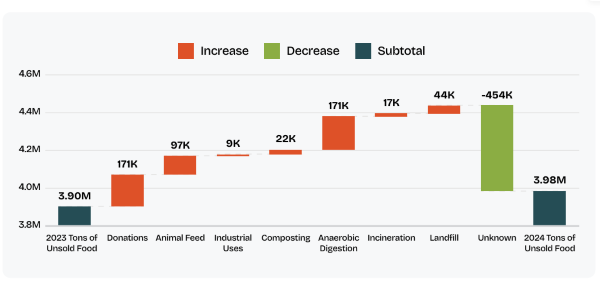
One of the most notable shifts in the dataset is the sharp decline in food waste categorized as having an “unknown” destination. The share of surplus food reported under unknown pathways dropped from 27% to 15%, a 44% reduction, suggesting that retailers are significantly improving how they track and categorize their waste streams.
Improved reporting is more than a technical exercise. Establishing a clearer baseline allows retailers, infrastructure developers, and policymakers to better understand where food waste is flowing and where additional diversion capacity may be needed.
Year-over-year changes in tonnage also highlight growth in preferred recovery pathways. Both donations and anaerobic digestion increased by 171,000 tons between reporting years, representing the largest increases among destination categories. Composting increased by 22,000 tons in comparison.
Figure 2. Year-over-year increases and decreases in food waste volumes (2023 vs 2024)
Source: ReFed 2026
The data also points to an operational shift in how retailers manage food waste. Pact signatories reported increasing use of anaerobic digestion facilities when service providers offer integrated programs that combine hauling, depackaging, and digestion capacity. These bundled services allow packaged food waste to be removed and processed without requiring store staff to separate food from its containers, reducing labor demands in environments where staffing and time are already constrained.
That convenience helps explain why anaerobic digestion is gaining traction in the retail sector. Grocery store waste frequently arrives in packaged form, particularly from departments such as fresh meat and seafood, prepared foods, and dairy. Separating food waste on site from its packaging can require additional bins and staff training. Integrated depackaging services off site can make diversion easier for retailers operating on tight labor margins.
At the same time, this shift raises broader questions about how diversion systems are designed. While integrated services make it easier to capture packaged food waste, they may also reduce incentives to prioritize source separation at the point of generation. As these models expand, infrastructure planners may need to consider how digestion facilities, composting operations, and logistics providers will adapt to handle larger volumes of depackaged and mixed retail food waste streams.
In practice, the structure of available services and infrastructure often determines how food waste is managed. While anaerobic digestion is gaining traction in retail, composting continues to play a dominant role in other parts of the food system. Data from the Pact’s foodservice reporting shows that where composting infrastructure exists, it often becomes the primary diversion pathway. In the foodservice sector, composting accounted for 58% of surplus food destinations in 2024, reflecting the influence of local infrastructure availability and municipal policy.
Taken together, the data suggests donations, composting, and anaerobic digestion each serve different segments of the surplus food stream, and their combined growth reflects a food waste management system that is becoming more diversified and specialized over time.