It’s easy to assume the biggest grinder on the lot is the safest buy. For a lot of compost and mulch operations, it isn’t.
A grinder sized to the operation — not the biggest one available — usually does more for the bottom line. It costs less to own, it’s plenty capable for daily volume, and depending on the model, it can also add color and shift between products as feedstock and markets change.
How to get there comes down to a few decisions: what feedstock the operation actually runs, what finished product its aiming for, and how color gets added along the way.
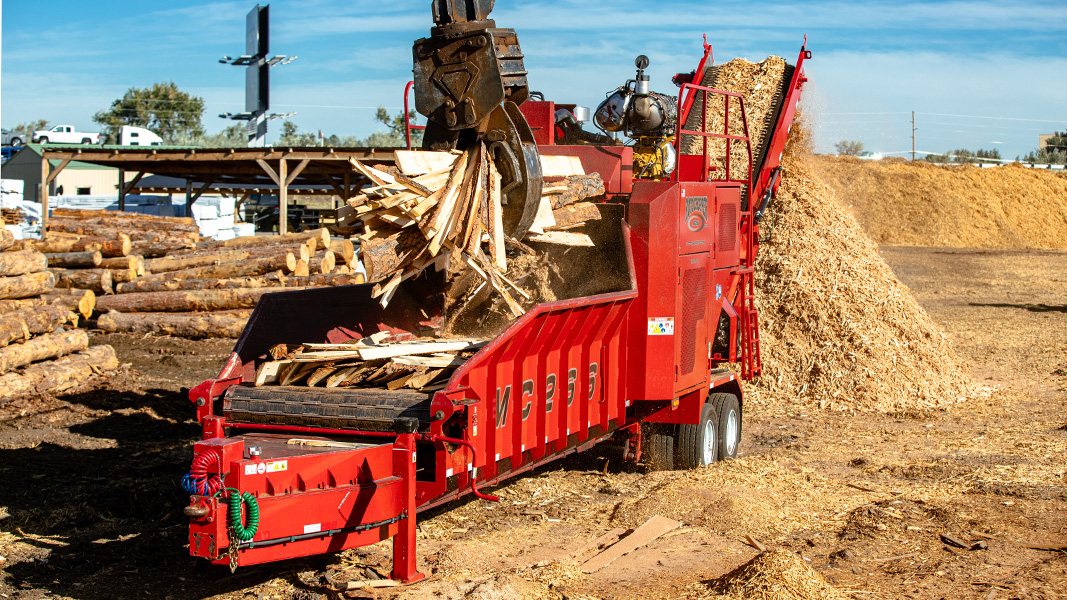
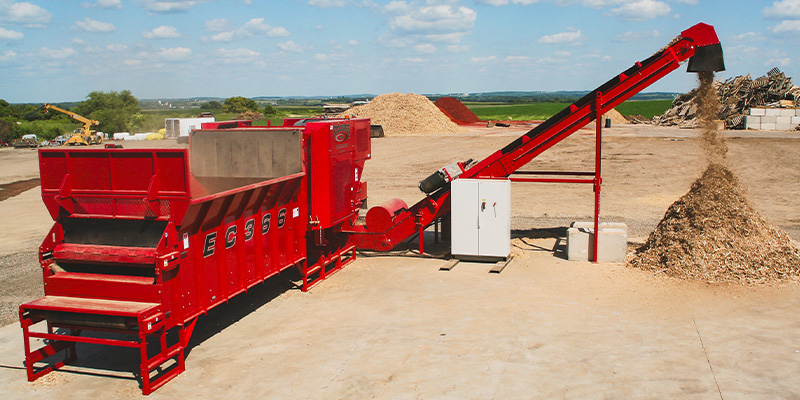
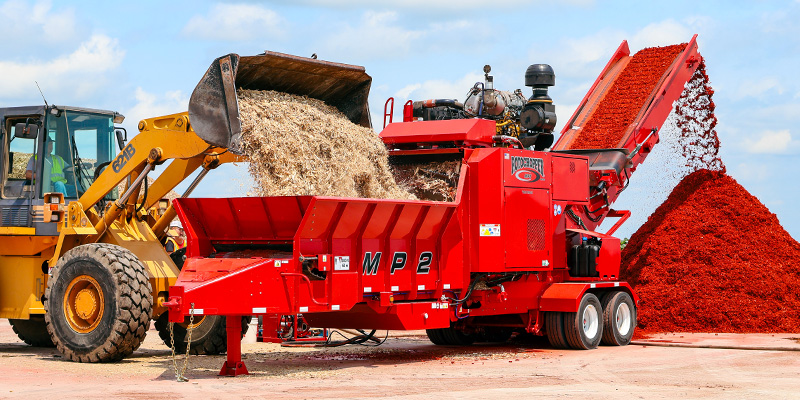
Rotochopper builds grinders across that range, from compact models like the MP-2 and EC-256 to midsize grinders like the FP-66, EC-366, and MC-266, up through high-production machines like the B-66, B-66L, B-66 E, and the L II. The right fit isn’t about horsepower — it’s about matching the machine to the material and the product.
Sizing the Grinder: Why Bigger Isn’t Automatically Better
Here’s why: a high-production grinder built for a tub-grinding contractor running full shifts on storm debris is overkill — and overspend — for a compost site processing a fraction of that volume.
Midsize grinders exist for a reason. They fit operations that need real production capacity but dont need to run a machine built for the biggest jobs in the industry. The right size comes down to a few practical questions:
- What feedstock are you running — brush, pallets, land-clearing debris, screen overs, or a mix?
- How many tons a day do you need to move to keep up with whats coming in?
- What finished product are you making, and what particle size does that product need?
- How much yard space do you have for the grinder, infeed, and stockpiles?
- Where is the operation headed in the next few years — is this a machine you’ll outgrow?
Answer those honestly and the right size becomes obvious. A grinder sized to the job runs more efficiently, costs less to own, and still leaves room to grow.
Getting More Value From Overs and Yard Trimmings
It’s easy to think about grinding as reduction: turn big material into small material, move on. That thinking leaves money on the table. The real value is in the finished product.
The same overs and yard trimmings can become landscape mulch, animal bedding, or biomass and boiler fuel — but colored mulch is where the biggest jump in value usually sits. A versatile grinder lets an operation shift between those products as markets and feedstock change, instead of being locked into one output no matter what comes in the gate or what’s selling that season.
That flexibility is what turns a grinder from a cost center into a product line, with colored mulch as the payoff worth building toward.
Three Ways to Add Color and What Each One Costs You
Once color enters the picture, operations generally take one of three paths:
1. Add a colorizer to the existing setup
A separate colorizing unit gets bolted onto the process after grinding. It can work, but it adds another piece of equipment, another handling step, and another thing that can go down and stop production.
2. Primary grind, then regrind with color
This is what most operations run, and for good reason: feedstock decides it. Large trees, brush, and green waste have to be sized down in a primary grind before color can go on evenly. That material runs through the grinder once to bring it down to size, gets stockpiled, then runs through a second time with colorant introduced in the chamber. Two passes, but each one is doing a job the material actually needs.
3. Grind and color in a single pass
For feedstock that’s already sized right — material that doesn’t need a primary grind to break it down — grinding and coloring can happen in the same pass, with colorant introduced as material moves through the chamber using a system like Rotochopper’s Generation II Colorizer System. That saves a handling cycle, but it only works on the front end of the process, not on raw trees or brush straight off the pile.
In-chamber coloring isn’t new. Rotochopper’s version dates back to 1997, and the current generation uses two spray bars to apply colorant as material moves through at speed, so color stays consistent even at higher throughput. Because the grinder is also controlling particle size at the same time, less oversize and off-spec material means less colorant gets wasted on material that won’t end up in a sellable load. Even the MP-2, the smallest model in the lineup, offers the colorizer as an option — a sign of how single-pass coloring is for operations running pallets, chips, and other already-sized feedstock through a compact machine.
Which path fits depends on what’s coming in the gate. Feedstock that needs sizing first will always need the regrind pass to get even color; feedstock that’s already sized down can skip straight to coloring. Either way, running color as part of the grind — rather than adding a standalone colorizer step — keeps the number of separate machines and handling points down.
The Grinder Is One Piece — Look at the Whole Line
A grinder doesn’t run by itself. Feeding, grinding, coloring, screening, and conveying all have to work together, or the fastest grinder in the world just creates a bottleneck somewhere else in the line.
Before buying equipment, walk the whole process and ask where material gets handled more than once. Every extra pass through a loader, every intermediate stockpile, every step that exists because two pieces of equipment don’t talk to each other — that’s cost. Matching the grinder, screener, and conveyors to the finished product you’re making is what turns a collection of machines into a system.
A grinder running an on-board colorizer can feed straight into conveyors and a bagger, so material goes from raw feedstock to a bagged, sellable product without an extra stop in between. Fewer stops between the grinder and the pallet mean fewer chances for something to slow the line down.
Real-World Application
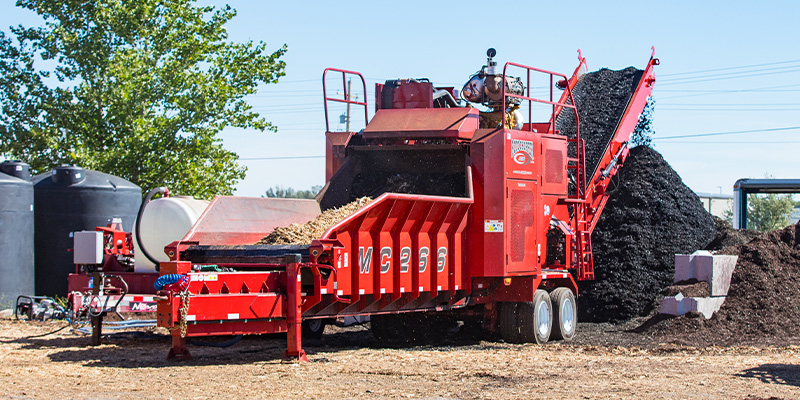
Nick Chiasson and his wife started Montana Custom Millwork, a sawmill in Billings, Montana, that ships post-and-beam, paneling, and siding products across the country. Like a lot of sawmills, the operation generates a steady stream of wood slabs — the first cuts off the log — as a byproduct. That pile had gotten big enough to crowd out the yard, and with no other processor in the area set up to handle that kind of material, Chiasson called Rotochopper.
He picked the MC-266, a midsize grinder — not the largest machine in the lineup — specifically because it came with the option to add color.
“Part of the reason we like the MC-266 is because it has the colorizer,” explains Chiasson.”We knew we’d be able to sell some natural mulch, but if we were going to buy a machine, we wanted it to be a multifunction machine. With the colorizing option, we have a different product to sell.”
Where Each Grinder Size Tends to Excel
Rather than one size being better than another, each tends to fit a different kind of operation.
Compact grinders (MP-2, EC-256):
- Smaller operations with modest daily volume
- Sites with tighter yard space
- Operations getting started with in-house grinding
- Lower up-front equipment investment
Midsize grinders (FP-66, EC-366, MC-266):
- Compost, mulch, and yard trimmings operations with steady daily production
- Sites that want to add colored mulch without a full-scale system
- Balancing production capacity against footprint and cost
- Operations planning for growth without overbuying now
High-production grinders (B-66, B-66L, B-66 E, L II):
- Large-volume contract grinding across multiple sites
- Storm debris and disaster cleanup
- Land clearing and C&D operations
- Biomass and fuel processing at scale
The Bottom Line: Matching Grinder Size to Product
The opportunity starts with material that’s already coming through the gate. Identify the product you can sell first — colored mulch, animal bedding, boiler fuel — then work backward to the grinder size, coloring method, and processing system that get you there.
These numbers shift based on your feedstock, throughput targets, and site setup. Because Rotochopper builds grinders across the full range and sells factory-direct, our engineering team can help you match grinder size and coloring method to your operation — before you commit.
Call 320-875-9950 or visit rotochopper.com.