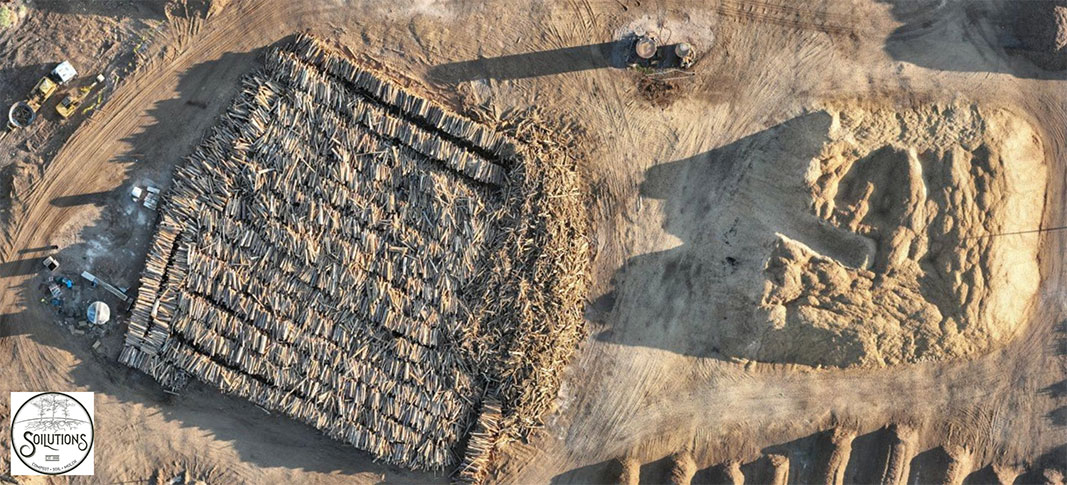
Top: Aerial view of Soilutons’ composting facility highlights the one-acre storage area for logs (on left) received from a U.S. Forest Service land clearing project. Photos courtesy of Soilutions
Nora Goldstein
Dawn and Justin Dewey are entrepreneurs. In 2021, they were looking for a new business adventure, and learned that Soilutions, a long-time composting company in Albuquerque, New Mexico, was for sale and made an offer that was accepted. Dawn Dewey, who had been head of marketing at a remodeling company, was familiar with composting as her father managed the City of Albuquerque’s composting facility for many years. But neither she nor her husband, who worked in the solar industry, had hands-on experience.
But they were quick learners. An early innovation was to improve homeowner access to finished compost by launching an e-commerce store to purchase bulk compost, soil blends and mulch online for driveway delivery. That was followed by establishing a partnership with a local landscape supplier to carry their bulk products at five locations throughout the metro area.
Incoming feedstocks included yard trimmings, land clearing debris, tree trimmings, manure and food waste from food manufacturers and grocery stores. (Manure is no longer accepted.) Soilutions’ sales grew from around $700,000 in 2020 to $2.2 million in 2023, Dewey told BioCycle in a 2024 article. And for the first time since they owned the business, demand for compost outpaced supply.
Increasing Food Waste Flow, Compost Production
Soilutions is located on a 14-acre site. The original owner utilized static piles for compost production, which is typically a slower process than turned windrows or aerated static piles. In January 2024, Soilutions began transitioning its compost manufacturing methodology from passively aerated static piles to an aerated windrow system. The company purchased a used windrow turner from the City of Albuquerque’s water department. “Right after we shifted to windrows, we recognized that we needed more feedstocks to compost,” recalls Dawn Dewey. “About a week later, Denali queried us about accepting a regular flow of food waste from its accounts in the Albuquerque area. They service big box stores, food distributors and other outlets, often getting loads of packaged food waste that cannot be sold or donated. We signed a 5-year agreement at an agreed upon rate to receive and process the food waste they collect.”

Soilutions receives about 200 to 250 tons/week of food waste, which is processed through a depackager prior to composting.
About 200 to 250 tons/week of food waste are delivered to Soilutions’ site. As part of receiving this food waste stream, Denali installed a Scott Equipment T42 Turbo Separator depackaging unit on site. Soilutions charges Denali a tipping fee to bring in food waste but it is responsible for fueling and operating the depackager, and for landfilling the packaging residue. Denali has a full-time employee on-site to maintain the depackager. “He’s a former employee, so is familiar with our operations,” says Dewey. “And he’s been trained on how to make adjustments to the paddles on the depackager based on the types of packaging being processed, as well as do maintenance. We haven‘t had more than one day of downtime at a time since it was installed in December 2024.”
Depack Tweaks
Getting the depackager to operate smoothly and consistently took some trial and error, and reconfigurations. When it was first installed, it was run at maximum speed. “The timing was bad, as the end product coming out of the windrows from that first processed food waste was for our spring sales,” explains Dewey. “We received complaints about packaging contamination in the compost, especially our Forest Floor mulch product. Soilutions has a triple-deck screener. The small wood chips from the middle screen make up 45% of the ingredients for our Forest Floor mulch. Last winter, we worked diligently to adjust the depack machine and our input ratios to minimize any contamination in our final products. We partnered with Denali and Scott to make adjustments to the depackager to address contamination. We also wanted to minimize food residuals in the packaging residues as that increases the weight of the dumpster, which in turn increases Soilutions’ disposal costs. Depackaging technology is definitely the unlock to scaling food waste recycling, so we are really grateful to have it and be on the cutting edge of this vital industry.”
Modifications included:
- Lowering the speed of the initial cork screw feeder that breaks open the packaging to reduce shattering of hard plastic containers
- Adjusting the paddles in the drum and the speed at which the drum operates
- Utilizing spray nozzles in the drum to create a washing machine effect, reducing the amount of residual food waste in the packaging
- Changing the screen size where the food slurry is pushed out from a 1-inch to a half-inch hole
“The tweaks resulted in a really good material, with virtually no packaging contaminants,” notes Dewey. “The packaging stays as whole as possible so it doesn’t shatter.”
Bring On the Logs
One outcome of increasing the flow of food waste was having to significantly increase the flow of carbon coming into the facility. Soilutions began offering free community drop-off for yard trimmings and brush but it wasn’t enough to meet its needs. “We spent two years pounding the pavement looking for carbon sources, including going to the conservancy district that was doing clean-up along the riverbank, and to the U.S. Forest Service (USFS),” says Dewey, “The Sandia Peak, just east of Albuquerque, was long overdue for tree clearing as part of a fire mitigation project. The work had been delayed, in part because the USFS couldn’t find a partner that could take in the volume of logs that would be cleared. Soilutions connected with USFS to become an outlet for carbon to both meet product demand and to process the food waste.”
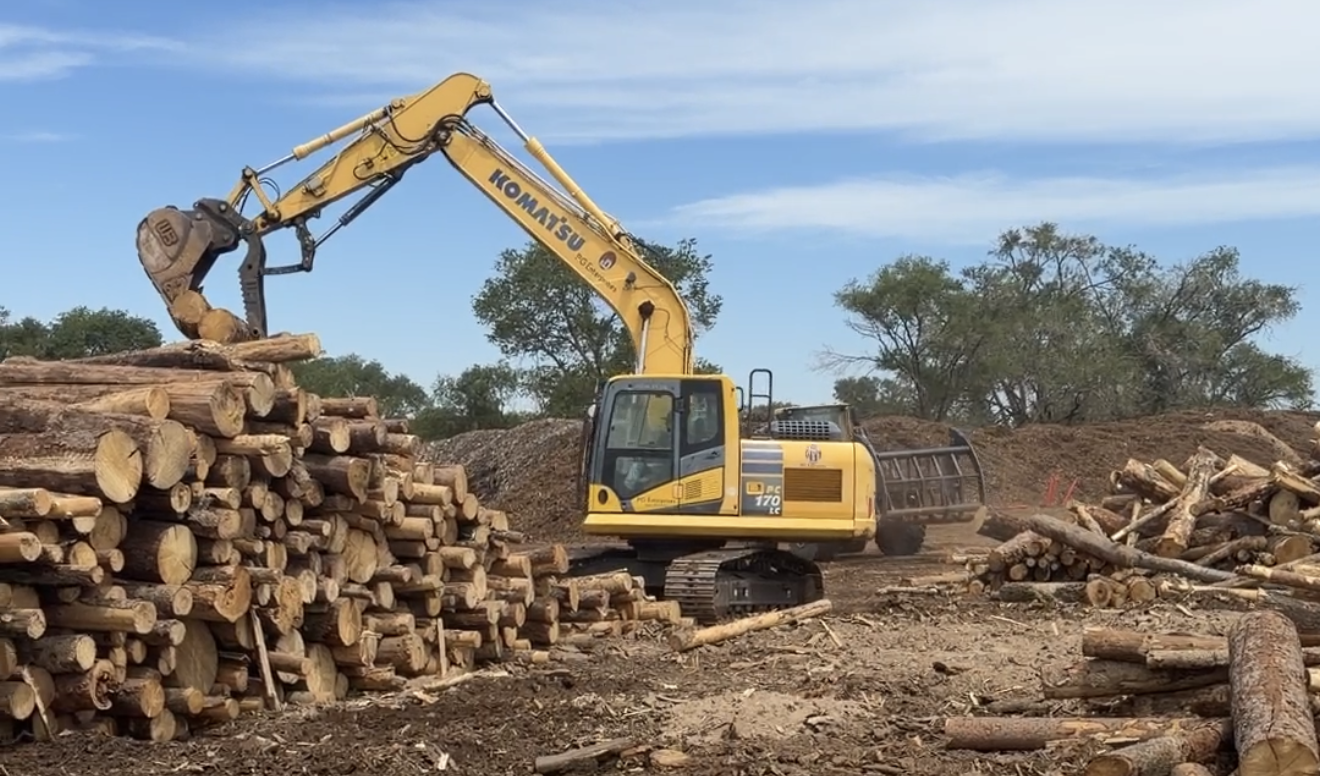
More than 50,000 logs were received in summer of 2026, providing necessary carbon for food waste composting.
Land clearing started in June 2026; ultimately, Soilutions received over 50,000 logs. “We designated a 1-acre area to stockpile the logs, and were getting close to 20 trucks per day,” she adds. “We limited the dimensions to 8-feet long, and they were 8 to 20 inches in diameter. An excavator and loader were used to stack them, and we had to rent a Vermeer 4600 grinder, as our tub grinder could not accommodate the logs. We were grinding about 2,000 yards/day. Soilutions proved to be a reliable outlet for the USFS land clearing project. There are 30 more acres to clear this Fall, and we hope to partner with them on many more projects for years to come.”
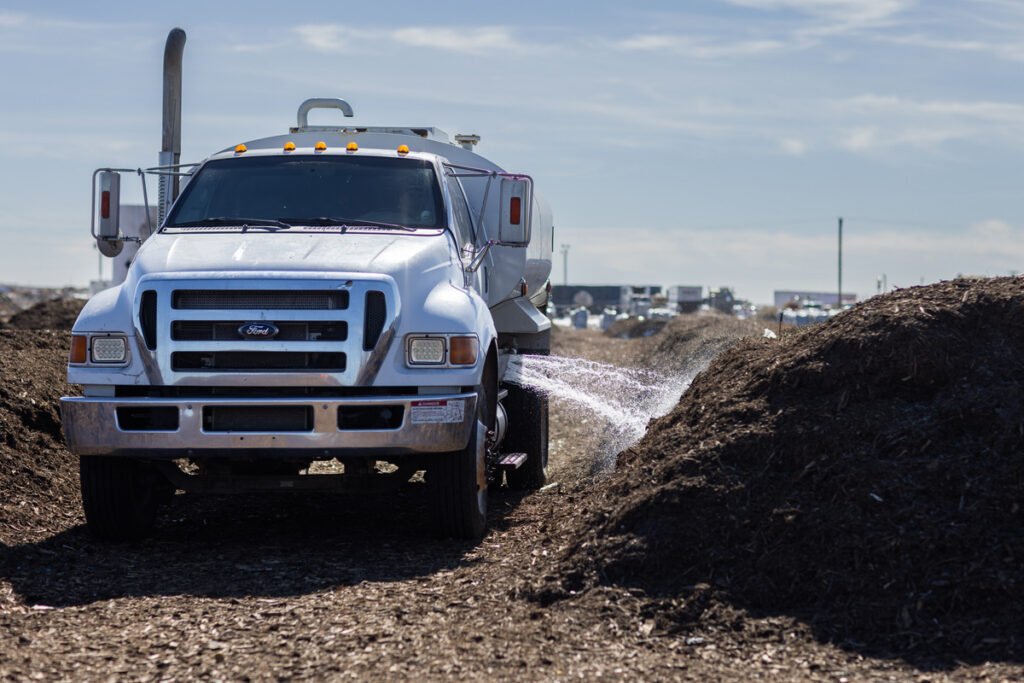
Soilutions increased its carbon to nitrogen ratio in its windrows, which has required more water addition.
Being carbon rich led Soilutions to adjust its compost recipe to accommodate a higher carbon to nitrogen (C:N) ratio, which in turn requires more water. “The food waste slurry is very moist and is a fabulous addition to the windrows,” says Dewey. “It is like a ‘wetting nitrogen bomb’! But the slurry doesn’t add a lot of liquid volumetrically, so we have to increase the amount of water we spray into the windrows using a water truck.”
Meeting Compost Demand
The increased flow of food waste and carbon has helped to meet market demand for its compost although the company was sold out in May of this year (versus March in 2025). “When we say sold out, it is basically where we have to enact limits on how much our big retailers and customers can purchase,” notes Dewey. ”So, making them wait and not be able to fill bins as fast as they are selling naturally depresses our overall sales potential.”
Soilutions receives between 1,200-1,800 cubic yards (cy)/week of feedstocks, and produces about 31,000 cy/year of compost. The site has capacity to take in more food waste, and Soilutions has been working with Denali to bring on more local partners such as restaurants and schools.
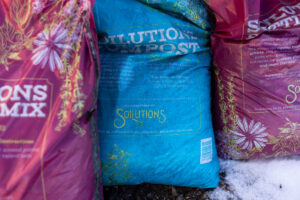
Bagged product is sold to plant nurseries and landscape supply stores.
In terms of end markets, about 50-60% of sales go to residential home gardeners; the balance is commercial landscapers, municipalities, botanic gardens and other outlets. In 2026, Soilutions worked with the bagging company it uses to make printed bags. “We did a run of 12,000 bags,” she says. “We sell them to plant nurseries and landscape supply stores. We almost sold out, and have about 10% remaining. We’ve also been servicing huge commercial projects, which we’ve been able to fill now that we have plenty of wood chips available.”
Overall, Soilutions has continued to see 30% growth year over year, with annual revenues close to $3 million in 2025. The company continues to reinvest profits in the facility. “The latest is installing a system of conveyors so that we can stop moving materials using loaders,” adds Dewey. “This will reduce the amount of spillage of finished products.”