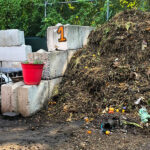
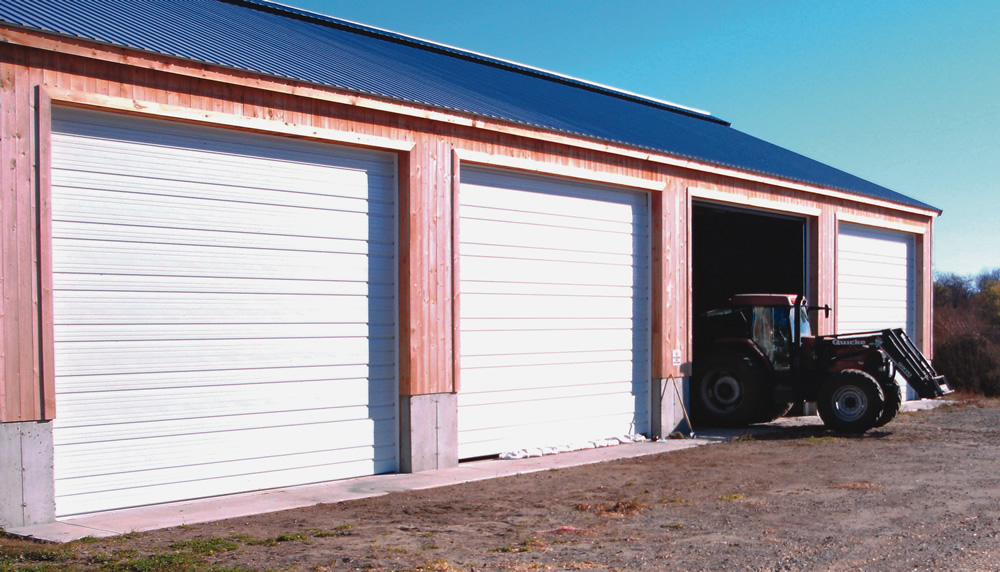
Top Photo: Courtesy of University of New Hampshire’s Organic Dairy Research Farm.
New Hampshire’s food waste disposal ban took effect in February 2025, requiring any business or institution generating a ton or more of food waste per week to divert it, provided a management facility exists within 20 miles. A new study commissioned by the state’s Department of Environmental Services puts hard numbers behind a problem many in the composting industry have suspected for a while. The ban is running well ahead of the infrastructure needed to enforce it.
What the Study Found Statewide
The New Hampshire Food Waste Generation Study and Infrastructure Analysis, conducted by Resource Recycling Systems, the Center for EcoTechnology, and New Hampshire Food Alliance, identified 888 entities across 17 sectors that fall under the ban. Together they generate an estimated 222,220 tons of food loss and waste annually. Of that total, 154,883 tons are already diverted through donation, animal feed, composting, or anaerobic digestion, leaving 67,338 tons still headed to landfill or incineration statewide.
Food processors and manufacturers — spanning dairy, seafood, bakeries, and grain milling — account for 155,570 tons of that generation, roughly 70% of the statewide total. Most of that sector’s waste is already diverted, largely to animal feed, which the study notes is a widespread but mostly informal and unregulated pathway. Grocery stores generate 32,294 tons and restaurants 10,860 tons.
Where the Ban Actually Bites
New Hampshire’s 20-mile rule is what determines whether an entity is legally required to divert, so the more useful number for infrastructure planning isn’t the statewide total. It’s the disposal volume among the roughly 460 affected entities that actually sit within range of New Hampshire’s existing in-state composting facilities. That subset generates an estimated 36,500 tons of disposed food waste per year. Against that, the state’s in-state composting infrastructure offers only 8,096 tons of annual processing capacity, with 3,405 tons of that currently unused.
The gap is worst in the southeast part of the state. GBN Farms, a composting facility in Chester, sits within 20 miles of 301 affected entities generating 23,922 tons of disposal volume, against its 3,650 tons of processing capacity, leaving a deficit of more than 20,000 tons at that one facility alone. Hillsborough and Rockingham counties post the highest concentrations of food waste generation statewide, at 51,090 and 68,820 tons respectively, and both fall squarely inside that underserved zone.
Table 1. New Hampshire’s Composting Capacity Falls Short Where It’s Needed Most (AES or Affected Entities)
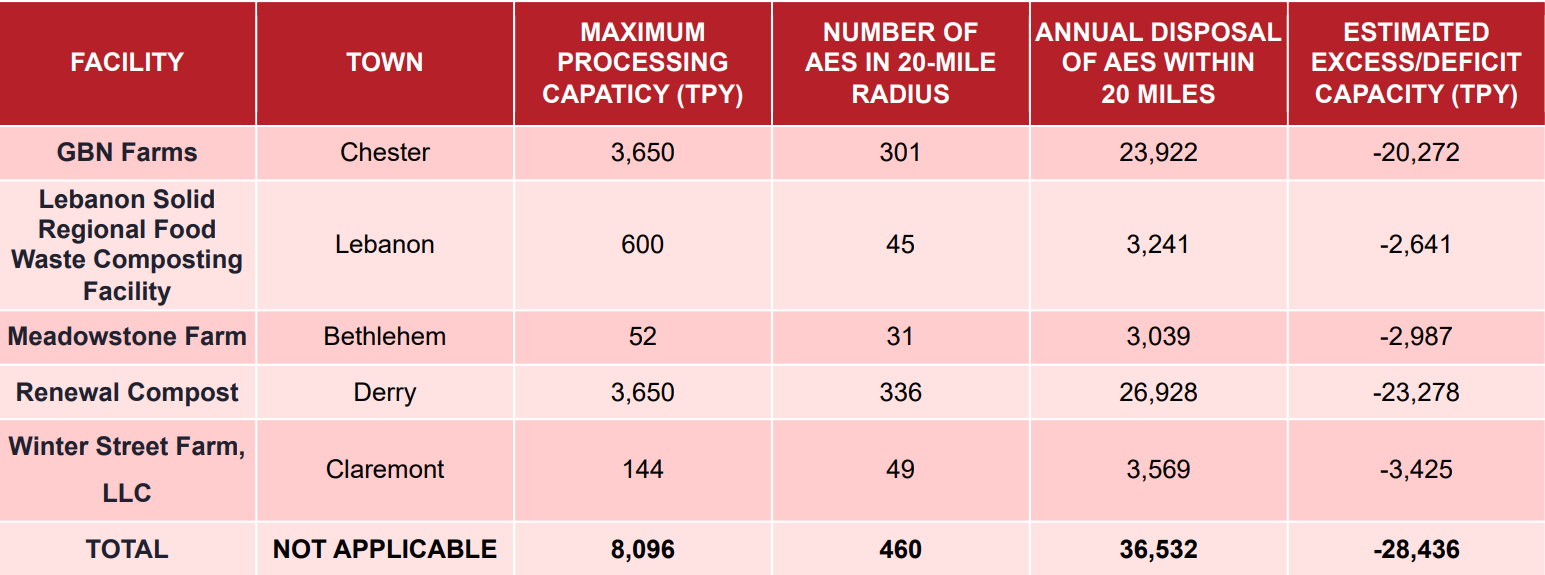
Facility-level capacity, service area, and disposal deficit for New Hampshire’s four in-state composting facilities. GBN Farms alone faces a shortfall of more than 20,000 tons a year within its own 20-mile service radius. Source: New Hampshire Food Waste Generation Study and Infrastructure Analysis. Click here to expand this image.
New Hampshire currently has no permitted food waste anaerobic digestion facility operating in-state. The nearest capacity comes from two Vanguard Renewables’ on-farm digesters just across the border in Haverhill and Deerfield, Massachusetts, which together process 36,500 tons/year against a combined 73,000 tons of capacity. A proposed AD facility with a co-located depackaging plant in Londonderry could become New Hampshire’s first, but it was still working through a public hearing process as of the study’s release.
The study also surfaced a diversion pathway that doesn’t show up in any formal accounting. Interviews with generators and the state’s food bank turned up informal, longstanding arrangements between local businesses and pig farms under New Hampshire’s swine feeding law, arrangements the state doesn’t track and largely can’t verify, but which appear to move a meaningful volume of food waste out of the disposal stream.
What the Study Recommends
The report’s five priorities center on technical assistance for generators still unsure how to comply, stronger support for donation and source reduction, targeted infrastructure investment in the counties with the widest coverage gaps, and better ongoing data collection so the state can track whether the ban is actually working. None of those recommendations require new capacity to appear overnight, but they set the direction for where public investment should go next.
New Hampshire’s own analysis makes clear that turning a requirement on paper into an enforceable one will depend on how fast composting and anaerobic digestion capacity can be built in the exact counties where it’s currently missing.