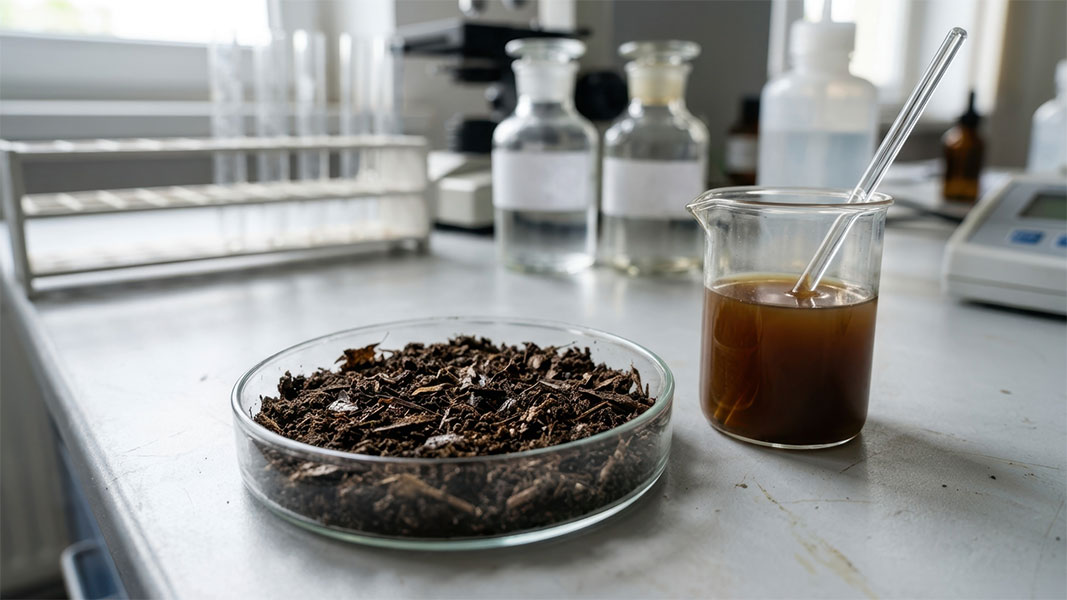
Photo from Adobe Express.
Juliana Beecher
Test Methods for the Examination of Composting and Compost (TMECC) is the lab manual of standard protocols for the composting industry, used by compost producers and laboratories in the U.S. and worldwide to evaluate compost quality. Standard test methods enable the comparison of composts across testing labs and composting processes across facilities. The data from comparable test results become the baseline against which the industry measures compost quality and builds trust with consumers. Standards tell us what we’re actually getting when we buy a bag of compost.
Why an Update Now?
TMECC was first published in 2002, but some of the methods were written as early as 1996. Only minor updates have been made to existing methods by volunteers throughout the years. A second edition was published in 2015. A lot has changed over the years: technology has come a long way and there are simpler, more accurate methods now available and widely used. Feedstocks have changed, along with types, quantities, and our understanding of contaminants (such as PFAS). Also, since these methods have been in use for over 20 years, we know which ones are difficult to interpret and which are unnecessarily time-intensive and expensive. Labs want less tedious accepted methods, and compost producers and users want field-based methods for faster decision-making and lower costs.
The Compost Research and Education Foundation (CREF), which publishes and maintains TMECC, has been fundraising for several years specifically for this update. Funding from the composting industry and from ReFED allowed for hiring two soil scientists to lead these major updates — Dr. Shelby Hoglund, TMECC Program Manager, and Dr. Michele Francis, Associate TMECC Program Manager. Labs, producers, university researchers and others provide regular feedback on the methods in TMECC, and that feedback is guiding their work.
Project Process
A current priority of the project is updating the methods used by the U.S. Composting Council’s (USCC) Seal of Testing Assurance (STA) program, a national program that certifies compost quality. The STA program looks at 18 parameters, and TMECC sometimes includes multiple methods for one parameter. New methods can be proposed by individuals and organizations for inclusion in TMECC. The method proposal form that must be submitted includes an evaluation rubric and requests justification for inclusion.
Forms are submitted to Hoglund and Francis, who decide if the proposed method passes muster for inclusion, or if more information is required from the proposer. If the proposed method moves forward, it is sent to topic experts on the CREF Standards & Practices (S&P) Committee, then to the full S&P Committee for feedback on whether to include the proposed method in TMECC.
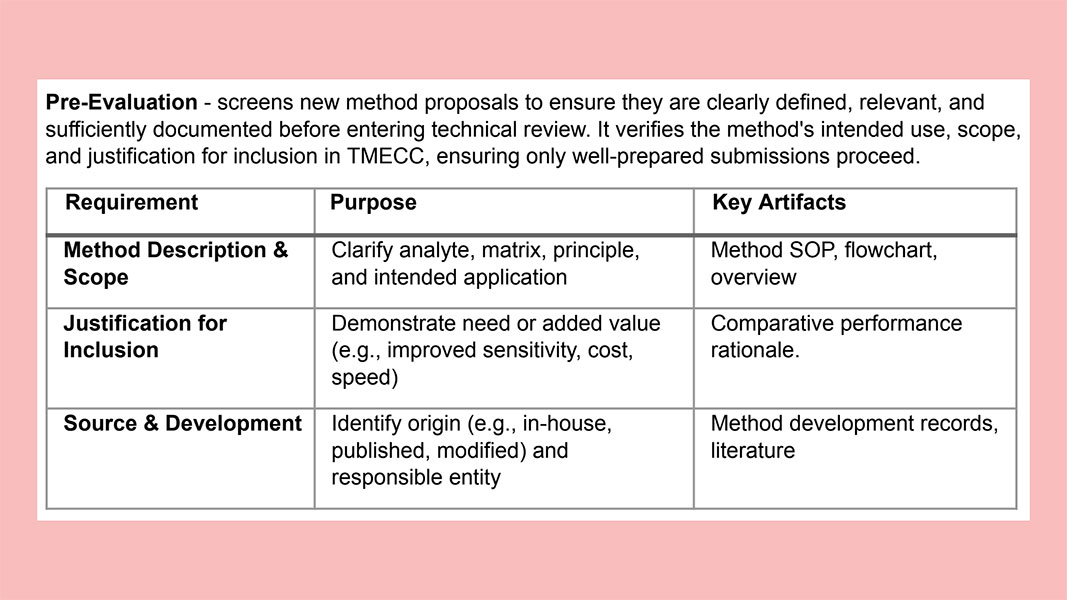
Snapshot of the form for proposed methods, which pass through four steps of a framework: pre-evaluation, technical suitability, risk and feasibility assessment, and external validation or benchmarking. Courtesy of CREF.
TMECC includes multiple methods for testing the same compost or composting characteristic. This is critical to its widespread use, even internationally — not every compost producer or lab worldwide has access to the most recent technologies, so some continue using lower-tech methods even as new, higher-tech ones become available. Some methods have been found to be outdated or redundant and will be retired.
What’s Changing
This major overhaul to TMECC will come in phases. The first round of updates, taking place over the next two years, will include methods for all 18 parameters used by STA, plus several new parameters: PFAS, microplastics, and microbial parameters (fungi, protozoa, bacteria). For a complete list of methods to be included in the third edition of TMECC, visit the TMECC website.
Field Testing: Compost producers and users have asked for more field testing methods that allow for faster evaluation of compost. For example, the California Department of Transportation (CalTrans), which has robust specifications for compost for various uses, wants to be able to evaluate a load of compost before hauling it from a facility to a job site without having to wait days or weeks for test results. Some of the methods proposed by individuals in the composting industry include in-field test methods, such as using a food dehydrator to dry a compost sample to measure moisture content.
Total N: Testing for nitrogen (Total N) is a great example of TMECC falling behind the technology. The old version allowed combustion analysis alongside wet-chemistry methods but was unclear about method selection and sample preparation, reflecting a time when combustion technology was less widely used and laboratory practices were less standardized. The updated method provides clearer guidance for combustion analysis, which is faster, cheaper, and already widely used by labs. Members of the CREF S&P Committee and the STA Advisory Committee, who decide which methods labs can use for STA certification, support this update.
PFAS: PFAS is a prime example of an emergent contaminant that’s unaddressed in TMECC. There’s currently no standard method for measuring PFAS in compost, but there is EPA 1633A, the standard for analysis of PFAS in “aqueous, solid (soil, biosolids, sediment) and tissue samples by liquid chromatography/mass spectrometry (LC-MS/MS).” Compost is not interchangeable with soil or biosolids: its high organic-matter content and heterogeneous mix of materials can bind PFAS, hinder their extraction and interfere with detection, potentially causing concentrations to be under or over reported. The CREF team is working with a research team at Purdue University to develop and validate standard modifications to EPA Method 1633A for use with compost. That includes developing and testing a standardized new sample prep process that accounts for the mixture of coarse and fine particles in most composts, and expanding the analytes to include PFAS precursors found in food waste.
Shipping Samples: In some cases, it’s not the test method itself but the handling or sample prep requirements that would benefit from an update. For STA participants, the test method for pathogens currently requires 24-hour shipping to a lab. That’s not only costly for compost producers, but not even available everywhere in the U.S. New shipping containers and freezer technology have been proven to keep samples below -10˚C for 48 hours. Changing the shipping requirement from 24 to 48 hours would cut the cost in half and open access to STA to producers in rural areas where 24-hour shipping is unavailable. The methods and technologies for detecting pathogens have also become easier and less time-consuming in recent years, and the updates in TMECC will reflect those improvements.
Measuring Contaminants: CREF has received many requests for new methods to measure physical contamination in compost — especially microplastics. TMECC only includes a lab-based method for identifying contamination, and “it’s a tedious method, based on the laboratory feedback we’ve received,” says Hoglund. A field-based test method for physical contamination is in high demand, as is a method specifically for microplastics. A research group at Stanford is helping to develop a microplastics method, starting with defining what “micro” plastics are, by dividing particles into macro, meso, and microplastics depending on their size.
Microbial Parameters: For the first time, TMECC will include methods to measure microbial parameters. This addition arises from the rapidly emerging interest in understanding the concentration of non-pathogenic microbes in compost including bacteria, protozoa and fungi.
Streamlining Access: The CREF team is also modernizing TMECC by making it available online and allowing users to purchase and download only the chapters they need, rather than purchasing the full suite of methods. The online version will come with recommended citations for every chapter, every method, with a permanent digital object identifier (DOI) link to the chapter. Hoglund and Francis are also updating the formatting, language, and sampling and handling instructions throughout — making the whole document more streamlined and accessible. There’s even the hope of making TMECC open access (free for use) in the future, though that would require significant funding.

The TMECC webpage displays existing sections, chapters and methods, with notes of what will be updated. Click here to expand image.
Why These Updates Matter
The conditions under which parameters are measured can affect the result of a measurement. To quote Francis in CREF’s informational video about the TMECC updates, “TMECC specifies these conditions and the measurement methods so we can be sure when we compare values for different composts we are really comparing the different composts and not the different conditions and methods that we used to measure that parameter.”
Standardized methods are invisible infrastructure that allow for comparisons across composts and across results from different labs. They support the development of parameter standards for regulations and specifications governing the production, purchase and use of composts. Standards build trust for compost products and the composting industry by providing a baseline against which quality is measured. For compost consumers, it’s important that test methods are reflective of their latest concerns, such as PFAS and microplastics. For compost producers and testing labs, up-to-date methods can mean lower costs, fewer labor hours, and shorter turnaround times.
Timeline and Future Plans
TMECC has 136 methods. With current funding, methods for just 18 parameters are getting updated — those used by the STA program — and methods for two are getting added for PFAS and microplastics. CREF received catalytic grant funding from ReFED to make updates to the methods for PFAS, plastics and pathogens, and raised funds for work on the other updates. Hoglund and Francis plan to present the first round of updated methods at the U.S. Composting Council’s COMPOST 2027 conference in February 2027.
Future updates beyond the STA methods will include new methods for predictive modeling, some of which have already been proposed. “Predictive modeling could, for example, allow compost producers to assess in situ synergistic effects of various composting parameters during the composting process to be able to make real-time decisions,” Hoglund says.
CREF has also proposed developing a predictive model for another project, a water savings calculator. This online tool will allow users to input compost and soil characteristics, growing conditions, irrigation practices, and compost application rates to calculate water holding capacity in soil with compost application. Meta-analysis for this tool is required that will look at the effects of different compost characteristics on water retention.
Once TMECC is online, it will become a living document, much easier to update as needed in the years ahead. The TMECC requires ongoing maintenance by experts like Hoglund and Francis. “If smaller, frequent edits can be made as needed, this will be the last TMECC overhaul of this scale,” Francis says. That will be good for the whole compost industry and its end users — more accurate, current test methods to ensure quality and consistency of products, and consumer trust.