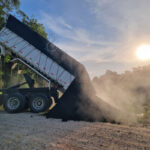

Top: Composting pad at Timber Creek Recycling in Nampa, Idaho. Photo courtesy Green Mountain Technologies
Jorge Montezuma and Stacey A. Smith
The working pad is one of the largest capital investments a composting facility will make, and it is also one of the most overlooked. Sometimes equipment is ordered, the first loads arrive, windrows go up, and operations begin on whatever ground surface happened to be there. For a while, it works. Then the ruts, the puddles, the equipment keeps moving along, and then soft holes appear, and the operator wonders when the surface went bad. The pad usually did not go bad on any single day. It often wears down a little at a time, for years, and not catastrophically.
This article discusses how to approach pad design and construction at composting facilities so that it supports the operation instead of slowly working against it. Composters sit on a wide spectrum. On one end are large permitted facilities that must submit engineered drawings before moving any soil. On the other are small, exempt, and/or farm-based operations that build a pad the same way they build many things: DIY, with the materials on hand, on a tight budget, discounts from friend contractors, and learning as they go. Our goal is to give operators at either end enough understanding to make better capital decisions and to recognize when a geotechnical professional should be part of the process.
Below the Surface
The first question in pad design is not which surface you want. It is what you have, what you are required to do, and what you are going to do on top of it. Regulatory and operational requirements set baselines and the soils beneath the site determine what is structurally feasible and at what cost. The gap between the requirements and the soils below the surface is what drives the design.
A geotechnical investigation, typically soil borings with laboratory analysis, provides that information. It identifies the soil types present, whether conditions are consistent across the site or variable, and whether there are problem areas such as pockets of organics or weak zones that need special treatment. Sites with sandy or rocky soils may have strong, stiff subgrades that require little intervention. Sites dominated by silts and clays are softer and more sensitive to moisture. Without evaluating the soils, there is no reliable way to know which situation applies.
The consequences of skipping that step can be significant. On one project, a drilling program revealed unexpected pockets of organics that turned what would have been a straightforward stone-and-fabric section into a stone column system spaced at 10 feet, which was necessary to prevent roughly 18 inches of settlement. On another, native clays in a desert climate with significant storm seasons revealed subsurface swelling on the order of nine inches, enough to make any structural designer think twice.
A geotechnical investigation may cost $5,000 to $50,000 depending on location and size of the project. Compare this to the cost of pads that cost hundreds of thousands of dollars plus the operating costs over years on end. Knowing what is below is the first act of sound judgment.
Keep Organics On Top of the Pad
Composters work with organic matter every day, but organic materials do not belong below the pad. Organics in the soils do not provide structure. No one would knowingly build a house on five feet of compost or mulch; it is far too soft. The same logic applies to the foundation beneath a pad.
Previous operations on a site may have left residual compost or organic buildup worked into the ground in unexpected places. Low-lying areas where water collects, or certain vegetation types, can indicate residual organics below grade. These conditions should be identified and removed before any structural surface is placed on top.
Pad Layers
A composting pad is a structural system, and understanding how its layers work together is what allows operators to make sound cost tradeoffs. For most operations the ideal end state is a concrete pad, which handles the loads, the scraping, the turning, and the constant wetting and drying. For many, this will be out of reach, and other practical surfaces can meet requirements with a lower capital expense but perhaps higher operational expense. Everything is a tradeoff and understanding the layers can help you determine what level of risk you are willing to accept and progressively improve your compost infrastructure. The following elements are integral to pad construction.
Figure 1. Pad Cross-section

Source: Jorge Montezuma, Wanu Organics. Click here to expand this image
Subgrade: This is below the surface you step on. The soil found on site is called native soils, and this is the starting point. In general, it should be compacted to 95% of an achievable or optimal density, a value determined by laboratory testing known as a Proctor Curve. In addition to random location in-situ (in ground) tests, the results can also be verified through proof rolling, which means running a loaded truck or weighted wagon over the surface to find soft or yielding zones that must be fixed before base material is placed. Soils compact differently: silts have a narrow moisture-density window that is easy to get wrong, while sandier soils are more forgiving. The strength of soils can be adjusted with moisture and compaction, so the moisture-density window matters to get pads right.

Test pit with organics shown underneath. Photo courtesy of Stacey A. Smith.
Stabilization: Where native soils are inherently weak, such as silts underlain by poorly draining clays or weathered rock, soil amendments such as lime or cement stabilization can improve the strength.
Geotextiles and Geogrids: These geofabrics are placed directly on the prepared subgrade. A geotextile serves two functions: separation of layers and equipment load distribution. It keeps subgrade soils from migrating up into the stone base under repeated loading, a process that contaminates the structural layer over time. It also distributes point loads across the fabric plane to help bridge weak zones. In practice, a geotextile can be worth roughly an additional 6 inches of stone. Where soils are very weak, stronger reinforcing geotextiles or geogrids may be warranted.
Aggregate Base Course: “ABC” Stone provides the primary structural support. It is strong, widely available, and can be increased in thickness to compensate for weaker subgrades. When this material is operated on and is poorly compacted, moisture and organics get into the pad through the scraping and turning by equipment. This slowly degrades the surface and requires patching it, often with whatever type of stone is around. That is manageable, and many operations run on stone for years. Just like soil subgrades, ABC should be compacted to 95% of its Standard Proctor (discussed above).
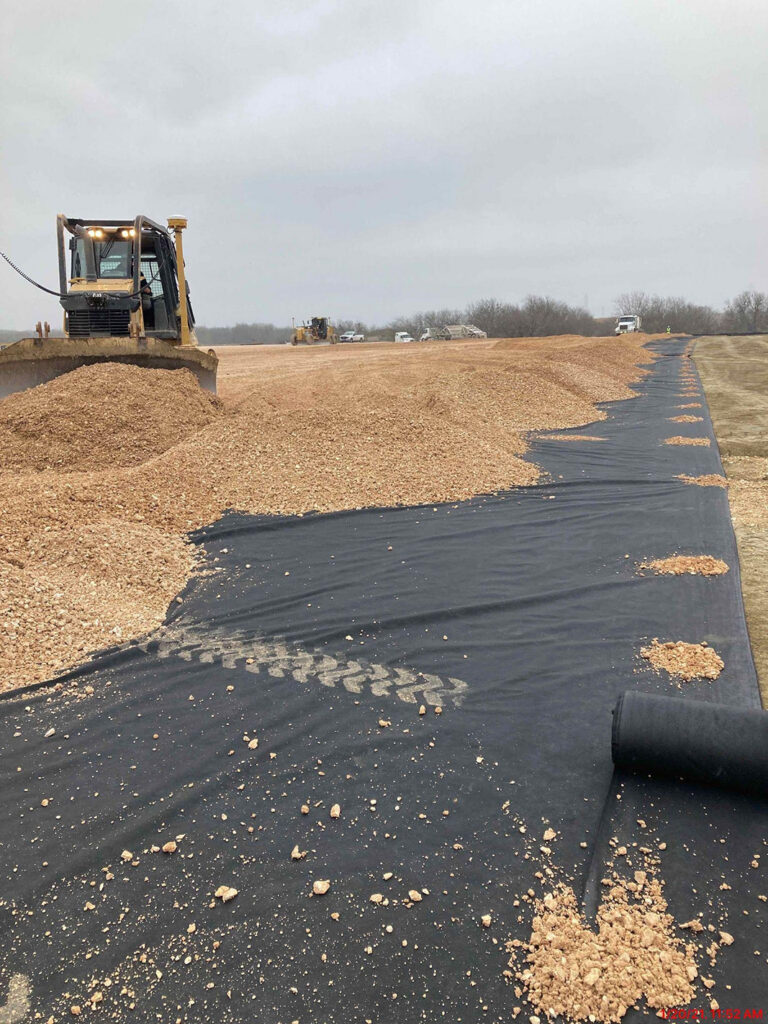
Rolling out geotextile and placing aggregate base on top. Photo courtesy of Stacey A. Smith.
Asphalt and Concrete: These are the top of the investment hierarchy. Asphalt is easier to patch but softens in warm climates, and the twisting of heavy equipment can damage its surface, especially when temperatures are high. Concrete is rigid, durable, and provides the best wear surface for scraping and loading, but it is unforgiving if the foundation beneath it is inadequate. A soft subgrade will cause concrete to crack, and once cracking starts, freeze-thaw cycles and scraper blades accelerate the damage. The required concrete thickness and reinforcement depend on both the soil beneath the slab and the equipment that will work on top of it: a weak or variable subgrade, combined with heavy and repetitive loads, requires a thicker section, added reinforcement, or an improved base before any concrete is poured. Depending on region and market conditions, asphalt and concrete can be comparable in cost.
Pad Design Basis: Equipment and Water
Two variables shape a pad as much as the soils do. The first is equipment. Wheeled machines produce higher point loads than tracked machines, which distribute weight across a longer footprint, so it’s easier on the surface it stands on. A tracked skid steer or a tracked turner can allow a thinner pad section, and tracks tend to handle wet or weak surfaces better than tires, which can spin and dig. Windrow turners deserve particular attention: their tight turning radius generates horizontal shear at the surface, and a four-wheel-drive turner making tight turns can damage even a well-built pad. If equipment has not been finalized, it is worth discussing with the engineer and vendor first, because the configuration directly affects what the pad must be. To account for different uses across the different stages of a pad, the surfaces can be different to decrease costs. For example, you may choose to only have concrete in areas with very heavy equipment traffic and compacted stone everywhere else.
The second variable is water, and it drives nearly everything. Geotechnical engineers often say that without water their profession would barely exist. For composting, the challenge is compounded, because the process itself requires moisture, which keeps the pad in near-constant contact with applied and natural water. For example, dry clay can be hard and stiff, but add moisture and it becomes pliable and weak, and the more moisture, the weaker it gets. Clay that performs well in a dry Texas climate must be designed very differently in wet North Carolina, not because the material differs but because the frequency and duration of moisture exposure do. Water can be managed through engineering and operational controls.
The pad surface also determines how much water the operation must manage. An impervious surface such as concrete or asphalt sheds almost all the rain that lands on it, which keeps the pad workable while sending more runoff into the stormwater system. A compacted soil or aggregate pad lets some water infiltrate, reducing runoff volume but leaving the surface more sensitive to saturation. A slope of at least 2% is recommended to give water a path off the surface rather than into it; fully paved surfaces can function with a slope as low as 1%. A maximum slope of 6% keeps water from moving fast enough to erode the pad. Too little slope is just as damaging as too much: water ponds where it cannot drain, and equipment ends up working on a softened surface that ruts and fails prematurely.
A few practical operational controls to take care of the pad are housekeeping, speed limits, and operating heavy equipment carefully:
- Keeping windrow lanes and traffic corridors clear of material buildup allows the surface to shed moisture quickly; when fines, leachate, and organic residue accumulate in traffic areas, they hold moisture on the surface, which weakens it further when equipment drives on top of it.
- Slower speeds help with preventing loose soils from eroding and from hard stops that put additional pressure on parts of the pad.
- Training your operators on best practices to take care of the pad is crucial, like avoiding driving on ponded areas, using a rubber lip on the bucket loader, properly patching potholes, and keeping the bottom of the bucket horizontal to the ground.
Windrow orientation is similarly important to shed runoff away from the piles. Aligning storage piles at high points on the site while orienting the windrow or static piles in parallel with the slope to allow stormwater flow along lanes vs. flowing across or through the piles will help reduce excess liquid from entering the piles while also releasing liquids from over-saturation. An effective compost pad will drain well without pools and puddles and keep mulch and compost sediments where they belong, in the operation.
Another important aspect is the water underneath it all. Pad construction, the underlying soil type, and state regulations together determine what groundwater protection is required, and some states require an improved pad with a known percolation rate (permeability). These requirements can be for certain parts of the operation, which can lead to the overall site having different surfaces. Where groundwater is shallow or regulations are strict, that reality can push the decision toward a less permeable surface regardless of whether existing soils can handle the intended operations.
In Practice
Many small, exempt, and farm-based operators build functional pads for a fraction of the cost by working from experience and available materials. A recent BioCycle article on low-cost infrastructure upgrades featured two operators whose approaches illustrate this well.
Justen Garrity of Veteran Compost has tried most of the options over the years. After an early contractor-poured concrete pad proved costly, the crew did the work themselves on subsequent pads and arranged with a local concrete plant to take its scrap loads as they became available. At a site in Alexandria, Virginia, where permanent improvements were not allowed, Veteran Compost used compacted asphalt millings over geotextile, paying only for trucking because the asphalt plant treated the millings as a waste product. The millings surface is not as durable as concrete and requires maintenance, but it provides an all-weather surface that improves operations.
Tim Bennett of Bennett Compost in Philadelphia took a comparable path, beginning with asphalt that matched the existing surface in the heavy-use and mixing areas, followed by concrete on the mixing pad. Before replacing a corner of the asphalt with concrete, he showed the contractor the loader that would work the surface and had a second contractor review the plan.
These operators were not working from engineered drawings, but they applied the same principles: they used geosynthetics, paid attention to drainage and heavy-use areas, and staged the work in phases they could afford. Good instinct was doing much of the work that engineering would otherwise do.
Skipping Steps
There is a well-known construction saying that you can be on time, on budget, or of high quality, pick two. A contractor is driven toward schedule and cost, and quality tends to be the variable that absorbs the pressure. That is not a criticism of contractors; it is just a reality of how projects work. For composters going directly to a contractor without design documents, three questions should be asked:
- Has this contractor built composting pads before?
- Are they engaging a geotechnical lab or engineer?
- Will they warrant their work?
A request to guarantee the pad for five or ten years forces the contractor to involve the people who can ensure that outcome.
The same gap appears at the other end of the spectrum. A large permitted facility usually must submit engineered drawings, which would suggest the pad is built correctly. In practice, many permits do not require an engineer to actually verify that the pad was constructed as designed. There is often no quality assurance or quality control confirming that the subgrade was compacted or that the stone section is the specified thickness. The small farm site skips the engineering because it was not required. The large facility skips the verification because it was not required. The money saved at the front end most likely will reappear over the years as pad repairs, higher equipment maintenance and repair costs, and areas that cannot be accessed for days after a heavy rain.
The appropriate level of engineering should scale with what is at stake. It is ultimately a risk management decision, very similar to insurance: how much is being invested, and how much can be lost if something goes wrong? A large capital investment on variable soils warrants full geotechnical services. A smaller project on good native soils may need less. The question is whether redoing a third of the pad is affordable if the geotechnical investigation is skipped and something unexpected appears.
Summary
For operators working within tight capital constraints, the goal is not to do everything at once. It is to understand the site, build the best possible subgrade from the start, and design the rest of the system to grow over time. The hardest part will be to balance it all: regulations, operational requirements, existing soils, ideal surfaces, the environment, upfront costs, operational expenses, and risks to be taken.
Jorge Montezuma, P.E., is a consultant, engineer, and educator at Wanu Organics PLLC , a consulting firm focused on developing and improving composting operations. Stacey A. Smith, P.E., is a geotechnical engineer and President at Smith Gardner, Inc., with extensive experience in site assessment, pad design, and construction quality assurance for composting and solid waste facilities.