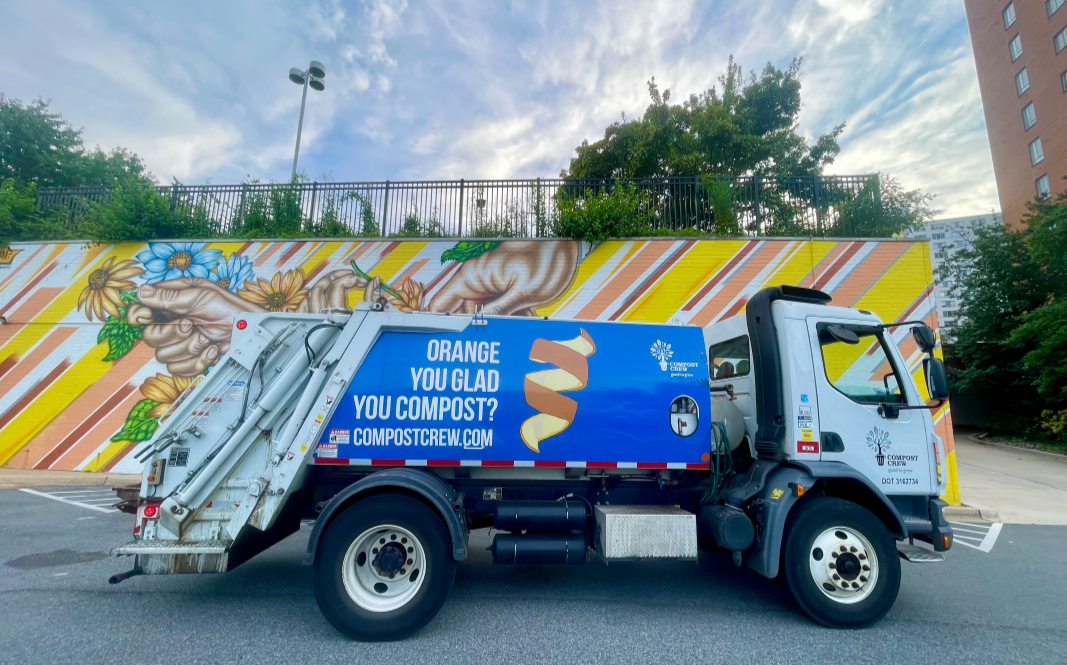
Top Photo: Courtesy of CompostCrew
Paula Luu
What would it take to make compostable packaging easier for small- and medium-scale composters to process? And if an operator had less than $40,000 to invest, what equipment would actually make a difference?
To explore that question, BioCycle spoke with two operators already processing compostable packaging — Kristie Blumer, Senior Director of Composting at Compost Crew, and Jamie Blanchard-Poling, Chief Queen Officer of Compost Queen PBC. Their perspectives were different, but they pointed to the same underlying challenge. The equipment that could make compostable packaging easier to manage at smaller facilities is either difficult to find or priced well beyond what many operators can reasonably afford.
Decontamination Comes Before Everything Else
Both operators identified decontamination as the step that determines whether compostable packaging can be processed at all. There’s no affordable equipment on the market built to catch contamination before it becomes unrecoverable, whether that’s before the compost pile or before the grinder.
Blanchard-Poling was direct about the gap. “There is no ‘sorting table’ for organics that I currently know of in distribution,” she wrote. “I highly recommend decontamination at the source as much as possible (like during pickup or monitoring during drop-offs),” followed by a sorting area to catch anything that gets through before processing begins. Some composters have gone so far as to build their own sorting tables, but none are available for sale on the market. Every compostable bag arriving at her facility has to be manually opened during decontamination.

Photo: Courtesy of Compost Queen
Blumer described a related version of the same bottleneck at Compost Crew’s Outposts. “The hardest part is just breaking open each compostable bag,” she wrote. That’s the reason her top equipment request isn’t a standard shredder, but a skid-steer bucket attachment that can break bags open without being “too fast or damaging to potentially break contaminants (e.g., plastic bottles, glass bottles, metal forks, etc.).” As she put it, “we don’t want to just throw all of it into a mixer” without knowing what’s inside.
Size Reduction Equipment That Won’t Multiply Contamination
Once compostable packaging is decontaminated, it still has to be broken down. The two operators pointed to different equipment for the job.
Some small-scale composters use Patz grinders and mixers to create more consistent feedstock mix, which works for processing compostables. “[Grinders and mixers] come in smaller sizes, which lowers the price range, and there are different types for different needs,” Blanchard-Poling wrote. Some operations only need a mixer “to create a more homogeneous mix for better product disintegration,” while others need an actual shredder or grinder “to decrease size and increase surface area.”
“If something gets through and they are grinding, a piece of plastic then becomes a million small pieces of plastic that will never be sorted out,” she wrote. That’s the operational logic behind Blumer’s more specific ask — a bag-opening attachment gentle enough to preserve visibility into the load before it reaches a grinder. For small operators, equipment selection for processing and decontamination sequencing are the same decision, not two separate ones.
A Windrow Turner Built For Compostable Packaging
Blumer’s operation works on “limited size plots” and relies on loader windrow turning to maximize available space, keeping piles at roughly seven feet high. That height rules out many industrial-scale turners. “It is really hard to find any windrow turner on the market that is a skid steer or tractor attachment that is worth the investment,” she wrote.
The challenge is not limited to compostable packaging. Any material that still needs additional breakdown and gets moved to the exterior of the pile during turning has to be reintroduced to the hotter interior. For Blumer, that makes pile management especially important because conventional windrow turners do more than agitate the center of the pile. They also disturb the carbon cap, allowing material from the interior to rotate outward.
One concept she has considered is a side-auger attachment that could turn material from within the pile while minimizing disturbance to the cap. But she noted that the idea is more appealing in theory than in practice. An auger would likely require a frame to generate enough forward force, and that frame would in turn limit the height of the pile, bringing the operation back to its original space constraint.
Compost Queen faces a similar challenge on a very small footprint, but uses Sustainable Generation’s CASP system to accelerate processing and make more efficient use of space. The system’s cover also helps keep material contained within the active pile, reducing the need to manually move partially decomposed material back into the interior.
The Price Gap In Trommel Screeners
Blumer’s operation screens compost to 3/8″ or 1/4″ “since it helps with decontamination from non-organics and even the small plastic produce stickers.” That makes screening a second decontamination pass, not just a finishing step, and it’s where the mismatch between need and price is most visible.
“There is a big issue of not having affordable trommel screeners on the market,” Blumer wrote. Star screeners, she noted, “don’t work well with wet compost,” which rules them out, and vibratory screeners have the same limitation. That leaves trommel screeners as the only workable option.
“The best one we found for small operations is the Sittler, which costs about $30,000,” Blanchard-Poling notes. “[Compost Queen] also has the Sittler bagger attachment for end-of-market production as well.
Blumer added that trommel screeners like the Revolver have faster throughputs than the Sittler but unfortunately it is drastically more expensive and well above a $40,000 target. What Blumer wants instead is “low-cost small and medium-size trommel screeners” that are compactable and bucket-loaded, so they can move between sites.
What does “Industrial” mean anyways?
Many compostable products are labeled for processing only in “industrial” facilities, but Blanchard-Poling pointed out that the term itself isn’t defined. “But what does ‘industrial’ really mean? Size? Throughput? Feedstock types? Type of operations? It is not a well defined term in our growing industry,” she wrote.
That ambiguity has practical consequences. Without a defined standard, equipment manufacturers have no clear target to design toward, and small and mid-sized operators have no clear benchmark for what they’re supposed to be scaling up to. Blumer’s and Blanchard-Poling’s equipment requests, the bag opener, the auger-fitted turner, the low-cost trommel screener, are all downstream of that unresolved question. Until the industry defines what “industrial” means, the market has no clear customer to build low-cost equipment for.