
Top Photo: The North Shore Country Club in Glenview, Illinois uses compost as a top dressing. Photos courtesy of Dan Dinelli.
Paula Luu
 My husband would be amused to know that I have spent the past few weeks researching golf. It is his sport. I, on the other hand, have never ventured beyond a mini-golf course. But I know compost, and when I look at the scale of golf course turf management, I see a significant opportunity for the industry.
The question started after I dug into a 2025 study published in JAMA Network Open, which found that people living near golf courses had higher odds of developing Parkinson disease, with the strongest association among those living within one to three miles of a course. Researchers also found elevated risk among people whose municipal water service areas included a golf course, raising questions about potential pesticide exposure through groundwater. The study did not establish that golf course pesticides cause Parkinson disease, but the authors concluded that the association warrants further investigation into pesticide exposure pathways and possible public health risks.
Golf is meant to support recreation, health, and time outdoors. So why should maintaining those spaces potentially create health risks for workers, players, and nearby communities? And if the impacts of intensive chemical use are increasingly understood, why is compost not a larger part of golf course management?
The answer is largely rooted in the practical realities of golf course operations. Superintendents need consistency, precision, and predictable playing conditions. Compost can offer substantial soil health benefits, but it remains more complicated to source, transport, store, apply, and evaluate than the conventional products the turf management industry has long relied on.
A Large and Underdeveloped Market
There are approximately 16,000 golf courses at 14,000 facilities in the United States, notes the National Golf Foundation’s year-end 2025 count. Together, golf courses encompass nearly 2.3 million acres of land, according to a national estimate cited by the United States Golf Association. The Golf Course Superintendents Association of America estimates that roughly 2 million acres are actively managed as golf course turf.
That acreage represents a considerable potential market for compost manufacturers, yet compost remains far from a standard input on most courses.
“I would say sand is heavily used as a medium, alongside spoon-feeding light rates of organic or inorganic fertilizers,” said Dan Dinelli, a longtime golf course superintendent and turf management innovator at North Shore Country Club in Glenview, Illinois. “Compost has a few people using it, but it’s far from mainstream.”

Dinelli’s team checks on the health of the rainbow trout in the ponds as an indicator of quality water, like a canary in the coal mine.
Dinelli has incorporated compost into his fairway management program for close to 30 years. His interest did not begin with an abstract commitment to sustainability. It began with a soil problem that conventional fertility programs were not solving. His irrigation water contained high concentrations of sodium and bicarbonates, contributing to the deterioration of the heavy clay soils beneath the course.
“One of the reasons I got turned on to using compost was not this romantic thought that it was environmentally cool,” Dinelli said. “What really got me started was the fact that I needed to rebuild the function of my soils.”
Compost became part of a long-term strategy to restore soil aggregation, drainage, and rooting after the club developed a better water source. Over time, Dinelli also observed benefits extending beyond the physical condition of the soil, including increased earthworm activity, improved thatch decomposition, and delayed development of dollar spot, a common turfgrass disease.
“It’s like a probiotic as well as a fertilizer,” he said. “Those organisms are basically energized, and they go to work for you on your turf.”
Selling compost as a substitute to fertilizer sells it short of the full range of benefits. Instead, compost should not be presented to golf courses merely as a less precise substitute for bagged fertilizer. Its value lies in its ability to influence multiple parts of the turf system at once, including nutrient cycling, water retention, soil structure, biological activity, and resilience.
Dinelli estimates that the fertility contained in the compost he receives can save his operation tens of thousands of dollars in conventional fertilizer costs. But the value, he emphasized, extends well beyond nitrogen.
“I’m getting so much more out of that than just nitrogen,” he said.
Why Conventional Inputs Remain the Default
If compost can provide such a broad range of benefits, why has the market remained relatively limited?
For one, the golf course needs space to host the compost being applied. Dinelli applies compost to approximately 35 acres of fairways. When he first developed the program, the application rate approached one tractor-trailer load per acre. The course therefore needed sufficient space to receive and stage 30 to 35 loads of material.
A golf course may also require suitable spreading equipment and, depending on the material, may need to screen or turn the compost again before application. Dinelli’s crew typically spends about five days applying compost to the fairways during the off-season. Wet weather can extend the process to 10 days because the material becomes sticky, clumpy, and less consistent as it passes through the spreader.
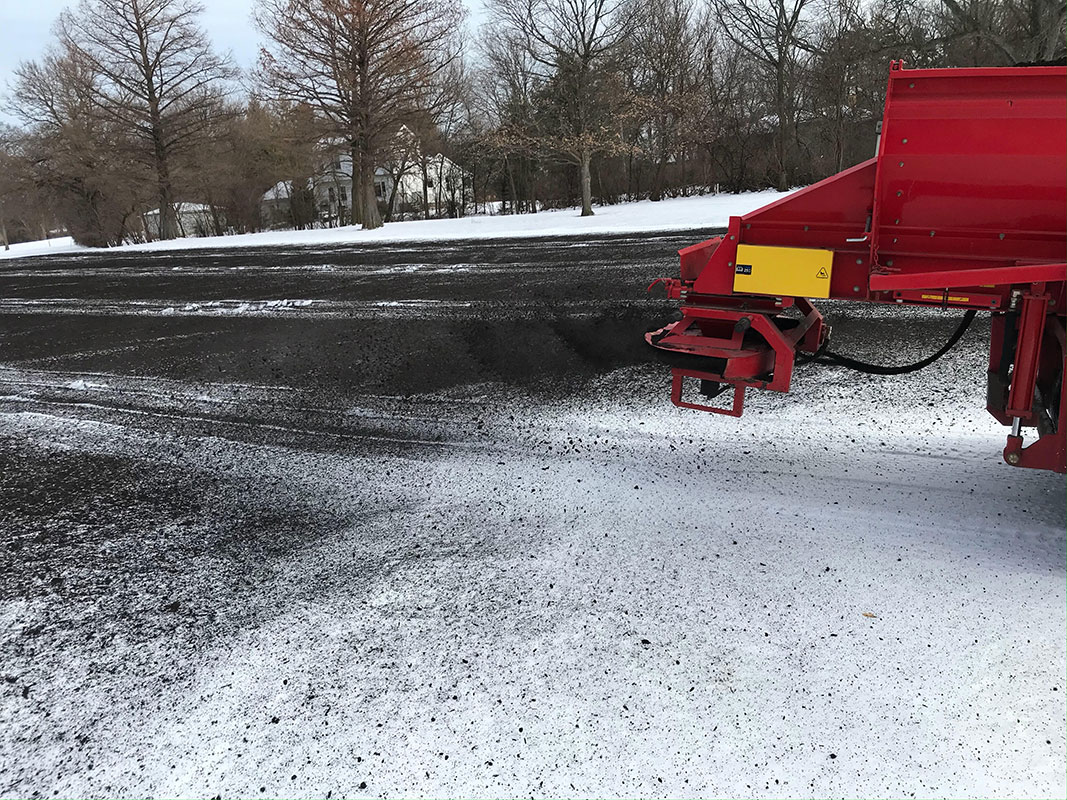
The North Shore Country Club crew typically spends about five days applying compost to the fairways during the off-season.
A bagged fertilizer offers a fundamentally different application experience. Its nutrient content, particle size, density, and application pattern are engineered for uniformity. The equipment and labor systems required to apply it are already widely available.
“There is some forgiveness you have to allow when using a material like compost versus something that comes in a bag that’s really refined, really consistent, and very predictable,” Dinelli explained.
Golf course managers are also responsible for delivering highly specific playing conditions. Conventional fertilizers can be applied in small, carefully timed amounts based on turf growth, color, and density. Pesticides can be selected to address a particular weed, disease, or insect problem. Compost influences the broader soil ecosystem, but its effects are often gradual and more difficult to isolate.
Penn State Extension recommends that compost used for turf applications have an earthy odor, an appropriate carbon-to-nitrogen ratio, and a particle size generally between one-quarter and three-eighths of an inch. Its guidance calls for applying a thin layer, approximately one-quarter inch, and incorporating it into the turf. Penn State also emphasizes that compost quality varies and that soluble salts and other characteristics must be evaluated for the intended turf species and use.
For compost manufacturers selling into these end markets, producing a material that technically qualifies as compost is not enough. The product must be compatible with the equipment, performance standards, and risk tolerance of a golf operation. Compost maturity, particle size, soluble salts, moisture, stability, and contamination all matter. Gravel or other debris that might be a minor inconvenience in a landscape bed can damage mowing equipment or interfere with play on closely cut turf.
Producing a Material Golf Courses Can Use
Ken Newman, managing member of Royal Oak Farm in Evington, Virginia, produces compost made from food residuals and yard and wood waste. The company makes blended soils for golf courses, athletic fields, landscaping, and other markets.
Royal Oak produces several grades of compost from the same base material using different screen sizes. Its turf product is screened to one-quarter inch. The company also manufactures a root-zone blend containing 90% sand and 10% compost, along with an athletic field mix containing 70% sand and 30% compost.
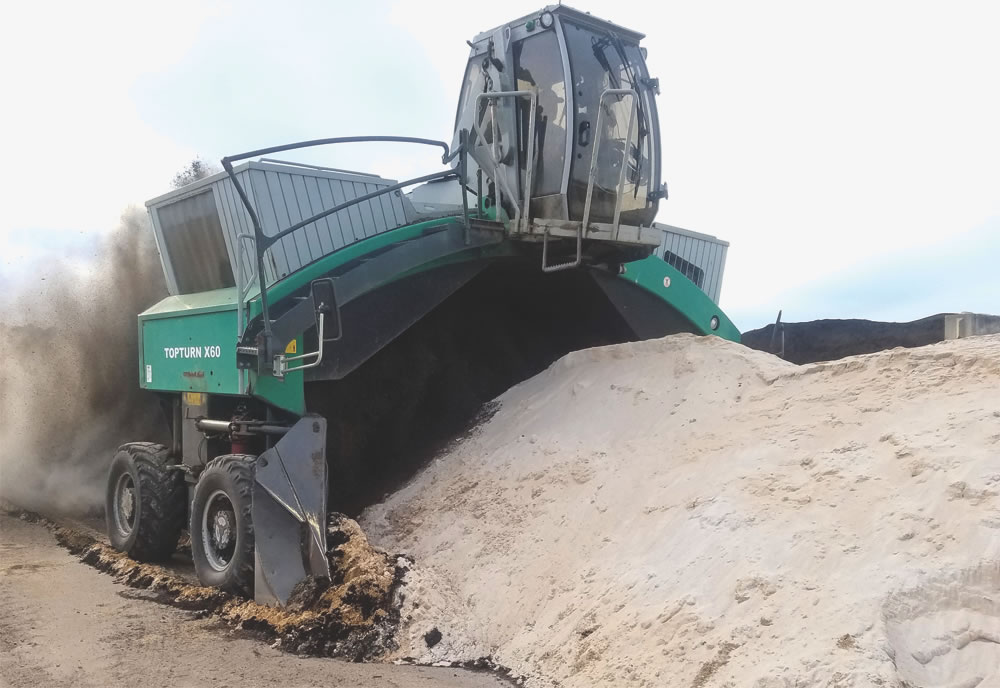
Royal Oak Farm in Virginia utilizes a windrow turner to mix soil, sand and compost to create custom soil blends. Photo courtesy of Royal Oak Farm
The higher sand content used for golf applications helps preserve drainage and playability, Newman explained. Compost adds organic matter, nutrients, and water-holding capacity without displacing the physical properties that golf course managers require from sand.
“The golf courses are using the same spreaders that they use for top dressing sand,” Newman said. “If they already top dress with sand, it’s not that different to have a sand-compost mix in the program.”
That approach may offer one of the most practical entry points for compost manufacturers. Rather than asking a superintendent to adopt an entirely new operational system, producers can formulate compost-enhanced materials that fit into an existing top dressing program.
Newman said golf course customers in Royal Oak’s regional market generally purchase between 20 and 40 tons annually. The company charges $75 per ton for the material, although that price and volume reflect one producer and one regional market rather than a national benchmark.
Golf courses are not currently Royal Oak’s largest customer category. Newman sells more athletic-field mix and enriched topsoil. Turf products do, however, help broaden the company’s sales season. Demand for golf and athletic field materials begins as early as February and can continue into late fall, while general compost sales are more concentrated in the spring.
“It helps with the cash-flow side and spreads it out over a wider window,” Newman said.
Royal Oak was well positioned to enter the turf market because it already owned compost turners, blending equipment, and screening drums, allowing the company to switch between one-inch, half-inch, and quarter-inch screens depending on the end use. Distribution is more challenging. Compost is heavy, bulky, and largely a regional product, but Royal Oak’s own trucking operation gives it greater control over delivery and customer service.
Not every compost manufacturer has that level of vertical integration. Developing a golf course market requires more than producing a finer-screened compost. Producers also need to consider blending, transportation, storage, application equipment, timing, and technical support.
Where to Start: With Half a Fairway
Dinelli does not recommend replacing an established turf management program across an entire course at once. Instead, he recommends repeating the trial for three or four years. Compost works through gradual changes to soil structure and biological activity, so a single growing season may not reveal its full value.
“Get your feet wet by testing small areas first,” he advised. “Do half a fairway. Find a problematic area and an area that tends to be pretty good, cut them in half, and do one half conventionally and one half this way.”
Courses should begin by identifying reliable local sources and reviewing compost test results. They should evaluate maturity, salts, moisture, nutrient content, and particle size, while also inspecting the material for physical contaminants, and have a realistic plan for receiving, storing, and spreading it.
Regional availability will shape the choice of material. Dinelli uses composted biosolids because they are available through the Chicago area’s wastewater treatment infrastructure. In dairy regions, he sees potential for composted manure and materials made from anaerobic digestion residuals. Other regions may have access to food waste compost, yard trimmings compost, or blends made from several feedstocks. The objective is not to identify one universally superior compost. It is to determine which locally available material can meet a course’s agronomic requirements and be supplied consistently.
Over time, Dinelli said, relationships with professional producers can reduce much of the uncertainty. “You find the ones that take composting seriously and manage it professionally,” he said.
The Market-Building Opportunity for the Compost Industry
If compost has this much potential on golf courses, the question becomes who is going to build the market. Golf course managers are unlikely to do that work on behalf of the composting industry.
That puts some of the responsibility back on compost manufacturers, state associations, researchers, and national organizations. The industry needs to make it easier for superintendents to understand what compost can do and, just as importantly, how to actually use it. That means developing turf-specific products, supporting demonstration plots, and documenting results on real golf courses.
And those results need to go beyond whether the grass looks good. What happens to fertilizer and pesticide use? Does the course need less irrigation? Does soil organic matter increase? What happens to infiltration, disease pressure, labor, and ultimately cost? These are the kinds of questions that multi-year trials could help answer.
The environmental case for compost is important, but it probably will not be enough to convince a superintendent to change an established management program. They still have a golf course to run. Playing conditions need to remain consistent, labor is limited, and introducing a new material comes with operational and financial risk. Compost producers have to be able to explain not only why their product is beneficial, but how it will arrive, where it will be stored, how it should be applied, what equipment is needed, and when a superintendent can reasonably expect to see results.
Compost may never eliminate every fertilizer or pesticide used on a golf course. Different climates, soils, turf systems, and disease pressures make that unrealistic, but it could help shift some of the focus away from treating individual problems with individual products and toward improving the underlying soil.
Dinelli described the turf industry as highly product-driven, with separate containers promising nitrogen, micronutrients, microbes, carbon, or plant hormones. Compost does not fit as neatly into one of those categories because it can affect several parts of the system at once.
“It’s such a holistic product that touches so many different aspects of soil and plant health,” he said.
With approximately 16,000 courses and around 2 million acres of managed golf turf in the United States, it would not take universal adoption to create a meaningful new market for compost. Even getting more courses to experiment with compost on a portion of their acreage could represent an opportunity for compost manufacturers while giving superintendents another tool for reducing reliance on conventional inputs.
For a composting industry that is constantly looking for reliable, higher-value end markets, golf seems worthy of a much more concerted effort.
As Dinelli put it, compost offers benefits “agronomically, socially, and financially.”
“Why isn’t this mainstream?” he asked.
After looking into it, I find myself asking the same question.