
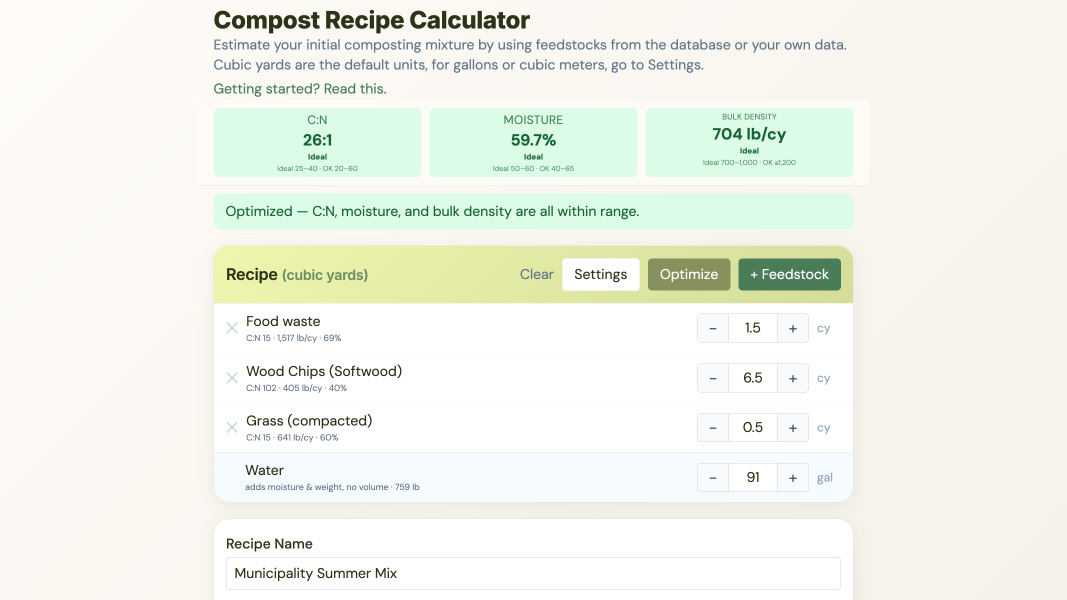
Wanu Organics has released a revamped version of its compost recipe calculator, adding new features intended to make recipe development easier for composting operators, trainers and facility managers working across different feedstocks and operating conditions. This tool is part of Wanu Organics’ broader set of CompostBuilder tools.
The calculator, first launched as a progressive web app in 2020 with support from Jorge Montezuma’s brother Johnatas, builds on earlier teaching tools Montezuma began developing in 2013. Montezuma’s goal has always been focused on helping composting professionals understand and apply recipe math without relying on laptops, Wi-Fi connections or Excel during in-person training. He is a regular Compost Operations Training Course (COTC) educator.
Since its launch, the calculator has logged 85,000 views, 6,000 sessions, 3,600 new users, 1,000 returning users and an average session time of eight minutes, according to Montezuma’s update. After more than six years of use in training and field settings, he said user behavior helped shape the latest round of improvements.
“Over the years using this tool at composting trainings, I learned a few things that composters wanted, and eventually I got around to it,” said Montezuma.
One major change is the removal of the Google login. Users can now add custom feedstock data without creating an account, then download their feedstock data and recipes as .json files and upload them again later. The information is stored locally in the user’s browser or downloaded folder, eliminating the need for CompostBuilder to manage user data.
The interface has also been streamlined so that new screens, including the feedstock database, settings and instructions, appear on top of the main screen rather than taking users into separate views. Montezuma said he made the change after seeing users get confused moving between screens.
Another major update is the new “optimize” button, which helps users identify the best available recipe within an ideal starting range. If the calculator cannot balance a recipe, it provides guidance to help users think through what to adjust.
“I saw that some people in the [COTC] class were struggling to figure out how to balance the various feedstocks, so I developed the ‘optimize’ button,” explained Montezuma. “This feature automatically gives the best recipe it can that sits within the ideal starting range, and if it can’t, it’ll give you some pointers.”
The calculator now includes metric units and gallons, making it more accessible for users outside the U.S. and for those managing smaller material volumes. Montezuma sees the calculator’s greatest value in helping operators and managers understand how changes in feedstock volumes affect carbon-to-nitrogen ratio, moisture and bulk density.
“If your starting mix is bad, the latest, shiniest composting technology won’t save you,” he said.
He added that the tool is useful beyond the loader operator. General managers, CEOs, sales teams and procurement staff can all benefit from understanding how feedstock decisions affect operations and product quality.
“The more knowledge we all have about key bottlenecks in our system, the better off we’ll be when we have discussions about product quality being poor, not enough carbon, etc.,” said Montezuma.
Try and use the compost recipe calculator at: https://compostbuilder.com/recipe/