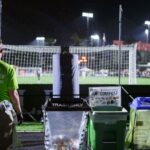

Top Photo: Hayden Thompson, co-owner, and Bridger Scraper, co-owner standing next to their homemade in-vessel unit that they built themselves to start Prairie Compost.
Paula Luu
Before Prairie Compost was a facility, the composting business was a Facebook post. Bridger Scraper, a biologist by training, had been watching curbside composting programs take hold in other parts of the country and wanted to know whether anyone in Fargo, North Dakota actually wanted that. About 90 people pledged their support. That was enough for him to decide to start.
“We just put out a feeler to see, hey, is this something people are wanting, or are they frustrated that we don’t have it,” said Scraper, who co-founded Prairie Compost with college friend, Hayden Thompson. “We got a really good response.”
That community post was the unlikely starting point for what would become North Dakota’s first permitted food waste composting facility, a 500 ton operation that opened in December 2025 and is already running at 40% capacity. Getting there took gravel, three arch-covered composting bays, very sore shoulders, and a meeting with Microsoft.
Starting Scrappy
Scraper and Thompson had met at North Dakota State University, bonded over rock climbing, and spent summers running a window washing company to cover tuition. After some time, they decided to pivot toward something with a bigger environmental impact, composting checked every box.

Co-owner, Hayden Thompson, mixes feedstocks together, including sawdust that they receive from the City of Fargo.
“Bridger taught me a lot in the beginning about why it matters,” said Thompson. “We looked at companies around the country doing this well — haulers, facilities, worm casting farmers — and said, why don’t we just combine all three and give it a real go here.”
Using earnings from the window washing work, they self-funded their first small composting unit and began collecting residential food scraps in Fargo, starting at roughly 40,000 pounds of annual capacity. It was enough to learn on.
“You can plan all you want, but until you actually start doing it is when you’re going to learn what’s efficient, what’s not working, what problems are going to arise,” Thompson said. “We would have never known if we just sat in the planning stages for years.”
Finding the Right Partner
As Prairie built out its residential base, Microsoft was doing its own homework. The company, which runs many campuses globally, had identified its Fargo campus as one in need of scaled composting services. As part of its evaluation of options in the region, Microsoft connected with the Prairie Compost team — and what they found was a company with the drive and community roots to become something much bigger.
“We liked that they were embedded in the local community,” said Alessandra Pistoia, Microsoft’s Director of Circular Economy Strategy. “They were a new company and we could see that they needed funding to really scale. And the scaling of their infrastructure not only benefits the Microsoft Fargo site, but it also opens up composting services to other residents and commercial businesses in Fargo.”
Microsoft’s involvement is rooted in a 2020 company-wide commitment to achieve zero waste by 2030. For Pistoia, that commitment requires a specific kind of thinking about where Microsoft operates and what gaps exist in those communities.
“We prioritize reduction and reuse, extend the life of the materials that we use, and then at the end of life we want to recycle and compost as much as we can,” she said. “That’s really where Prairie comes into play.”
In May 2025, Microsoft provided grant funding that Prairie used to build the infrastructure needed to grow the program long term. The investment went toward two Grande Composters from Actum Resources, Ltd., a skid loader and screener, trucks, arch structures to shelter the composting phases, gravel, and 64-gallon residential collection carts. Capacity jumped from 40,000 pounds to nearly 1 million. Microsoft also became a paying customer, using Prairie’s hauling service monthly for the Fargo campus — an arrangement that gives both parties a long-term stake in the operation’s success.
“It put us where we are now instead of where we would have been in five to ten years,” Scraper said.
The results have been concrete. The project increased the Microsoft Fargo site’s waste diversion rate by 30%. And Microsoft’s early role as Prairie’s anchor commercial client gave the co-founders their first real education in high-volume food waste logistics — lessons they have since applied to every commercial relationship that followed.
“It kind of helped us figure out what are the problems that will arise and how do we attack those on the front end,” Scraper said. “A very small amount of contamination can cause a lot of problems on our end. We’re really proactive about that, especially with restaurants.”
Breaking New Ground, Literally and Legislatively
Prairie Compost operates on a rented quarter-acre corner of a former horse park on the extraterritorial edge of West Fargo. The co-founders chose in-vessel composting technology because it maximizes processing power in a compact footprint, insulates against winters that regularly drop to minus 20°F, and keeps odors and pests tightly contained. The units ran through the entire winter without a dip in composting temperatures.

Bridger Scraper, co-owner, moving material out of their in-vessel unit at theWest Fargo facility, located on former horse park.
After material moves through the vessels, Prairie is currently curing compost in piles within 30-yard roll-off containers, though the team is building out dedicated curing bays to support growing throughput. Finished compost is sold directly to individual gardeners and local produce and flower growers in the Fargo–Moorhead area through Prairie’s website, with plans to expand into retail channels over time.
The operation also incorporates vermicomposting. A portion of the finished compost is used as bedding for worms, which produce castings that are sifted and sold into the same markets. Demand has been strong, with castings consistently selling out, and Prairie is scaling production by breeding additional worms to increase output.
Getting the facility permitted took from June to December 2025. Prairie was the first food waste composting site in the state, and there was no template for regulators to follow. Their application grew from three pages to nearly twenty in the second round.
“More detail is better than less,” Thompson said. “The people looking at the application don’t necessarily know what this equipment is. We wanted to be very transparent with what the process looks like.”
What Comes Next
Since opening, Prairie has expanded its customer base to include residential households, three restaurants, a preschool, several offices, a shared kitchen, and Microsoft. One restaurant diverted over 2,000 pounds of food waste in its first month and a half. Microsoft, once nearly 50% of Prairie’s revenue, now accounts for less than 25% as the customer base has diversified.
A second in-vessel composter arrives this month. Drop-off sites at City of Fargo recycling facilities are in development. And Prairie is exploring where to deploy a larger community-scale composting system as the next step in its expansion.
Pistoia sees the Fargo model as a template worth repeating. “We hope that this is a signal to other companies who may be operating in communities where they also have a zero waste commitment,” she said. “This can be a model for how those companies can partner with businesses within the local community to address those gaps.”
Scraper and Thompson are focused on the work in front of them — more customers, more volume, more food waste diverted. But they are also clear-eyed about what it took to get here and what advice they would give to anyone else starting out.
“You just have to start,” Scraper said. “Once you actually start composting, that’s where you make connections, learn what works, and figure out how to grow. We would have never known any of it if we waited until everything was perfect.”