Top Photo: Image courtesy of SWACO.
The Solid Waste Authority of Central Ohio (SWACO) and the City of Columbus closed out Earth Month in April with the official commissioning of a central Ohio Class II composting facility at the Alum Creek Waste & Reuse Convenience Center in Columbus. Class II facilities are permitted to accept pre and post-consumer food waste, along with yard trimmings, compostable products, some agricultural residuals and other feedstocks. The new infrastructure addresses one of the region’s most stubborn waste challenges, with nearly one million pounds of food waste arriving at the Franklin County Sanitary Landfill every single day.
“That makes food waste both the largest source of material at the Franklin County Sanitary Landfill, and one of the best opportunities to reduce our reliance on the landfill,” said Joe Lombardi, SWACO Executive Director. “The facility represents a significant step forward for central Ohio’s circular economy, introducing composting technology that can be replicated across the Solid Waste District.”
The facility is built around Green Mountain Technologies’ Earth FLOW EF-IM40, a 40-foot in-vessel composting system manufactured in Sandusky, Ohio. Unlike traditional open-air composting, the sealed system controls odors, deters pests, and automates mixing and aeration to significantly reduce labor time. The unit can process up to 400 tons of organic material annually.
“By establishing a Class II facility, SWACO and Columbus are moving beyond small-scale community gardens and backyard composting to a robust, scalable system,” said Betsy La Force, Business Development at Green Mountain Technologies (GMT).
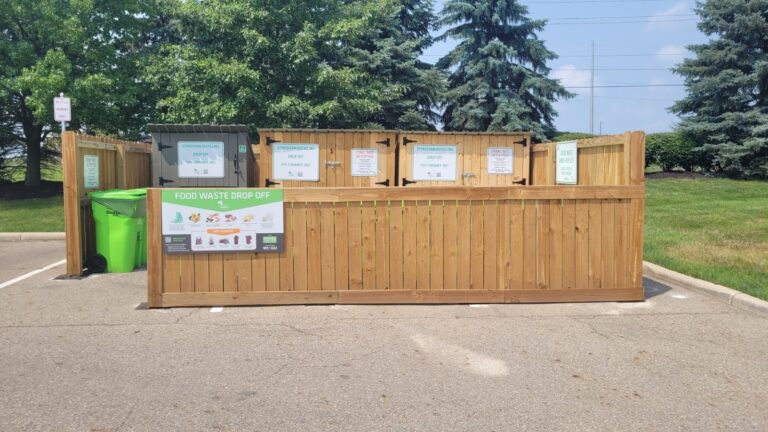
The facility will initially process organic materials collected at Columbus’ free food scrap drop-off locations scattered throughout the city. Finished compost will be donated to Franklin County’s network of community gardens, where it will help grow nutritious food for local residents and families.
The new facility is the tangible result of SWACO’s Greenprint for a Sustainable Future, a strategic roadmap designed to increase the region’s diversion rate through reimagined programs, emerging partnerships, and new infrastructure investments. Food waste currently represents 15% of the local waste stream and costs the average family of four nearly $2,000 annually in discarded food.
SWACO has already purchased a second GMT unit and is scouting additional sites across central Ohio to expand the network. The goal is to make composting more convenient and efficient, eventually enabling the City of Columbus to scale its drop-off programs and offer broader services. Columbus residents can participate in SWACO’s Save More Than Food program by using the city’s free food scrap drop-off locations.