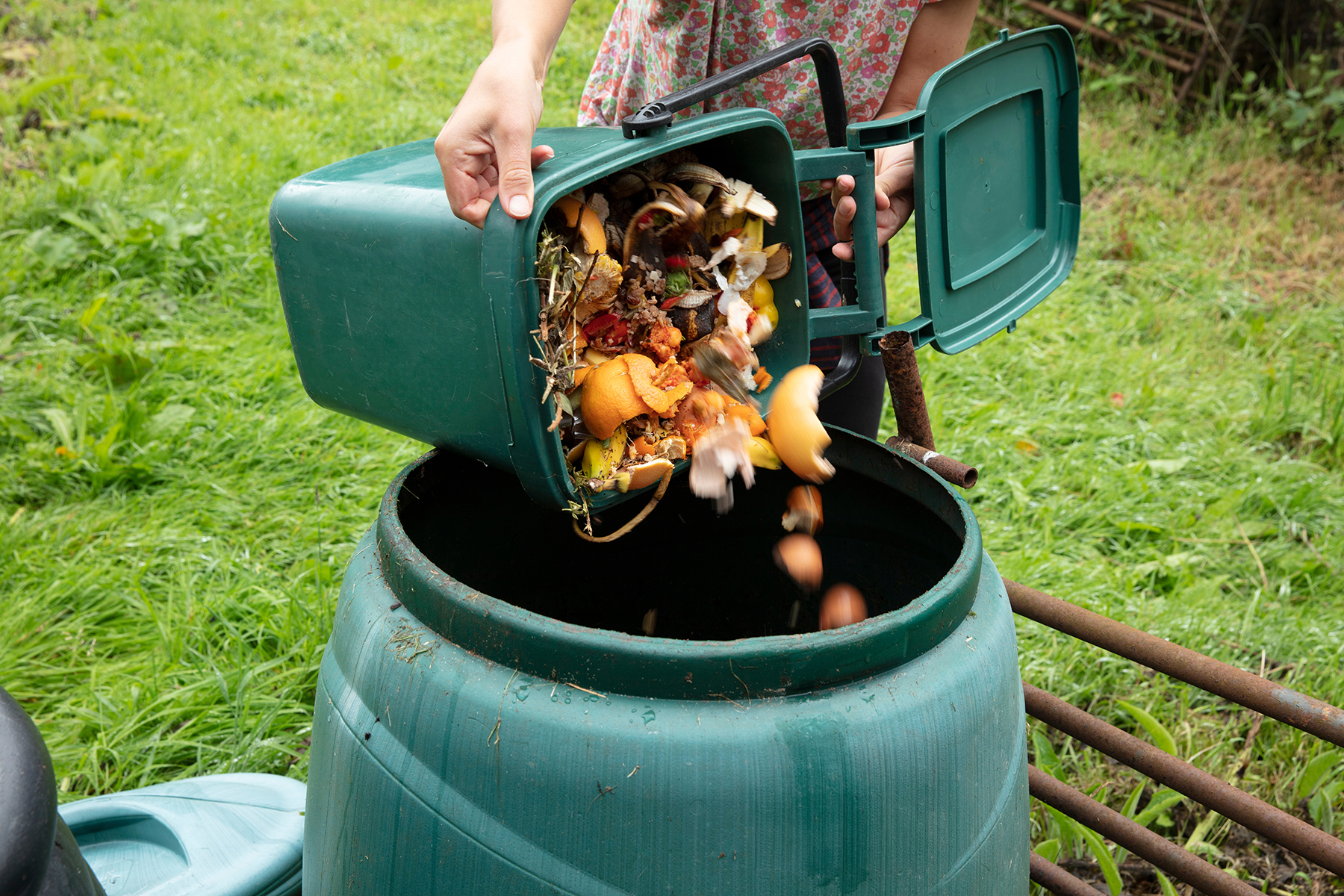
Top Photo: Courtesy of Sustainable Packaging Coalition (SPC).
Americans experience a paradox when it comes to food waste. Nearly seven in ten feel guilty throwing food scraps into the trash, yet the vast majority continue the practice regularly. This tension between environmental consciousness and actual behavior reveals a more systemic problem that extends directly to the viability of home compostable packaging as a waste mitigation solution.
To better understand this gap, the Sustainable Packaging Coalition (SPC) examined consumer behaviors, perceptions, and barriers related to home composting, as well as how people interact with home compostable packaging in real-world settings . The findings in the report, SPC Research into Home Composting Behaviors and Packaging, reveal a clear pattern that while people are motivated to act sustainably, there remains a gap between intention and what actually happens in practice.
The report’s lead author, Olga Kachook, Director at SPC, concludes that home compostable materials can play a role, particularly for heavily food-soiled items, but only when paired with robust consumer education and infrastructure support.
The Knowledge Gap
Over half of Americans acknowledge that practicing environmentally friendly habits matters. Yet when composting specifically enters the conversation, conviction can waver. Fewer than half of the survey’s respondents believe home composting delivers major environmental benefits, particularly among those without direct experience. This gap stems from what the research identifies as two intersecting problems. First, consumers feel overwhelmed by multiple “green” choices, and second, they lack clear information to guide decisions.
The barriers to composting participation were also measured in the SPC survey. Nearly half of non-composters say that knowing how to compost correctly would motivate them to start, despite the fact that hundreds of resources already exist – including from municipal education programs to local Master Composter trainings and community guidance. The SPC survey suggests that residents are demanding clearer guidance on how to compost, finding that only 30% of adults feel confident composting at home independently.
The remainder either need support or believe they lack the capability entirely. This disparity matters less for its current impact than for what it signals about potential. Two-thirds of the population report familiarity with home composting, suggesting that the infrastructure and knowledge exist to reach far broader participation.
How Experience Transforms Behavior
One of the research’s most revealing findings concerns how hands-on experience fundamentally shifts perceptions. Consumers who have actually composted describe the practice as rewarding and satisfying. Those without experience characterize it as messy, inconvenient, or confusing. This suggests that there is a tipping point to modify behavior. Once people try composting, behavior often follows.
This observation carries particular weight for compostable packaging adoption. Among experienced home composters, two-thirds actively compost packaging labeled as “home compostable.” Compare this to the broader population, where the vast majority sends these materials to trash or recycling bins instead, creating unintended consequences and contaminating recycling streams.
Traditional systems dominate at-home composting setups. Roughly half use open piles, and 40% rely on bins. More modern approaches like worm composting or bokashi containers remain niche, though certain urban demographics show higher adoption. Seventy-one percent of home composters actively feed their systems weekly, suggesting a stable base of regular practitioners.
Compostable Packaging Labels
The disconnect between intent and action becomes acute when examining home compostable packaging specifically. Less than half of American consumers notice “home compostable” labels on products. More troubling, the survey suggests that 40% of home compostable packaging ends up in the trash or recycling. Approximately 30% of the home compostable packaging ends up in commercial-scale composting infrastructure entirely (Figure 1).
Figure 1: Where home compostable packaging actually ends up

Click figure to enlarge.
From a educational perspective, consumers’ understanding of what “home compostable” even means remains fragmented. Nearly half participating in the SPC survey define it as material that biologically decomposes into soil amendments. Most assume breakdown happens relatively quickly – typically estimating two to four weeks or a few months. In reality, performance depends heavily on how a compost system is managed. Factors like temperature, moisture, aeration, and feedstock mix can significantly influence how quickly materials break down.
As Margaret Eldridge, Certification Director at Biodegradable Products Institute (BPI), explains, “factors that home composters can control, like pile temperature, moisture, aeration, and even cutting materials into smaller pieces, can significantly influence how quickly something breaks down.”
The Infrastructure Reality
Geography shapes both awareness and capability around composting alternatives. Urban residents report substantially higher familiarity with options beyond home composting, including drop-off sites, curbside programs, and subscription-based services. Rural and suburban populations show markedly lower awareness of these alternatives, concentrating instead on traditional home systems.
For home compostable packaging to achieve its environmental purpose, gaps in education and infrastructure must be addressed. Local systems need to be both accessible and designed to properly handle these materials.
Disintegration Performance Expectations vs. Reality
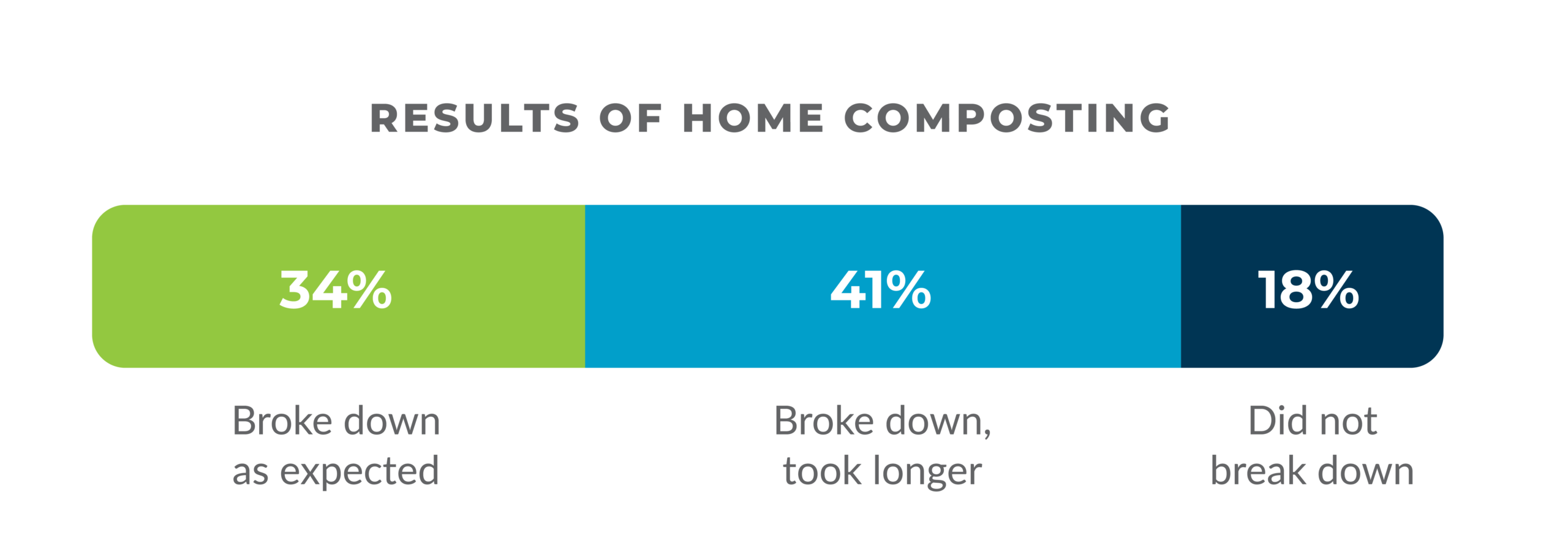
SPC’s survey found that when home compostable packaging is placed in home composting systems, respondents report that only one-third breaks down as expected (Figure 2). Forty-one percent of the respondents reported packaging disintegration, but noted that it required significantly longer timeframes than anticipated. Eighteen percent reported that the packaging failed to break down at all. These outcomes directly undermine consumer confidence in both the home compostable material and the system.
BPI notes that its home compostable certification is designed to reflect a range of real-world backyard conditions, but outcomes will still vary depending on how actively a system is managed. “Certified items will work in many typical backyard setups,” Eldridge notes, “but [disintegration] results depend on how the pile is maintained.”
Figure 2. Results when home compostable packaging is placed in home composting systems
Click figure to enlarge.
The research suggests that educating users of home compostable packaging – and providing clear guidance on managing compost piles and how conditions affect disintegration – would strengthen, not weaken, consumer adoption. Transparency about actual breakdown timelines, combined with education about the conditions necessary for successful composting, addresses both the knowledge gap and the experience barrier simultaneously.
A Path Forward
The SPC research makes clear that consumer recycling intent exists. The missing elements are knowledge, access, and demonstrated disintegration results. Brands considering home compostable packaging should not view labels as a complete solution. Industry groups like BPI agree, emphasizing that home compostable packaging is only one part of a broader system. Composting pathways are highly localized, and effective diversion depends on aligning materials with the infrastructure available.
As Leslie Rodgers of BPI notes, “a successful system depends on multiple pathways, from home composting to community and industrial facilities.” Products certified for home composting are also designed to be compatible with industrial systems, offering flexibility where multiple end-of-life options exist.