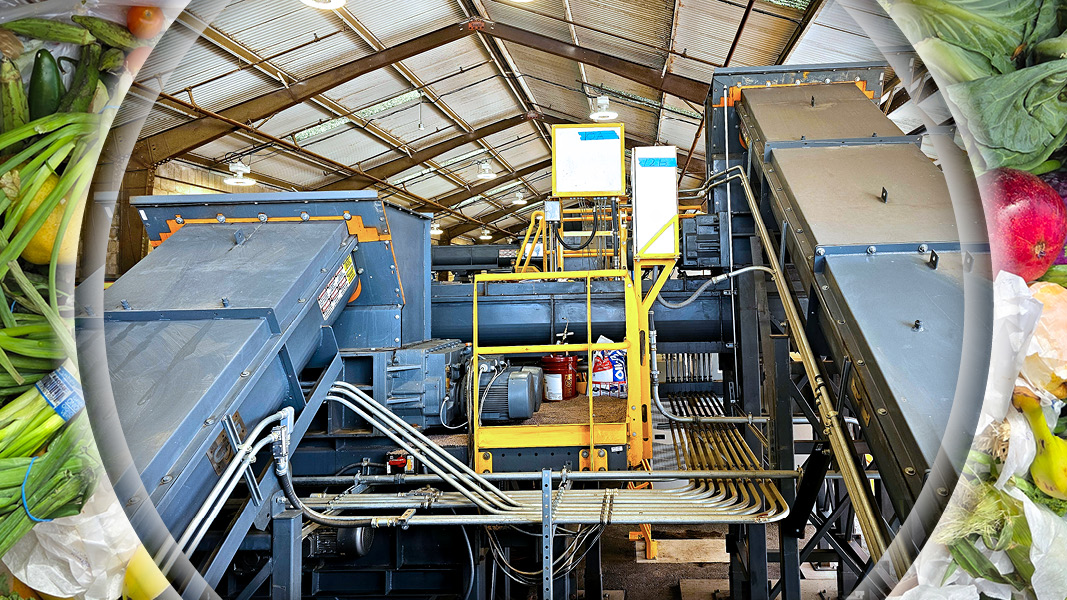
Top: The Mountain View Food Waste Processing Facility in Oxnard, California.
Nora Goldstein
In November 2025, Agromin and partner Harrison Industries opened a new food waste preprocessing facility in Oxnard, California, to create a feedstock that can be utilized as a liquid fertilizer, an input for composting and anaerobic digestion, and animal feed. “The Mountain View Food Waste Processing Facility was eight years in the making,” notes Bill Camarillo, Agromin CEO, a long-time organics recycler and composter in the state. “We’ve built a manufacturing plant with capacity to process 300 tons/day and produce an output with multiple end uses.”
The property is about 1.5 acres and has two buildings — an 8,000 sq. ft. one that houses the automated food waste processing line and an 12,000 sq. ft. building that is being equipped to convert some of the processed food waste into liquid and dry fertilizer. Production is anticipated to start in the fall of 2026. “The liquid food waste will go through a fermentation process and become liquid fertilizer,” explains Camarillo. “The solids will go through an aerobic in-vessel-like compost system.”

Harrison Industries collects food waste from large local farms, food processors, restaurants, schools and homes and delivers it to the Mountain View processing facility. Photo courtesy Harrison Industries
Harrison Industries, based in Ventura (CA), collects food waste from large local farms, food processors, restaurants, schools and homes and delivers it to Mountain View. The company provides residential, commercial and industrial trash, recycling and organics collection services to 90,000 customers in various Ventura County cities and unincorporated areas under franchise agreements. It had teamed up with Agromin in 2012 to do a residential food waste collection pilot, and the two companies have been collaborating since that time.
Multi-Faceted Processing Line
Agromin and Harrison Industries had wanted to fill a void for food waste preprocessing in Ventura County for a number of years. They tested multiple mechanical depackaging systems, which all “reasonably get food out of the trash,” says Camarillo. “But it’s high speed pulverizing with only one phase of materials handling, and our goal was to design an integrated system using many technologies that yield a clean slurry. We’ve been dealing with food waste for well over a decade. It is wet, sloppy and heavily contaminated and we understand the complications of processing these incoming feedstocks to yield clean material.”
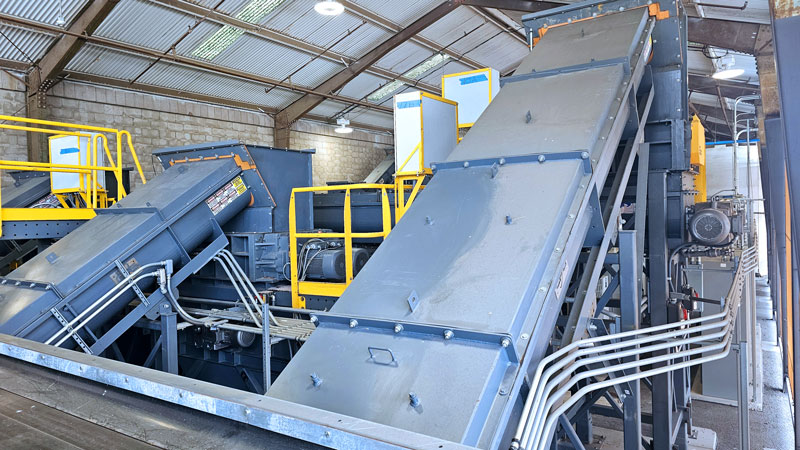
Twin conveyors move food waste through the presses. Facility photos courtesy Agromin.
Working with CP Group, which designs, builds and installs advanced recycling lines and materials recovery facilities (MRF), a fully-enclosed processing system was created for the Mountain View plant. Harrison Industries tips food waste loads into a hopper equipped with augers that move the material into shredders. From that point on, the rest of the processing lines — both for food waste and residuals — are fully enclosed.
A slow-speed shredder size reduces the feedstock to about a 3-inch minus size. Post-shredding, plastic fragments are fairly large, as are other contaminants. The next step is to pass through a screw press to separate the food waste from the non-food items, which then is processed through a series of finishing screens that float off any tiny pieces of plastic, metal, inerts and rocks. The residual stream is reprocessed through a macerator to remove remaining food. “The amount of food that is still in the trash is about 5%,” says Camarillo. “Overall, we are averaging about 8% residuals after the processing line.” The trash is conveyed to two compactors; this line is also totally enclosed.
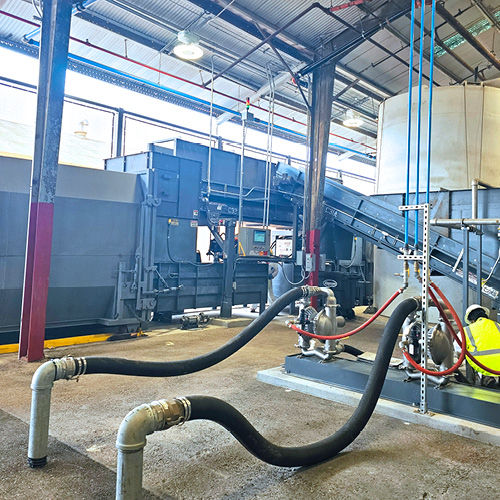
Discharge hoses from the storage tanks load trucks with slurry that is hauled to an anaerobic digester.
The slurry is pumped into two 10,000 gallon storage tanks. Currently, it is being transported in 6,000-gallon tanker trucks to the Victor Valley Wastewater Reclamation Authority’s plant in Victorville, where it is codigested with biosolids. The biogas is upgraded to renewable natural gas for pipeline injection. Once the fertilizer production facility is operating, a portion of the slurry will be pumped from the tanks to the adjacent building for processing.
Capital costs for the facility were around $16 million. The operation has a solid waste facility permit from CalRecycle, the state solid waste regulatory agency.
Residential Organics Stream
Harrison Industries collects residential food and green waste as part of its franchise collection service. Recognizing that households would be resistant to putting loose food waste into the green carts, residents are instructed to put the food waste in paper or plastic bags, and then place the bags in the green cart. “We take that stream to our MRF in Ventura and remove the bags from the green waste,” explains Donald Sealund with Harrison Industries. “The green waste is transported to Agromin’s Limoneira composting facility and the bags are taken to Mountain View.”
To date, most of the commercial food waste is collected by Harrison Industries from restaurants and commercial businesses. “We aren’t working with food distribution centers but we do get some packaged food that can’t be eaten,” adds Sealund.
Camarillo notes that much of its compost gets sold to leafy greens and lettuce growers who are restricted from applying any material that contains human or animal by-products. That is a significant motivator to keep the green and food waste streams separate, and direct the residential food waste to the Mountain Facility. The company explored animal feed as an output pathway for the processed food waste but the quantities the plant could produce are an “insignificant amount” for area livestock growers, says Camarillo. “We’re going to stick to what we do best for now, which is making organic fertilizers and blending some with our compost to ‘beef it up.’ And we will continue diverting slurry to anaerobic digesters for RNG production.”