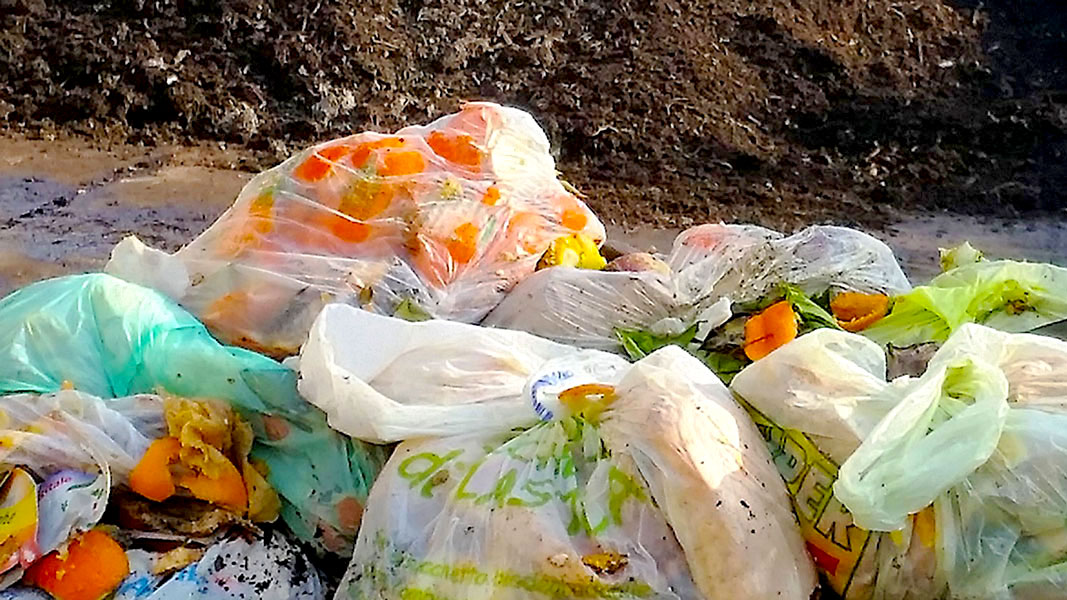
Top Photo: Compostable bags used for food waste collection in Italy. Photo by Massimo Centemero, CIC
Helena Nageler-Petritz
Originally reported by Helena Nageler-Petritz for Waste Management World, the global waste management news and analysis publication run by the International Solid Waste Association (ISWA). This abridged article is used with permission from Waste Management World. Read the full article here.
Italy is Europe’s model student when it comes to biowaste. The country made separate biowaste collection mandatory in 2022, two years ahead of the European Union (EU) deadline, and established a mature, near-nationwide door-to-door collection of food and garden waste.
It also has an Extended Producer Responsibility (EPR) scheme for the compostable bioplastic packaging sector, Biorepack, the Italian national consortium for the recycling of compostable bioplastic packaging. Established in 2018, Biorepack became operational in 2021. The EPR system manages “the end-of-life of certified compostable bioplastic packaging compliant with the European standard EN 13432, which is collected through the municipal biowaste stream,” explains Carmine Pagnozzi, Biorepack’s managing director. Biorepack brings everyone on board, he emphasizes: biopolymer and packaging producers, users/distributors of compostable plastic packaging and compostable plastic packaging recyclers. “Producers of biopolymers and compostable plastic packaging are legally obligated to join our consortium,” he adds. The fee applies exclusively to compostable plastic packaging certified in accordance with the EN 13432 standard. The consortium represents the “closing of the loop” for the bioplastics sector.
“Thanks to the development of compostable bioplastics — conceived from the outset as a tool to increase biowaste collection — Italy stands as a true European leader,” continues Pagnozzi. “Every year, the country collects and treats 5 million tonnes of biowaste, representing 41.2% of total separate waste collection. Through treatment across a widespread network of industrial facilities, this process produces 2 million tonnes of compost, avoids nearly 6 million tonnes of CO2 emissions and provides a natural fertilizer for agricultural soils. It is worth noting that agricultural land across Europe is severely degraded; in Italy, 68% of agricultural soils have lost more than 60% of their original bio-carbon content.”
Biorepack is fully financed by producers in accordance with the EPR principle. “Member companies are required to pay an ‘environmental’ contribution for each tonne of packaging produced or converted, which will be €246/t starting from July 1, 2026,” he says. The fee structure takes several factors into account: collection, sorting and bio-recycling costs; revenues generated from material recovery; European and national regulatory targets; ecodesign and recyclability criteria.
The money covers the collection, transport and recycling costs of municipalities or their contracted waste management operators. The system is designed to incentivize not only the quantity of waste collected but also its quality, notes Pagnozzi: the lower the contamination of biowaste by non-compostable materials, the higher the financial contribution paid by Biorepack to the municipalities. The consortium conducts rigorous quality control of the collected and recycled biowaste.
Public cooperation is a key factor in the system’s success. To this end, it is vital to raise awareness and offer easily accessible information about the correct disposal of bioplastics, compostable or otherwise. In addition to communication campaigns, the Biorepack Consortium has developed a specific label, “Organico Biorepack,” for compostable plastic packaging produced by its members. This helps consumers to identify the packaging and dispose of it correctly in the biowaste bin.
Joachim Quoden, Managing Director of EXPRA, the Extended Producer Responsibility Alliance, sees Italy’s Biorepack as “a unique and pioneering example in Europe, illustrating both the potential and the complexity of integrating compostable packaging into EPR systems.”
Sticking to the Rules
Pagnozzi is very clear about any concerns about the disintegration of certified compostable packaging: “Based on our experience and a specific study conducted by the University of Rome Tor Vergata, certified compostable plastic packaging does not pose any issues in biowaste treatment facilities that are capable of producing a soil improver (compost) compliant with EU Regulation 2019/1009,” he says. That’s if the guidelines set out in the European Commission’s BREFs (Best Available Techniques Reference Documents) are adhered to, he emphasizes. The BREFs include a minimum treatment duration of no less than 9 to 10 weeks in strictly aerobic facilities and a fixed 30 to 45 days duration of the composting stage alone in integrated facilities (anaerobic-aerobic digestion).
“It is clear that if processing times are excessively shortened — because the primary objective is to generate energy from biowaste rather than producing soil improvers — problems can indeed arise,” he adds. “However, this affects all solid biowaste fractions, including garden waste, animal bones, eggshells and mollusc shells. It is evident that in these scenarios, the issue is not an intrinsic limitation of compostable packaging, but rather a consequence of a specific treatment process designed to maximize energy production rather than the recycling of biowaste.”
The same goes for the quality of the compost. “A study by the University of Bologna has shown that bioplastics do not alter the chemical-physical characteristics of compost nor do they affect soil fertility,” says Pagnozzi.
Clear Applications and Regulatory Framework
The bioplastic producers’ side is often confronted with skepticism around their products. “I understand the concerns of waste operators and recyclers,” says Lorenza Romanese, Secretary General of European Bioplastics (EUBP). “These sectors are already under pressure, and any change in materials, sorting systems or treatment routes can create additional costs and operational anxiety. Compostable packaging is not simply ‘business as usual’: it requires the right collection, sorting and treatment chain, and in some cases adjustments in infrastructure or strategy.”
She also advocates for not simply replacing all plastics with bioplastics but to take a close look at the applications. “We have the responsibility — and also the opportunity — to be selective,” Romanese says. “Compostable packaging makes sense where it helps the system: where it supports the collection of organic waste, where food contamination makes mechanical recycling unrealistic or inefficient, or where the packaging is naturally disposed of together with biowaste. Where an item is clean, recyclable, reusable or likely to enter the wrong waste stream, then we should be honest: compostability is probably not the right route. The ambition should not be to make everything compostable, but to use compostability where it delivers real environmental and operational value.”
The Italian system opted for this approach. According to the regulatory framework, compostable packaging is only permitted for certain food contact applications that are commonly found in the biowaste stream, such as bags, plates, cutlery and cups. This helps to prevent mishandling and cross-contamination between plastic and compostable packaging. And this clarity, both Pagnozzi and Romanese agree, is what makes the system successful: Clearly defined compostable applications, certified according to recognized standards, properly labelled (think harmonized EU labels in the future) and accepted within the biowaste system.
“Contamination concerns must be taken seriously,” says Romanese. “But the answer is not to block compostable packaging everywhere. The answer is to replicate the systems that work, reduce confusion, support infrastructure and give consumers a few clear, universal instructions across Europe. In a Single Market with hundreds of millions of consumers moving across 27 Member States, fragmented labels and rules are part of the problem.”
EUBP supports EU harmonized sorting labels under the EU’s Packaging and Packaging Waste Regulation (PPWR), with matching labels on packaging and bins, simple pictograms and clear but limited text. “For compostable packaging, it is also essential to distinguish industrial compostability from home compostability, as these correspond to very different treatment conditions and disposal routes,” she adds. Her vision is a coherent European framework: “Targeted, harmonized and based on real system value.”
Does the PPWR go far enough?
According to the PPWR, the compostability of certain types of packaging will be mandatory. These are:
- Permeable tea bags and coffee/tea single-serve units
- Sticky labels attached to fruit and vegetables
- Very lightweight plastic carrier bags
It is, of course, up to individual Member States to broaden the scope, as Italy did. Romanese would welcome that. “The mandatory compostable packaging applications identified in the PPWR are a positive step in the right direction,” she says. “At the same time, we believe additional packaging formats — such as coffee capsules — could also represent suitable applications for compostability, where this delivers clear environmental and system benefits. The Compostable by Design criteria also provide a useful science-based framework to assess whether a packaging application is suitable for compostability.”
Joachim Quoden adds: “The PPWR is a significant step forward, but its effectiveness will largely depend on implementation, clarity of definitions, and enforcement at the Member State level.”
Need for Harmonization
Italy’s example shows what is possible for compostable bioplastics in the biowaste stream. But one country isn’t enough to make a real difference. The experts agree that the goal should be a harmonized EU approach, though obstacles remain. “One of the main challenges lies in the diversity of national waste management systems and governance structures,” explains Quoden. The operator reluctance described earlier — the fear of contamination — is, in his view, frequently linked to three causes: limited or non-adapted composting infrastructure, operational concerns regarding sorting and treatment efficiency, and differing interpretations of what constitutes “acceptable” input in biowaste streams. These structural differences are a significant barrier to harmonization, he says, as EPR systems must operate “within very different technical and institutional environments.”
These obstacles cannot be overcome overnight. But even small steps in the right direction help. So, what do Member States need to do in order to become a model student just like Italy? According to Quoden, the key enabling conditions include:
- A dedicated EPR scheme (Biorepack)
- Integration with biowaste collection systems
- Strong institutional coordination
- A supportive legal framework
Or, as Pagnozzi says: “The biowaste collection system, the presence of an efficient network of treatment infrastructures, and a consolidated compostable bioplastics industry are three essential components of a virtuous circle that has proven to work.”
From a technical point of view, it should be easy to make this approach work in other European countries, rapidly improving their recycling rates for the bio-fraction of waste, adds Pagnozzi: “Take the example of a metropolis like Milan: in just a few years, it has gone from a waste crisis to a virtuous model, separating approximately 87% of the biowaste generated in the city.” Setting binding targets at the EU level rather than “incentivizing other recovery options” is also vital.
To establish a functioning EPR scheme for compostable packaging waste, Quoden sees three key elements as essential:
1. Build on proven best practices
- Learn from established systems (e.g. Italy, Belgium, Netherlands)
2. Ensure appropriate governance and cooperation
- Non-profit, producer-led structures
- Strong coordination with municipalities and waste operators
- Clear allocation of roles and responsibilities
3. Guarantee effective enforcement and resourcing
- Adequate capacity within public authorities
- Monitoring, control and compliance mechanisms
“These elements are fundamental to ensuring both credibility and long-term system performance,” explains Quoden.
But how to persuade countries that they need to act — both by implementing a scheme like Biorepack and by improving separate biowaste collection? “We would remind them that the biowaste fraction represents between 30% and 40% of all household waste: failing to manage it properly would therefore mean failing to meet the EU’s recycling targets, which would cause serious environmental damage,” explains Pagnozzi. “Our advice would be to intensify the collection and recycling of all biowaste, not just green waste. Establishing specific EPR systems for compostable bioplastic packaging would also help enormously — and it’s fully consistent with the principle of making those who produce these materials pay for managing them as waste.”
The Italian model has shown that compostable packaging is an extremely useful tool for the circular transition, he argues. “If the EU fails to recognize the importance of biowaste recycling and the added value provided by compostable bioplastics, other countries — starting with China and the United States — will have free rein to exploit its potential and we will have missed a precious opportunity, both from an environmental and industrial perspective.”