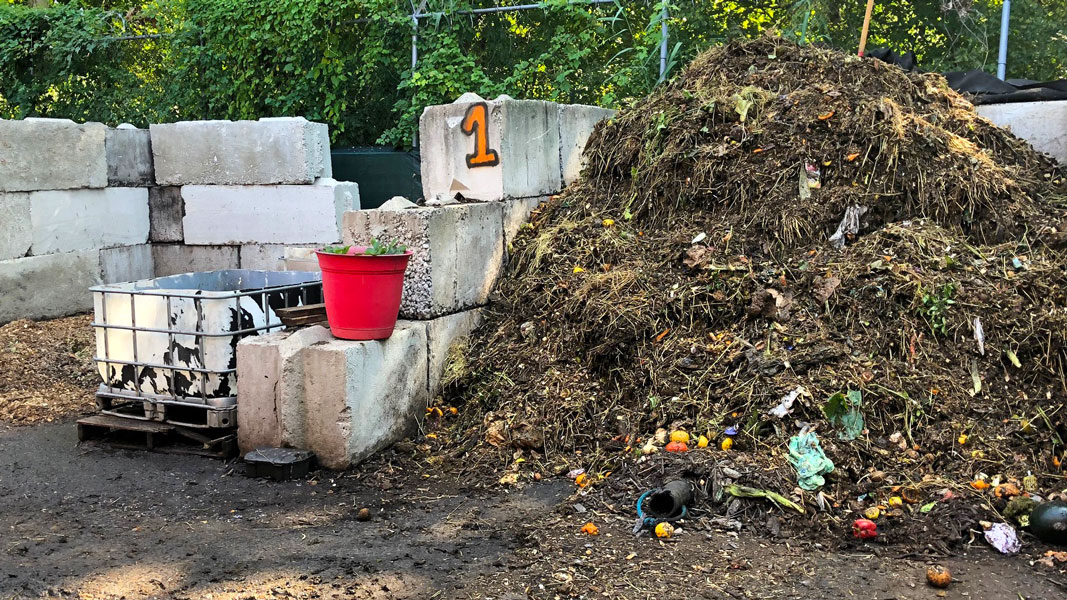
Top photo: Bennett Compost’s food waste composting operation in Philadelphia. From BioCycle Archives.
The Harvard Law School Food Law and Policy Clinic (FLPC) has released Waste Less, Feed More: A Local Food Waste Policy Toolkit, a rich resource outlining how cities and counties can use local policy to reduce wasted food and strengthen recovery systems. The report is a practical breakdown of the policy levers local governments can use to support food scrap diversion, composting, and market development.
Food waste remains one of the largest components of the municipal waste stream, and the toolkit underscores just how concentrated that material is at the consumer and commercial levels. Households account for the largest share of surplus food generation in the U.S., followed by consumer-facing businesses such as restaurants and retail. That distribution matters because it points directly to where local governments can intervene most effectively through collection programs, commercial requirements, education, and infrastructure planning.
Figure 1: Where Surplus Food Is Generated in the U.S.
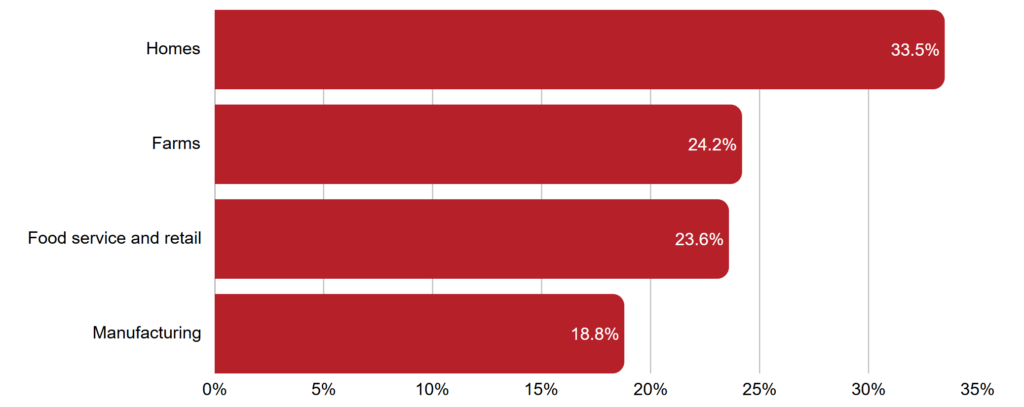
Households generate the largest share of surplus food in the U.S., followed by restaurants, retail, and foodservice. Graphic based on ReFED data cited in FLPC’s Waste Less, Feed More toolkit. Click here to expand this image.
Eight Policy Areas for Local Governments
The toolkit identifies eight areas where municipalities and counties can take action, drawing on existing ordinances, programs and policies from communities across the country.
- Local government strategies for food waste reduction: Cities can establish food waste reduction plans with measurable targets, dedicated staffing and agency accountability, as illustrated by Washington, D.C.’s Sustainable DC planning framework.
- Requiring donation of safe, excess food: Municipalities can require certain food businesses to recover and donate edible surplus food before it enters the waste stream, with Ulster County, New York, providing an example.
- Diverting food waste from landfills and incinerators: Local governments can combine organic waste disposal restrictions, mandatory collection, processing infrastructure and pay-as-you-throw pricing to encourage diversion, with examples from Honolulu and New York City.
- Using special event permitting and licensing requirements: Cities can incorporate food donation and organics recycling requirements into permits for festivals, concerts and public events, as demonstrated by Austin, Texas.
- Aligning zoning and permitting with composting goals: Local ordinances can explicitly permit composting facilities and tailor requirements to operational scale and feedstock types, reducing barriers that can otherwise prevent new infrastructure from being developed. Island County, Washington, is highlighted as an example.
- Developing markets for finished compost: Governments can purchase compost for public projects, require its use in landscaping or construction, and incentivize private applications through programs such as Denver’s soil amendment requirements and Zero Waste Sonoma’s compost and mulch rebates.
- Tracking progress through mandated reporting: Food waste generators can be required to report disposal, donation and recycling quantities, giving communities data to monitor compliance, identify gaps and improve programs.
- Supporting infrastructure and capacity building: Municipalities can provide grants, technical assistance, incentives and education to help food recovery organizations and composters expand operations, using local assessments to identify infrastructure needs before allocating resources.
Connecting Collection Policy to Composting Capacity
The report notes that local zoning and permitting requirements can create barriers when composting facilities are not explicitly recognized as an allowable land use or when smaller operations must satisfy requirements intended for larger solid waste facilities. Tailoring regulations to facility scale and feedstock can help communities accommodate different types of composting operations.
Market development is another consideration. Local procurement policies can provide reliable demand for finished compost, while soil amendment requirements and rebate programs can encourage greater use by contractors, farmers and property owners. The toolkit highlights both regulatory and voluntary approaches for building these markets.
Beyond its policy analysis, the report includes sample ordinance language and links to model policies addressing organics bans, collection requirements, compost application and other measures. These resources give municipalities a starting point for adapting policies to local conditions rather than developing regulations from scratch.
Read Waste Less, Feed More: A Local Food Waste Policy Toolkit