Photo credit: BioCycle archives
Paula Luu
Every compost pile moves through a series of temperature phases, and each one favors a different community of microorganisms (see Figure 1). In the first mesophilic stage, bacteria and fungi break down readily degradable materials like sugars and starches, and that activity generates enough heat to push the pile into the thermophilic range. Heat-loving bacteria take over from there, working through more complex materials while temperatures above 131°F kill pathogens and weed seeds. Active composting usually covers this hot, thermophilic part of the cycle.
Figure 1. Temperature and Microbial Phases of Compost
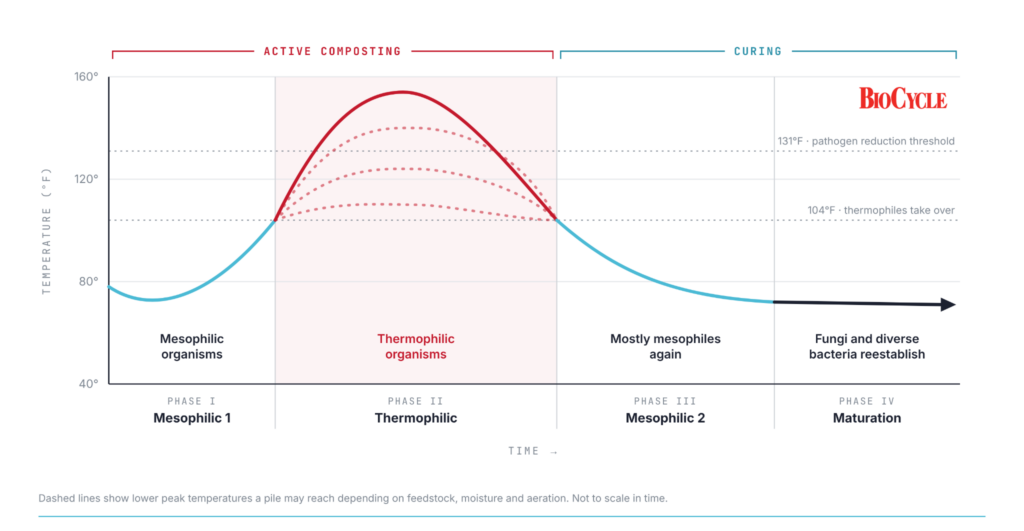
Dashed lines show lower peak temperatures a pile may reach depending on feedstock, moisture and aeration. Not to scale in time. Click here to expand this image.
As the easy food runs out, the pile cools into a second mesophilic stage and then maturation, which together make up curing. The mesophilic community reemerges, and fungal colonies, along with a broader mix of bacteria that can’t survive the heat of active composting, reestablish themselves. Fungi play a critical role here in breaking down complex materials like the lignin in wood and fiber. In general, more mature compost goes hand in hand with thriving fungal and bacterial colonies that support the health of soils.
That begs a question for the composting industry. If part of the value of compost comes from time spent curing, what does it mean that curing times are shortening?
What 24 Composters Told Us
Recently, BioCycle asked composters how long their active composting phase runs and how long they cure before compost moves off the pad. In our outreach, we described curing as “the number of days (or months) that compost is kept at mesophilic temperatures to enable the repopulation of microbial and fungal diversity.” Twenty-four composters responded from across the country, primarily municipal and commercial food scrap operations running aerated static piles (ASP) and/or windrows.
Curing times ranged from about three weeks to more than a year. The median facility cures for roughly 83 days, and half of the facilities that responded cure for less than 90 days. Only four cure for six months or longer, including Windham Solid Waste District in Vermont at 6 to 10 months and Royal Oak Farm in Virginia. Figure 2 below breaks down active and curing timeframes from the 24 composters who responded to our inquiries.
Operators also define curing differently. Some count the weeks that material sits in stockpiles waiting for a screener, while others start the clock only after screening, so these figures are best read as each facility’s own description of its process rather than an industry benchmark.
Signs of a Shift
While BioCycle’s survey questions didn’t focus on how and if curing timelines have changed over the years, several of the 24 compost manufacturers’ responses point to an industry trend toward shorter curing times. Dakota Prairie SMSC Composting in Shakopee, Minnesota, offers the clearest before and after. At its old windrow site, active composting ran 70 days and curing ran 60 to 90 days. After the move to covered aerated static pile (CASP) bunkers, active composting dropped to 20 to 25 days and curing to 45 to 60 days. “Active composting is in our aerated bunkers, then material is moved into windrows for curing,” says Erin Skelly, manager of compost operations. From an economic standpoint, shortening active and curing timeframes is great, allowing more material to move on and off a site faster, increasing throughput and revenue.
Other operators describe curing as the phase that gives way when demand rises. At Hammond Farms in Michigan, curing typically runs three to five months but can drop to a matter of weeks in late spring and early summer. “I’m a firm believer that our compost would be higher in quality with a longer curing time; however, high customer demand has made it difficult to let it cure longer,” notes Sean Barton, Hammond Farm’s Sustainability Director. Mark Cherry of Country Oaks Landscape Supply in Burton, Michigan, says curing there is “usually 8 months, but in high demand times as little as 3 months,” and Miramar Greenery in San Diego cures for 4 to 8 weeks depending on demand.
The West Cures Fastest
The pattern is sharpest in the West. The four Western facilities that responded — three in California and one in Montana — report a median curing time of about 41 days, roughly half the median for the full group. Napa Recycling cures for about 40 days and Miramar for 4 to 8 weeks, while Agromin, which operates sites across California, averages about 45 days with final timing set by what customers request. Happy Trash Can in Bozeman, Montana, cures for about 30 days, following 60 days of active composting under GORE covers.
All four Western facilities run some form of aerated system, which shortens the active phase and keeps material moving through the site. By comparison, Northeast facilities report a median cure of about 128 days and the three Southeast facilities about 120. BioCycle fully acknowledges that four facilities is a small sample — and the fact that it’s not yet known how much of the curing timeframe differences in regions comes from climate, markets, regulation and/or technology. These are all questions BioCycle plans to keep asking Western composters.
Figure 2. Active and Curing Process Time by Facility
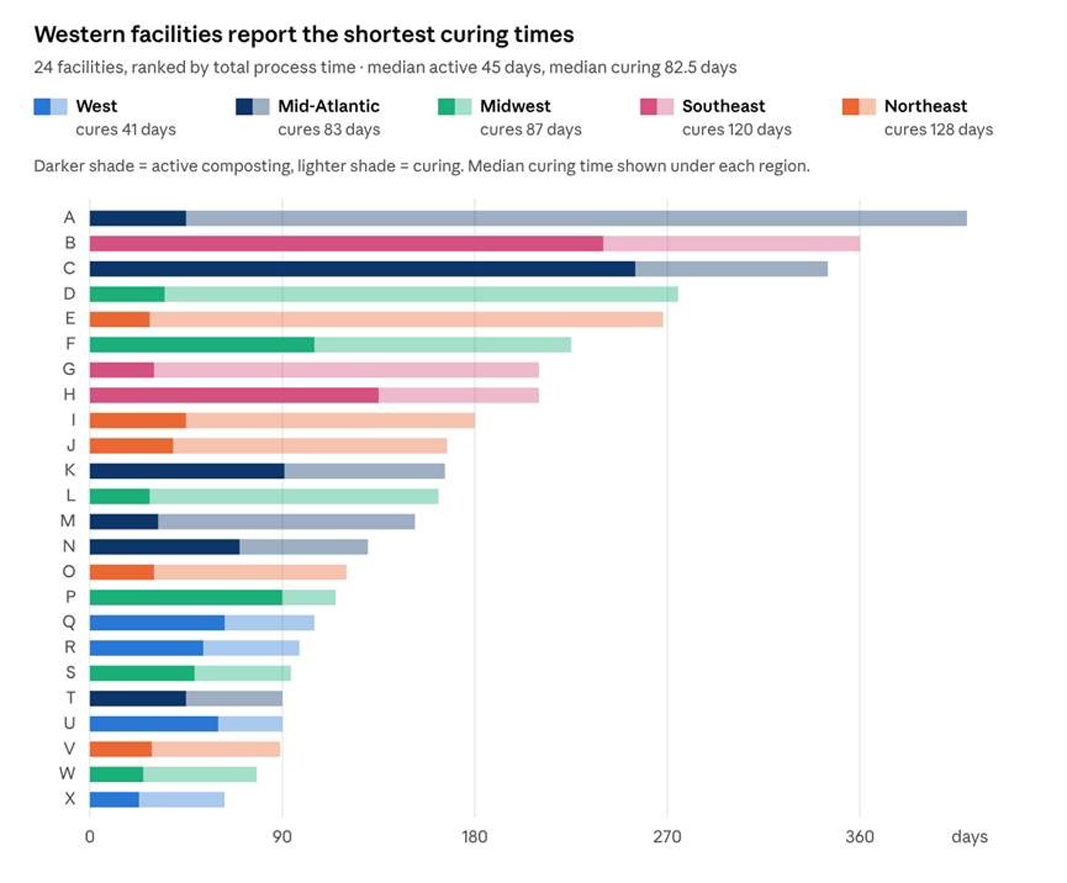
BioCycle surveyed 24 facilities. Median active composting was 45 days. Median curing time was 82.5 days. Source: BioCycle. Click here to expand this image.
Note: Each bar is one facility, ranked by total process time and colored by region. Reported ranges were converted to their midpoint, with months counted as 30 days.
Why Curing Gets Squeezed
Seasonal demand is the most consistent driver in the responses. Creekside Soils in Hutchinson, Minnesota, cures for about three months when material is windrowed between March and August and up to six months the rest of the year. “We slow everything down through the colder winter months,” the Creekside team explains. Hammond uses winter to its advantage, screening warmer compost that screens more easily and has time to cure ahead of spring sales.
Technology is the second driver. Aerated systems have compressed the active phase to about a month at many sites, including Napa (22 to 23 days), Ulster County Resource Recovery Agency in New York (at least 28 days) and Veteran Compost (28 to 35 days on air). Faster active composting frees up capacity, but it doesn’t automatically deliver mature compost. Barton found that once screened compost sits in a cone, pH and temperature barely move for about three months. He built a small ASP system to aerate curing compost, but “all it did was make the compost very dry,” and he is now testing other ways to get oxygen into curing piles.
The third driver is pad space. At Brooks Contractors in Durham, North Carolina, blended batches often sit for two months waiting for a windrow bay to open. “We consider 6 months in the active phase (windrows) but truthfully we should add another 2 months for pre-composting,” says Amy Brooks Fulford, Assistant Manager at Brooks Compost Facility. Green Mountain Compost in Vermont typically holds material in stockpiles for two to three weeks (after ASP but prior to curing) before its primary 2-inch screen, and Emmett County in Michigan cures in cone-shaped piles until a contracted screener arrives to batch-screen about 1,000 cubic yards a year. Ed Wansing of The Compost Company in Tennessee manages around these limits by rotating stock, explaining that “our Premium Screened compost gets screened as needed from the oldest material.”
What Longer Curing Buys
The facilities that cure longest describe the extra time as part of the product. AgRecycle in Pittsburgh cures every batch for at least 90 days under breathable covers after screening, and runs its active phase longer than most to achieve “better nutrient content in the finished products and a greater biodiversity of beneficial microorganisms.” Windham SWMD cures for 6 to 10 months after four weeks in CASP with heat recovery. Barton points to other large-scale producers, who cure their compost for nearly a year before selling it.
Hammond’s own records put numbers on the difference. Most of its compost now tests at a pH of 7.8 to 8.0, down from the high 8s and 9s when the farm started working on the issue. A pile Barton has set aside and cured for nearly two years sits at 6.5, and the wood chips that are plentiful in freshly screened rows have nearly disappeared from it. “They eventually break down if given enough time,” he says.
Questions for the Industry
Composters are selling what they make, adopting faster systems and sometimes working within tight footprints, all signs of a growing market. We’ve started to look into the reasons curing times are shortening, and the responses raise questions that we think the industry should be considering.
- Should maturity be measured in days or by tests? Black Earth Compost cures until it gets a good Solvita test score rather than to a set number of days. A shared maturity standard could give operators and buyers a common language.
- What do shorter cures mean for soil biology? If fungal and bacterial colonies reestablish during curing, compost that leaves the pad after a few weeks may carry less of the biology customers are counting on. The industry has little data on how much curing time is enough.
- Do high-throughput systems need their own curing practices? Aerated systems have compressed the active phase, but curing methods still range from turned windrows to covered piles to early experiments with aeration.
- What would it take to expand curing capacity? More pad space and inventory carry real costs, and few financing models are built around the curing stage.
- Will buyers pay for more mature compost? If end users understood the value of longer curing, cure time could become something composters sell around.
BioCycle will keep tracking these questions, including whether the regional patterns in this first round of responses hold up as we hear from more facilities. We want to hear from composters, researchers and end users about what would help the industry meet growing demand while delivering the quality its customers expect.