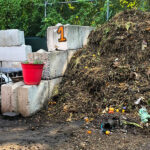

Top: About 90,000 tons of food waste were composted in Massachusetts in 2024, including at the Save That Stuff facility in Brockton. Photo courtesy Save That Stuff
Nora Goldstein
The Commonwealth of Massachusetts established an Organics Action Plan in 2012 as part of its 2020 Solid Waste Master Plan, which led the Massachusetts Department of Environmental Protection (MassDEP) to promulgate an initial Commercial Organics Waste Ban regulation in 2014. The ban applied to businesses and institutions generating 1 ton or more of food waste per week. In 2022, as part of the 2030 Solid Waste Master Plan (published in 2021), the ban was expanded to include businesses and institutions generating a half ton or more per week of food waste.
The 2030 Solid Waste Master Plan requires MassDEP to conduct a stakeholder process by 2025 to assess when to ban all organics from disposal by 2030. On October 9, 2025, MassDEP introduced a proposed approach during a meeting of the Department’s Organics Subcommittee, a stakeholder group that provides input to MassDEP on organics, composting and conversion regulations, policies and programs. John Fischer, Deputy Division Director, Solid Waste at MassDEP led the discussion, which included a slide presentation and Q&A with the stakeholders attending the virtual meeting.
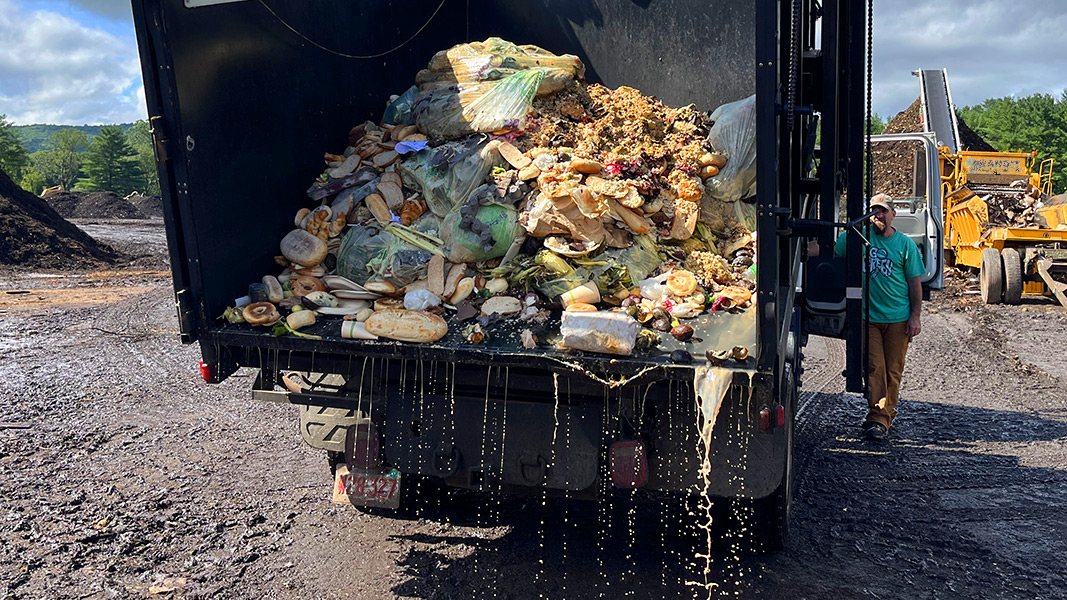
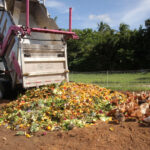
Food waste being received at Martin’s Farm, a composting facility in western Massachusetts. Photo courtesy of Martin’s Farm.
State of Food Waste Affairs
The presentation opened with the facts that Massachusetts disposes of about 930,000 tons of food waste per year — 21% of all the state’s trash — while at the same time, one in six residents are food insecure. The MassDEP estimates that 510,000 tons are from commercial generators and about 420,000 tons are from the residential sector. Its 2030 goal is to increase annual diversion by 500,000 tons over the 2018 baseline of 280,000 tons of food waste — or a total of 780,000 tons. About 350,000 tons were diverted in 2024 (Table 1) — roughly half way to the 780,000 tons goal. Underlying the diversion goal is the reality that disposal capacity in Massachusetts — as well as the overall region — is very limited, leading to significant volumes of trash being rail hauled for disposal in more distant states. “We want to be more self-sufficient, and the best way to do that is reducing the amount of food waste being disposed,” noted Fischer.
The Department’s “waste ban expectations” were that the diversion resulting from the 2014 ban would lead to an increase of 300,000 tons/year, and the 2022 ban (half-ton/week or more) would add an additional 100,000 tons diverted annually. “The remainder may need to come from smaller sources,” explained Fischer, which would include the small tiers of commercial and institutional food waste generators, and the residential sector.

Food waste receiving tank at Bar-Way Farms in Deerfield, which operates a codigestion facility. Photo by John Maciel, courtesy of Vanguard Renewables
Table 2 shows the 2024 data on existing food waste management capacity in Massachusetts. About 70% (360,000 tons) goes to 10 anaerobic digestion (AD) facilities in the state that accept food materials — a combination of dairy farms, wastewater treatment plants and stand-alone facilities (e.g., an AD at a Stop and Shop distribution center). Approximately three ADs in neighboring states receive food waste from Massachusetts. “Increasingly, regional, interstate capacity is available, especially now that all the New England states have food waste disposal bans,” said Fischer.
 In comparison, only 90,000 tons of food waste are composted. These facilities may be permitted to accept more food waste than they are currently receiving. However they are not taking increased volumes in part because on an operational level, they don’t have the needed infrastructure, explained Fischer. He added that the amount of food waste diverted to animal feed is likely higher but can be a challenge to track. And while donation and rescue outlets may have capacity to receive more edible food, they might need an infusion of capital in order to receive and distribute greater amounts.
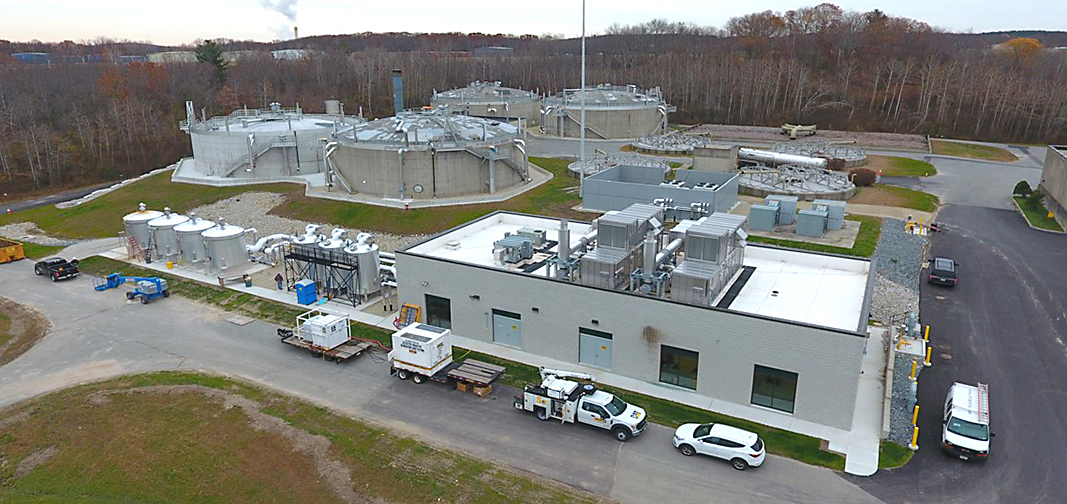
The Greater Lawrence Sanitary District (GLSD) in Andover codigests slurried food waste from a preprocessing operation in Boston operated by WM. Photo courtesy GLSD
The MassDEP acknowledges that to move closer to its 780,000 tons diversion goal — especially as smaller food waste generators and residents are brought into the fold — more distributed capacity and expanded collection infrastructure is needed. “As we look at the eastern third to the eastern half of the state in terms of food waste capture, we need to be mindful of cost-effectiveness, which speaks to distributed processing and food rescue infrastructure and a decrease in transportation distances,” said Fischer.
Another data point in assessing the current state of food waste affairs in Massachusetts is the number of food waste hauler customers. Figure 1 captures the increase in the number of businesses and institutions contracting for organics hauling in 2024 — 4,150 — as compared to 2022 (3,100) and 2023 (3,123). The increase reflects compliance with the lower threshold (a half-ton/week or more) enacted in 2022. This data is gathered from food waste haulers by RecycleWorks Massachusetts, a recycling assistance program funded by MassDEP and delivered under contract by the Center for EcoTechnology. “What is interesting is we are seeing a drop in the overall food waste diversion over the same time period (Table 1) as we are seeing overall growth in the number of customers being served,” observed Fischer.
Ban Expansion Considerations
The MassDEP cited eight factors that are driving the Department to consider a food waste diversion program shift, including severely limited solid waste disposal capacity, a leveling off over the last three years in food waste diversion progress, and available estimated capacity of 160,000 tons between current diversion levels and the estimated capacity. Another factor, discussed later in the article, is the need for more effective enforcement at the half-ton per week ban threshold. Increased contamination in newly diverted food waste streams also was cited as a consideration.
Another consideration for a potential expanded waste ban is the effectiveness of voluntary food waste diversion programs. To date — without a disposal ban in place — 160 municipalities report some type of residential food waste collection program. These include 82 food waste drop-off sites, 14 curbside programs, nine municipalities that use both curbside and drop-off, and 55 jurisdictions that have preferred vendor initiatives for food waste collection serviced by a private food scraps collection business (e.g., the City of Newton, MA).
Also to be factored into the evaluation are disposal reductions as a result of food waste prevention, and an increase in rescue and donation. The MassDEP has been tracking food waste prevention data since fiscal year (FY) 2019. The amount prevented has continually increased; in FY25, 716 commercial customers prevented 4,196 tons of food waste. Cumulatively, since FY2019, close to 16,600 tons have been prevented. In addition, a recent economic impact analysis of the ban was completed by ICF for MassDEP. The study found that in terms of food waste tonnages diverted, the food rescue segment had grown the most — 93% — since ICF conducted a similar analysis for MassDEP in 2016.
Initial Proposal
Fischer emphasized, before reviewing the specifics of a potential proposed ban expansion, that what MassDEP was presenting at the October 9 meeting is an approach to share with stakeholders and get their reactions. Essentially, nothing is set in stone at this point with what MassDEP describes as a “comprehensive approach.”
The proposed ban expansion would take place in two stages. Stage 1 includes the following:
- Become effective on or after November 1, 2028
- Lower Commercial Organics Ban threshold to zero
- Consider exemption for businesses with incidental food waste (e.g., offices with lunchroom waste, medical offices, non-food retail, etc.)
- Would most likely include all schools (assuming have a cafeteria)
A potential Stage 2 includes these steps:
- Become effective on or after November 1, 2030
- Expand ban to include residential food waste
- Establish municipal compliance program standard
- Municipalities with specified program would be considered compliant
- Could include curbside, drop-off, home compost bin and/or subscription service options
- May vary for curbside and drop-off programs
- Eligibility requirements may increase over time
The dates presented are the earliest that each proposed ban expansion would go into effect. Fischer noted that in MassDEP’s experience, starting a ban in late fall has “been a good time for a ban to go into effect,” after the start of the academic year. He also said, with regard to municipal programs, the Department recognizes that it is not viable to collect all food waste from all residents. During the Q&A, one municipal stakeholder emphasized the challenges his city faces with multifamily residences, for example.
Keys to successful implementation of the potential ban expansion are financial and technical assistance support to establish and comply with the requirements. The final portion of Fischer’s presentation focused on the plan for increased funding to be directed into existing support programs. These include Recycling Business Development Grants to cover capital costs; ensuring adequate funds are available in the Recycling Loan Fund (currently, up to $1.5 million is available for AD facilities); Waste Reduction Innovation Grants for start-up and pilot projects for food waste, with consideration for larger capital projects for food materials in the 2026 grant cycle; Compost site technical assistance; Programs to support businesses and institutions that are required to comply, including on-site assistance, web-based resources and guidance, and direct outreach at meetings and conferences; Green Team programs to support schools, as well as grants for equipment, e.g., carts and collection containers; Equipment grants for municipal and residential programs, e.g., collection carts, drop-off site equipment and organics capacity grants for larger projects; and Recycling Dividends Program (RDP) Funding, where municipalities earn points for food waste programs. In 2024, for example, municipalities earned $320,000 in RDP funds from implementing organics programs.
Ban Compliance Logistics
Another key to successful implementation of the potential ban expansion is compliance — and for this MassDEP can take a page from how it enforces compliance with its bans on disposal of recycled materials like cardboard, bottles and cans. “When the threshold is zero, it enables MassDEP to inspect loads and enforce more effectively,” explained Fischer. “Just seeing a cardboard box, plastic bottle or a banana peel in an otherwise load of just trash does not require an enforcement action — those are de minimis amounts. More significant quantities are what can lead to taking enforcement steps. That is the key different between zero and a half-ton.”
How MassDEP is enforcing the ban — and how it would approach the ban’s expansion — were explained during the meeting (recording and presentation slides available here). Load inspections are conducted at solid waste transfer stations, landfills and incinerators. These facilities use action levels for implementation purposes — e.g., 10% for cardboard in a load. The assessment is visual, based on a volume estimate in a trash load. The MassDEP can issue “warning letters” based on load observations, facility data, or third-party data. In addition, the Department sends requests for information letters to individual businesses in targeted sectors to inquire about compliance with the ban. Some note they are under the threshold, while others are aware they are over the threshold and are taking steps to comply.
To date, warning letters have been sent to more than 60 companies with 900 locations, said Fischer. They are required to confirm compliance with the ban, and MassDEP is required to follow up and track if they are complying.
Next Steps
The MassDEP emphasizes that it is “very early in this discussion, and there is a long way to go for it to become real and implemented. For starters, Massachusetts implements bans via a regulatory process, not a legislative one. It is typically a two-year process, factoring in public comment periods, public hearings and modifications.
The Department intends to engage many different stakeholders in the potential ban expansion conversation. It will hold follow up meetings to work on specific issues as it drafts regulations and guidance. At the end of the Organics Subcommittee meeting, Fischer encouraged stakeholders to reach out directly with feedback and suggestions, emphasizing that input is critical to the ban development