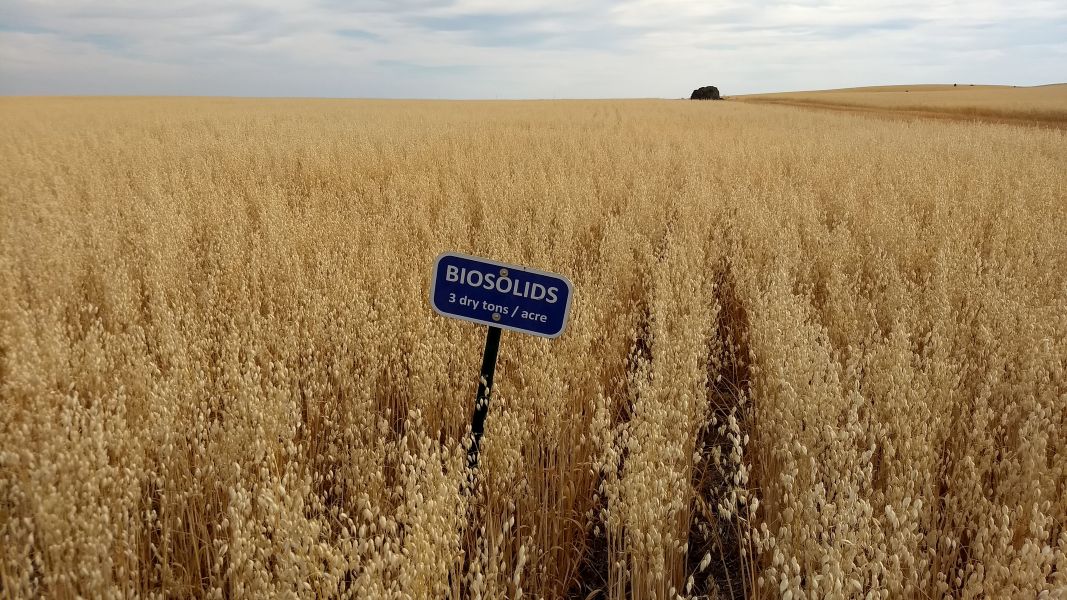
Top Photo: Wheat growing in the biosolids treated soils. Credit: Deidre Griffin La Hue.
Sally Brown
The reason that they call natural cycles cycles is because they are supposed to go around and around. One of the things that we humans have been successful at is interrupting those cycles. We have excelled at linear thinking and tried to force that onto natural systems. That is not necessarily a good thing. More and more we are realizing that we want cycles to function as such rather than trying to turn them into lines. Regenerative agriculture is one great example. Reusing nutrients in wastes is a key component of regenerative systems.
Nutrient cycling is an example of a system that had been working just fine until we started to try and turn it into a system of lines. Animal wastes (including human) were routinely returned to the soil and used to grow more food so that the animals (including humans) could eat more and, you guessed it, make more waste. With the advent of mineral fertilizers and fixed nitrogen, that circular system went the way of the landfill.
Nowadays, pasture grasses and grains used for animal feed are often fertilized with di ammonium phosphate rather than good old manure. There is even a term for this – footloose – and I don’t think that Kevin Bacon was the inspiration. The term is based on the fact that the animal is no longer tied to the cycle of growing its food. Much has been written and laws have been passed to try and put some curve back into those lines. In other words, encourage nutrient cycling in the form of manure fertilization for animal feed. In the range of peer review publications on the topic, authors often say that reintroducing circularity into nutrient management may result in benefits outside of those related to recycling nutrients and may merit any subsidies required to make circularity happen.
Effectiveness Of Circular Nutrients Systems
I am here to tell you that that is absolutely correct. We recently looked at a circular nutrient system tying animal wastes to food production and found a whole range of benefits. The animals in this case were the proud citizens of Washington state and the food was dryland wheat. Unlike animal manures, management of both solid and liquid human waste has associated costs that are the legal obligation of municipalities to bear. A portion of your garbage bill and your water bill are allocated to doing something with these materials. Washington is one of the few states that actually encourage beneficial use of biosolids and much of the material produced in the state is used to grow wheat. Class B biosolids – biosolids with some remaining pathogens – require a permit for use. Application rates are based on the nitrogen needs of the crop. What that means is that there are excellent records of when, where and how much biosolids have been applied to land. We used those records for this analysis.
Biosolids applications are concentrated in Douglas County with over 40% of the material generated in the state ending up on fields there. Biosolids have been applied there since the 1990s. The program has been designated as a BUF, or beneficial use facility. Communities from across the state bring their biosolids. You can see rows of biosolids waiting to go to the field, each with a marker designating where they hail from. This is needed as the different materials will have different total N, the basis for determining the application rate.

Photo Caption: Rows of biosolids awaiting land application on wheat fields. Credit: Deidre Griffin La Hue
It is also the site of research plots established by Washington State University that have monitored changes in soils and crops when biosolids are used in place of commercial fertilizers. Those plots also have control and fertilizer treatments.
The average farm in Douglas County is 456 ha with farm income (as of 2017) of $64,000. Household income is below both the state and national averages. Space is plentiful with less than 10 people per km2. Rainfall is not, with average precipitation of 20 cm per year. What that translates to is that farmers get by, not by a lot, often with federal assistance. It is dry enough that typically you only grow one crop every two years, to allow for moisture to build up in the fallow year.
Then came the biosolids. Based on multiple papers, lots of soil cores and several decades of yield data, it is clear that the biosolids work well. The biosolids improved the soil, increasing organic matter and reducing bulk density. In combination, it lets the soil hold onto more water. Higher water holding capacity means more plant available water. More water means more wheat. The field plots set up by WSU have measured higher yields with the biosolids of 15% in comparison to the fertilized soils.
Latest Study Findings
For this study we also used satellite imagery to see if the biosolids-amended soils (from different farms, not the replicated field plots) were greener than neighboring farms that did not use biosolids. In fact, you can see biosolids from space. Not literally, but the wheat growing in the biosolids treated soils was denser and greener than the wheat grown with fertilizer.
The field plots set up by WSU were located on an active farm. The farmers involved in the project were well respected in the community. That meant that the results got talked about in the one coffee shop in town. Farmers were interested and many have signed up to get their cake. Total dry tons of biosolids applied to farms in the area during the study period ranged from 18,440 to 32,460 or treated manure from 3 million to 5.3 million people each year. Even those who are gluten intolerant contributed. At an application rate of about 6.7 dry metric tons per ha, that is a decent amount of land each year.
What does this all translate to? We looked at the impact over a 10+ year period – 2012-2022 – and here are the results from that period. First, a lot of nitrogen (N) and phosphorus (P) are recycled, an average of 1,625 tons of N and 484 tons of P each year. The farms also get a fair quantity of other macro (Calcium and sulfur) and micro (copper and zinc) nutrients. Soils were healthier and the atmosphere also approved. Each dry ton of biosolids applied stored about 0.3 tons of carbon in the soil (equivalent to about 1 ton of CO2e). In addition, using biosolids saved the energy associated with manufacturing N fertilizers and mining and processing P. Using a value of 3 kg of CO2e per kg N and 1.5 kg CO2e per kg P, a dry ton of biosolids with 5% N and 2% P would give you additional benefits of -0.18 tons of CO2e. In comparison, emissions associated with trucking (even with a very long drive) were minimal (0.14 Mg CO2e). That means you sequester over a ton of CO2e for each dry ton of biosolids applied.
More Revenue For The Farmers
Perhaps the most important beneficiaries of all of this are the farmers. They benefit in two ways. While they pay for biosolids (about $8 per dry US ton), they pay a lot less than they would for synthetic fertilizer. At the normal rate for wheat, they pay $21 per acre and that lasts for two cropping cycles of wheat. That translates to about $10 per hectare per crop. In contrast, the price of anhydrous ammonia during the time period we looked at ranged from $37.50-$99 per hectare per crop. Therefore over the time period we looked at, using biosolids saved farmers between $27 and $90 per ha.
They also get more money at harvest. The increased yield means increased revenue. How much more money depends on the price of wheat. During the time period we looked at, the 15% yield increase meant an additional $70-$144 per ha. You add the savings at both ends up and realize that the farms in this area are hundreds of hectares in size and you realize that biosolids have been a boon for the farm economy. Increased farm revenue (using the average size farm in the area) as a result of using biosolids instead of fertilizer ranged from $11,000 to $26,000 a year. Use of biosolids here is great for nutrient cycles, but it also gives farmers a linear increase in income.
That increased yield enriches both the farmers and the food supply. The farms in Douglas County generally grow soft red winter wheat, a variety that makes up about 16% of the wheat we consume. Based on that, each ha of wheat fed by nitrogen makes enough of this wheat to feed 326 people. Feed the soils with biosolids and you make enough wheat to feed 375 people, or an extra 50 people per ha.
Municipal Economics
While this program costs the municipalities, the revenue from the farmers is much less than the transport costs, and it is much cheaper than disposing of the biosolids. Transport to a landfill and the tip fee there would more than double the cost of most programs. Look at how well landfill disposal is going in Maine. Building an incinerator is a huge capital expense that costs money to operate – assuming you can get a permit. Some are looking at pyrolysis as a silver bullet – again if you can afford the ticket price for construction and you are willing to spend millions on a facility that operates from time to time. The one cheaper option in Washington state is to make a pathogen free biosolids product that is suitable for general public use. Tacoma does this and has reached over $1,000,000 in sales revenue. Not bad for a municipality of 225,000 people.
We had a problem getting this paper published because we didn’t talk about any contaminants in the biosolids. No mention of metals, microplastics or PFAS. We pointed out to the reviewer that three prior publications had focused on increased soil health on the replicated plots due to the biosolids. What we showed here is that using the biosolids increased nutrient cycling (measured in tons), carbon sequestration (measured in tons), farm income (measured in thousands of $$) and food security (measured in thousands of people). To me, those benefits dwarf concerns about compounds that are measured in 0.0000001 cents to the dollar.
Sally Brown, BioCycle Senior Advisor, is a Research Professor at the University of Washington in the College of the Environment.
Reference
Brown, S., M. Vernik, D. Butman, D. Griffin-LaHue and J. Finlinson. 2026. Quantifying the environmental and economic impact of municipal biosolids use in dryland wheat in Washington State. Urban Ag. Regional Food Sys In press