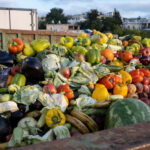

Top Photo: Created by the BioCycle editorial team.
Sally Brown
Back 30 years or so, much of the focus on food waste was on its fate in landfills. In this respect at least, the world is now a better place. Controlled anaerobic digestion with energy capture, potentially followed by land application or composting of the digestate, is a real thing in many places. Perhaps it is time to start some menu planning for microbes. For us people, the general socially acceptable goal is not to pass gas, at least in public. What you do in the privacy of your own home is your own business. The opposite is the case when you are talking about controlled anaerobic digestion. The more farts the better.
Anaerobic digestion of food waste is increasingly recognized as a way to have your cake and eat it too. Digestion captures the energy but then leaves you with residual solids and nutrients that can be made into compost or be directly land applied. The question then becomes what do the methanogens like to eat? Is what is true for humans also true for microbes? Are beans as magical for bugs as they are for people? Should we be feeding cans of beans to digesters every day?
Beans, beans, the musical fruit.
The more you eat, the more you toot.
The more you toot, the better you feel.
So eat your beans with every meal!
Calculating Methane Potential of Digester Diet
Anaerobic digestion/decomposition is a multistage process that requires a number of different reactions. Not all food is eaten the same way or with the same release of energy. The goal with digestion for energy production is to produce as much methane as possible. Different foods have different methane generation potential. Some are easier to eat in an anaerobic environment than others. Understanding this is a focus for controlled digestion.
It turns out that for methane generation potential all food is not created equal. There is an equation that predicts how much methane different types of foods will give you. The theoretical methane yield (Y CH4 m³/kg substrate) for a compound with the formula CdHhOxNnSs is:

This equation may give you a headache just from looking at it, but it highlights an important principle. Carbon and hydrogen generally increase methane potential, while oxygen, nitrogen, and sulfur reduce it. The negative nitrogen (-3n/8) and sulfur (-s/4) terms help explain why protein-rich or sulfur-rich feedstocks can produce less methane than expected. Excess nitrogen can lead to ammonia accumulation, which can inhibit or even shut down the digestion process. Sulfur can also reduce methane production because it acts as an alternative electron acceptor, diverting electrons that would otherwise be used to convert carbon into methane (Brown et al., 2008; Frigon and Guiot, 2010). As a result, feedstocks high in nitrogen or sulfur can create both lower methane yields and operational challenges.
Applying that equation to different types of foods give you:
- 0.37 m³ CH4 per kg carbohydrates
- 0.51 m³ CH4 per kg protein
- 1 m³ CH4 per kg fat
In other words, if you want gas skip the carbs and load up on protein and fat. Sounds a lot like the Atkins diet to me.
Another tool is to look at the volatile solids concentration of the material. The volatile solids are the fraction of the carbon and associated compounds that will return to the air when heated to 500°C. In other words, burnt to a crisp. However, total volatile solids are unlikely to all become microbial dinners. Volatile solids destruction during anaerobic digestion of different animal manures has been estimated to range from 45-60% (Brown et al., 2010; Frigon and Guiot, 2010).
Common sense can also give you some clues on methane potential. If the stuff you want to put into a digester has already been digested, it is bound to give you less CH4 than virgin foodstuffs. What I mean by that is that animal manures, including pig, horse, cow and human, will have much lower methane generation potential than what was fed to those beasts in the first place. In particular, animals with multiple stomachs like cows, will have done a really good job at extracting energy from what they eat and leaving only very difficult to digest compounds in their patties. Humans may only have one stomach, but much of the human waste that gets sent to anaerobic digesters passes through wastewater treatment plants where aerobic digestion (aka secondary treatment) does a very good job of getting the energy out.
Here are some estimates of CH4 potential from different kinds of poop:
- Cattle manure: 30 m³ CH4 per ton
- Poultry manure: 35 m³ CH4 per ton
- Pig manure: 35 m³ CH4 per ton
- Sewage: 80 m³ CH4 per ton
In contrast, if you add a ton of clover or grass (assuming a volatile solids concentration of about 90%), you get about 0.27 m³/ kg or 270 m3 CH4 per ton VS. Get my point? (Eleazer et al., 1997; Frigon and Guiot, 2010).
Planning The Menu

Just like bellies, digesters can get upset too with no recourse to digestive aids.
From the above discussion you may have decided to build your own digester and fill it with fat. For sure that is the most gas for the microbes to pass. However, the same way that a high fat diet can upset your stomach, it is almost certainly going to sour a digester. Fats, oil and grease (FOG) are the holy grail of anaerobic digestion feedstocks as they have very high embodied energy and produce a lot of methane with very little energy going to the microbes doing the work. As a high yield inefficient process, it requires a lot of handholding not to go wrong. Like needing to take a Lactaid and a Tums with a little Prilosec thrown in before you sit down to dinner. Without the extra attention, long-chain fatty acids can build up and that can give you a sour digester. Park et al. (2025) added biochar made from oyster shells and found that it settled the digester tummy quite well. The calcium-rich materials kept the pH high enough and the authors got a CH4 yield of 486 mL/g volatile solids.
The amount of methane that you actually get out of different feedstocks will vary by the configuration of your digester, how long the material stays around and the health and well being of the microbes that do the work. New research has focused on how to get the most methane from different food groups. Menu planning for methanogens if you will. Much of this is trying to define the microbial equivalent of Tums. A sour digester is like your own belly ache but sized in the thousands of gallons.
Zhou et al (2025) looked at the co-digestion of carbohydrates and proteins and high solids loading rates. Too many carbs and the digester can get too acidic. Acid reflux is not solely a plague for people. Add enough protein with your carbohydrates and the pH stays nice and neutral. However, add too much and you get ammonia inhibition — not sure what the human equivalent of that is. The authors found that adding carbs at a rate of about 40-50% of the protein kept things moving with a CH4 conversion efficiency of about 0.7. A few fries with your steak sounds good to me.
Aim for a Balanced Diet
Another simpler approach is to send the equivalent of a balanced diet to the digester. Feeding a mixture of different food groups is a way to make sure that the different critters involved in the multistage process of anaerobic digestion all get a piece of the pie. A well-balanced diet also is a tool to prevent buildup of unwanted compounds (i.e., ammonia), big fluctuations in pH, and too long a line at the buffet — here meaning buildup of certain precursor compounds such as long-chain fatty acids that can all stop the party cold. Adding different foods to a digester that is accustomed to eating the same meal, day after day, can also work to increase the microbial appetite. Co-digestion of food scraps in wastewater digesters has been shown to increase both CH4 yield and volatile solids destruction. You would get excited too if you had been eating the same mix, day in and day out.
Back to the Beans
Let’s get back to those beans. A study from Korea where food scrap diversion is as common as rice and kimchi looked at the CH4 generation potential of different foods (Cho et al., 1995). Cooked meat gives off much more CH4 (482 m³/ton VS) than either boiled rice (294 m³/ton VS) or fresh cabbage (277 m³/ton VS). All of those sulfur compounds in the cabbage may wreak havoc in your intestines but don’t count on them to do the same in a digester. Table 1 shows the relative amounts of fats, proteins, sugars and carbohydrates, along with the associated calories for each of those foods.
Table 1: Nutrient concentrations in rice, cabbage and ground beef

Click table to enlarge.
Analyzing the nutrient concentration of black beans, i.e.,reading the label, tells me that each cup (172 g) of the beans has 1 g of fat, 41 g of carbs and 15 g of protein. Using the methane potential for each of those types of compounds and scaling it up to a kilogram, I get that each kg of beans gives you about 4.1 of CH4. Now that is something to toot about!
The point of all this is not to upset your stomach or even to make you crave fats. It is to show that adding food to digesters that has not yet been eaten is a great way to make more CH4. It is also not always a simple way to make more CH4. The bugs that make the methane are fussy and prone to upset stomachs. Feed them as you should yourself — with care and in moderation.
Sally Brown, BioCycle Senior Advisor, is a Research Professor at the University of Washington in the College of the Environment.