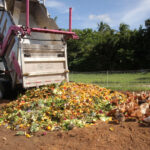

Top: Semi-trailer leaving the Cayuga Digester in Auburn, New York, after a delivery of packaged food waste. Photos courtesy of Generate Upcycle
Nora Goldstein
In the 2000s, Jim Hotaling, then Executive Director of the Cayuga County (NY) Soil and Water Conservation District (SWCD), envisioned a community digester facility that would address the concerns of manure storage and land application odor, and improve the water quality in Cayuga County. In 2004, Hotaling identified a company that could bring his vision to a reality, reported BioCycle in a 2007 article.
Ultimately, a 39,000 gallons/day anaerobic digester was installed in Auburn, New York — about 30 miles from Syracuse — to process manure from area farms. The District also was pursuing about 50 tons/day of food processing waste. It contracted with a transportation company to collect manure from participating farms, and then return liquid digestate to those farms for land application. Eventually, the digester was constructed and began operating around 2010, however farmers were resistant to paying a tipping fee to have the manure collected and digested. Due to a host of factors, the facility shut down.
In 2017, Generate Upcycle purchased the idled community digester and relaunched it as a state-of-the-art organics recycling campus that combines product depackaging, recyclable commodity recovery, and production of pipeline quality renewable natural gas (RNG). The facility now recycles 90,000 wet tons/year of food waste, making it the largest in New York State, producing 203,000 Gigajoules (GJ) of RNG and sending the digestate to local farms to use as an organic soil amendment.
Generate Upcycle began the overhaul in 2022, installing a new 1.4-million gallon digester tank with a vertical mixer, and constructing a 14,400 sq. ft. building to house a materials recovery facility (MRF) and food waste depackager. The $30 million construction project was completed in 2025, more than doubling its capacity to process waste and generate RNG. In October 2025, Generate Upcycle won the National Waste and Recycling Association’s Organics Management Facility of the Year award, highlighting the unique MRF integration into an organics recycling operation.
MRF And Depackaging
At the time of BioCycle’s visit to the Generate Upcycle Cayuga Digester last November, about 50% of the incoming food waste was packaged and the other 50% was unpackaged (including feedstocks that arrive in tanker trucks). “We are aiming to increase the amount of incoming packaged food waste ,” notes Jon Augarten, business development manager with Generate Upcycle.
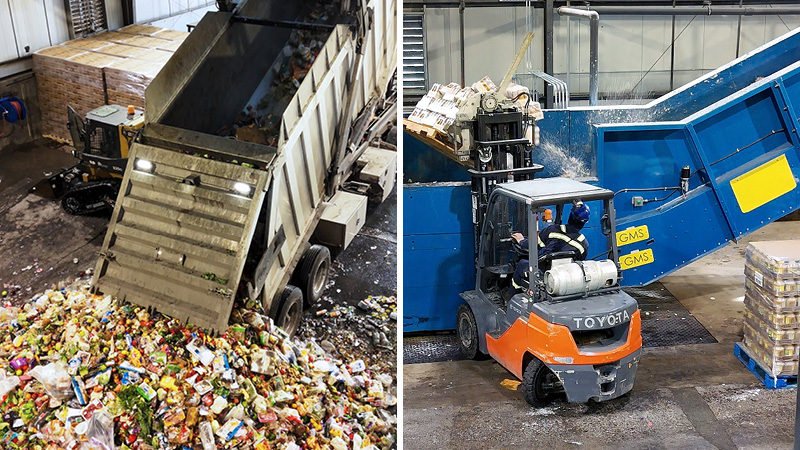
Source separated food waste streams are unloaded on the tip floor (left). Skid steer loading pallet of packaged food waste into the hopper that feeds the processing line (right).
The diagrams in Figures 1 and 2 show the configuration of the depackaging and MRF equipment (the latter was installed by Green Machine). The building has four loading docks and a tip floor to accommodate roll-off dumpsters, dump trucks and live-floor trailer deliveries. There is a storage area on the tip floor for feedstocks. On the day of the BioCycle tour, pallets with cases of beverages were stacked along one side, awaiting depackaging.
 Generate Upcycle uses a Tiger depackager with capacity to process 40 tons/hour. The entire process can depackage food and beverage waste from any stage of the supply chain, with few limitations based on types of packaging. A skid steer loader is used to fill the hopper at the base of the conveyor that feeds the processing line. A disc screener at the top of the conveyor rips open cardboard cases; the contents drop into the depackager. “The screener also separates out larger plastic containers — with its contents dropping into the depackager,” explains Augarten. “But the primary purpose is to separate out the cardboard and keep it clean to optimize its value as a commodity.”

Depackager placement at the MRF.
A Scott Equipment CleanSweep — with 5/32nd-inch screen holes — was installed to remove contaminants remaining in the depackaged food waste stream, prior to that stream being pumped out of the building and into holding tanks. (The CleanSweep unit was not operational during BioCycle’s tour.) There is also a rotary screen with one-quarter-inch mesh installed at the lagoon, to remove particles in the liquid digestate as it is pumped into tanker trucks to go to area farms.
 Packaging coming out of the depackager falls onto a conveyor that has a cross belt magnet at the top to recover ferrous metals. That stream falls onto its own conveyor that drops into a bunker. The remaining packaging passes under an eddy current separator to remove non-ferrous items (primarily aluminum). From there, material is conveyed to a hand-sorting line. “What we recover at that point is typically dependent on the quantity of a specific type of plastic we receive and the commodity market,” says Augarten. “The more of one specific grade of plastic we receive, the more worthwhile it is.” The different packaging commodities are dropped into bunkers to await being baled and sent to recyclers.
The amount of packaging that ends up as residuals needing disposal (the target is 0-<5%) is highly dependent on the inbound material and varies from product to product, depending on the demand for a specific type of packaging in the recycling market, according to Generate Upcycle. In general, “we get very good autonomous separation on the metals,” notes Augarten. “With plastics, some containers are easier to remove on the pick line than others.”

Sorters inspect cardboard separated by the disc screen for its recyclability (left). A cross belt magnet installed after the depackager captures ferrous metals (right).
Not long after the MRF equipment was installed in late 2023, the facility experienced a fire. As part of the reconstruction, Generate Upcycle took the opportunity to spend the next two years rebuilding and upgrading the plant. Among these improvements, changes were made to the processing line, decreasing the incline of the feed conveyor to prevent items from rolling back into the hopper, and increasing the size of the depackager (from 20 to 40 tons/hour). The upgrades also included converting the facility from producing electricity to RNG.
Digester Operations
A separate building is equipped to service tanker truckloads of food waste. The liquids, along with the slurried food waste, are pumped into one of two 180,000-gallon tanks that serve as holding tanks to create a blend that gets fed into the digester. Retention time in the digester is 25 days; liquid digestate is stored in a lagoon. Generate Upcycle contracts with a company to haul and land apply the material on agricultural land. “There are a number of larger farms in the area that receive the digestate,” says Augarten.

Tanker truck in front of the liquid stream unloading building.
The biogas is conditioned to RNG, which is sold under voluntary agreements and end users looking for “green” gas to meet climate commitments, like utilities and other sectors such as steel manufacturers. The facility can produce 203,000 GJ/year of RNG.

Biogas upgrading system at Cayuga Digester cleans biogas for RNG injection into pipeline.
New York State has a commercial food waste disposal ban for generators producing 2 tons a week or more and who are within 25 miles of an organics recycling facility. To date, notes Augarten, the Generate Upcycle Cayuga Digester has not seen large quantities of food waste flowing in as a result of the ban. However, in January 2027, the ban will be expanded to cover businesses and institutions that generate an annual average of 1 ton or more per week of food waste, and are located within 50 miles of an organics recycler. The company anticipates this will increase the flow of food waste to the facility.
“Because of the 25-mile proximity clause and the fact that our facility is in a somewhat rural area, we are not seeing a lot of demand resulting from the current ban,” he says. “The vast majority of our customers seek us out for sustainability reasons, or landfilling constraints. We primarily receive material from food and beverage manufacturers, distribution centers and, increasingly, grocery stores.”