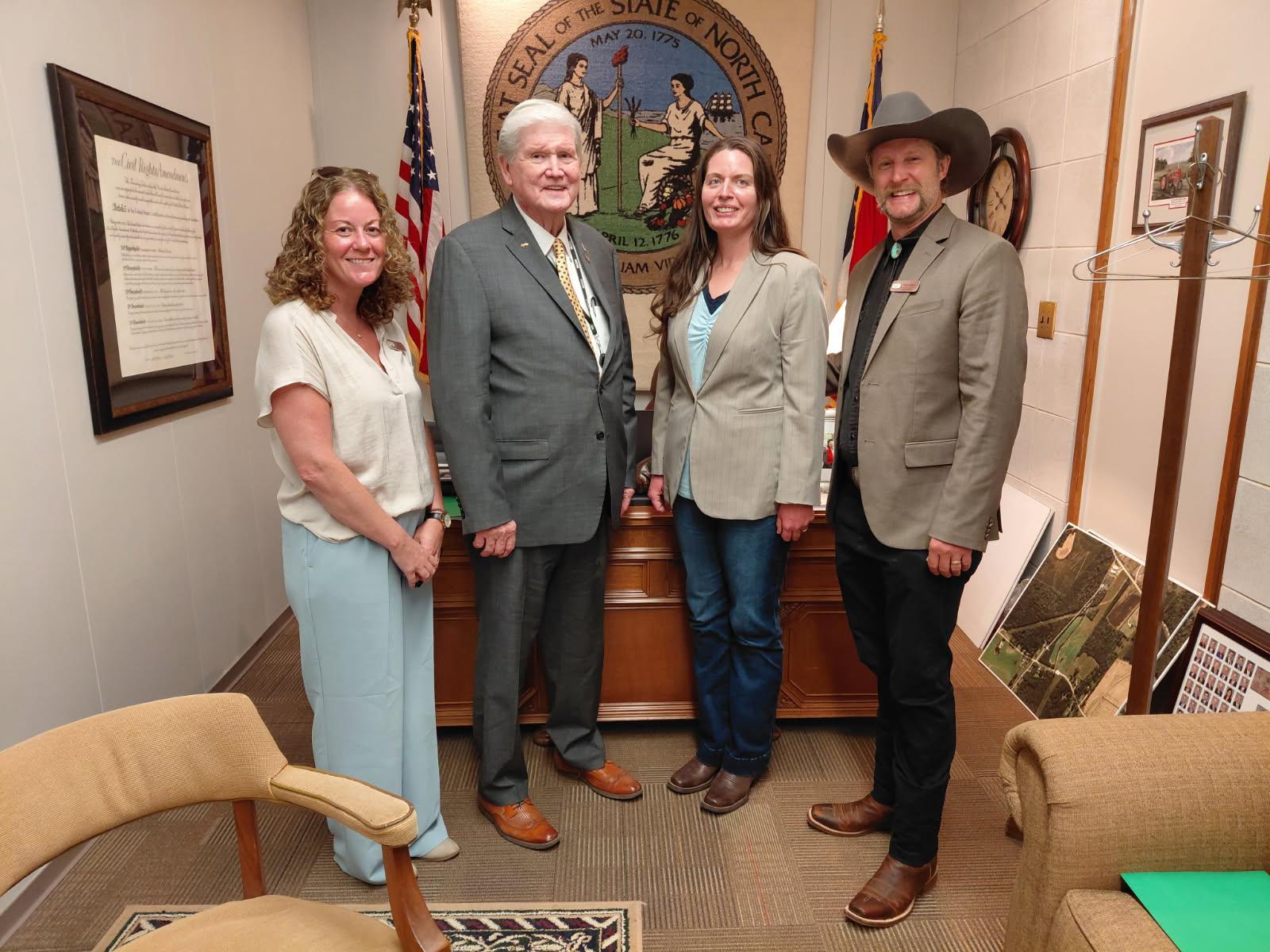
Top Photo: Representative Jimmy Dixon of Duplin County (second from left) invited the NCCC’s Advocacy and Access Committee to present directly to the North Carolina House Committee on Agriculture and Environment. Photo courtesy of North Carolina Composting Council (NCCC).
Paula Luu
Governor Josh Stein signed Senate Bill 401 into law on June 22, 2026, making North Carolina one of the few states to formally include composting within its statutory definition of agriculture. The change gives permitted composting facilities a stronger legal and economic footing while offering a policy model that advocates hope other states will follow.
The legislation, known as the NC Farm Act of 2025-2026, expands the state’s definition of agriculture to include the production, processing, storage, use, and sale of compost made from yard and food waste. It applies to permitted Small and Large Type 1, Type 2, and Type 3 composting facilities.
The law also creates a pathway for qualifying operations to pursue bona fide farm status under North Carolina General Statute 160D-903. That designation can provide protections historically reserved for conventional agricultural producers, including stronger standing in land use disputes, potential property tax benefits, and protections from certain nuisance lawsuits.
For the North Carolina Composting Council, the law is both a hard-won policy victory and a springboard for future industry growth.
“Now that permitted Type 1, 2, and 3 composting facilities are recognized as agriculture under North Carolina law, the industry is better positioned to grow,” said Kat Polk, Executive Director of the North Carolina Composting Council (NCCC). “This designation can help reduce some of the financial and regulatory barriers to starting or expanding a composting operation while also strengthening confidence in compost use as an agricultural product.”
From Waste Diversion Goal to Infrastructure Need

The North Carolina Composting Council’s Advocacy and Access Committee spent four years championing composting provisions through three consecutive Farm Acts. Photo credit: NCCC
The policy arrives as North Carolina faces increasing pressure on its remaining landfill capacity. The North Carolina Department of Environmental Quality’s (NCDEQ) 2025 Waste Characterization Study found that 30% of material being sent to landfills could have been composted instead.
That finding helped advocates frame composting as both a waste management solution and an agricultural opportunity. In June 2026, at the invitation of Representative Jimmy Dixon of Duplin County, the NCCC’s Advocacy and Access Committee presented directly to the North Carolina House Committee on Agriculture and Environment. However, legal recognition alone will not create the processing capacity needed to divert that material.
“To scale fast enough to make a meaningful dent in the organic waste gap, the industry needs access to start-up and expansion capital, as well as continued development of end markets to ensure sustained demand for the finished product,” Polk said.
NCDEQ offers annual grants that can help private companies and municipalities offset the cost of composting infrastructure. Polk said those programs are valuable, but public grants will not be enough to build the industry at the scale the state needs.
“Local banks and investors also need to recognize the value of composting in order to provide the low-interest loans needed to help companies get started and scale up,” she said.
Just as important is demand for the finished compost. Polk pointed to significant untapped opportunities in agriculture, transportation projects, green infrastructure, landscaping, and new development. State and local policies could help expand those markets through procurement requirements or specifications that encourage compost use.
“There need to be strong end-markets to close the economic loop and seal the deal for composters and investors to come into the business,” Polk said. “Either way, compost quality must remain consistently high in order for demand to grow.”
She added that trained operators will remain central to the industry’s success. “Skilled and dedicated composters who learn the trade and mentor others are at the heart of bridging the gap,” she said.
A Four-Year Legislative Strategy
The Farm Act provision did not emerge from a single legislative session. The NCCC’s Advocacy and Access Committee spent four years building relationships and advancing compost provisions through three consecutive Farm Acts.
In 2023, the Council helped secure a sales tax exemption on compost purchased by farmers. In 2024, Type 1 composting facilities were included under the state’s Right to Farm Act. The 2026 legislation went further by placing composting within the core statutory definition of agriculture.
“These relationships proved to be the foundation of our success,” Polk said. “We learned early on that identifying and cultivating legislative champions, particularly committee chairs and other key decision-makers who shape policy behind the scenes, was just as important as building broad support.”
She added that one lesson was that advocates should engage agricultural institutions early on, not only lawmakers.
“If we could do anything differently, we would have engaged other key stakeholders earlier in the process, including the Department of Agriculture, the Farm Bureau, and other agricultural partners,” she said.
Showing how composting supports agriculture, waste reduction, and economic development helped broaden the coalition and create a stronger foundation for lasting policy change. The Council also had to accept that progress would come incrementally. “There were times when we didn’t achieve everything we hoped for in a single legislative session, and we had to be willing to accept incremental progress rather than a perfect outcome,” Polk said. “Each Farm Act built on the last, and every step forward created new opportunities for the next.”
An Industry-Driven Effort
The legislative agenda was shaped by composting businesses, start-ups, experienced operators, and other industry leaders who were willing to explain their barriers directly to policymakers.
“These leaders are the same experts who have been willing and able to go to the North Carolina General Assembly to share their authentic experience in person,” Polk said. “These genuine connections, from communities that are well known by state lawmakers, have made the difference.”
The Council credited the outcome to collaboration among state legislators, NCDEQ, the Farm Bureau, industry partners, and composting advocates.
The strategy was deliberate, incremental, and built around relationships. North Carolina’s approach offers a replicable model for other states. By positioning composting within agricultural law rather than treating it solely as waste management, the state has created new pathways for legal protection, financing, infrastructure development, and market growth.